The shape of the truth
Salvatore Giuliano is a docudrama that reconstructs the life, death and political afterlife of the Sicilian bandit not as myth or biography but as a forensic inquiry. Francesco Rosi does not seek to explain Giuliano’s psychology or dramatise his charisma; instead, he treats the man as an aperture — a point where state power, separatist ambition, Mafia collusion, peasant loyalty and Cold War realpolitik converge and fracture. The film avoids linear chronology, voice-of-God narration, or dramatic reenactment in the conventional sense. It deploys archival footage, courtroom transcripts, on-location shooting in actual villages and towns, non-professional actors drawn from Sicilian communities, and a fragmented structure built around contradictory testimonies. Its method is procedural: each scene functions like evidence presented at a hearing, with emphasis on who speaks, how they speak, and what remains unsaid. Rosi’s aim is not to settle the truth of Giuliano’s death but to expose how official versions are manufactured — and why certain truths are buried, then exhumed, then buried again. The film’s form is its argument: history as contested terrain, not settled record. (158 words)
The look of it
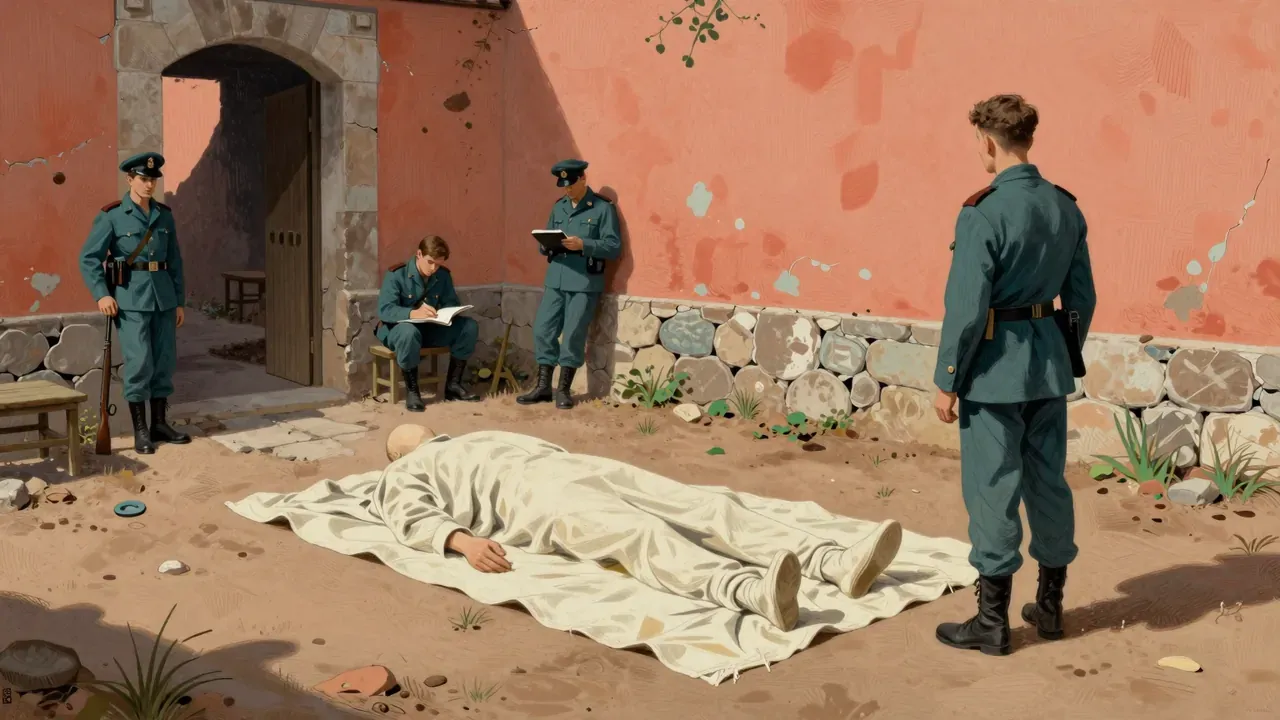
The story unfolds through juxtaposition rather than causation: a dead body in a courtyard, then a flashback to a policeman’s killing in 1943; a courtroom verdict, then a silent shot of shepherds riding down a hillside toward Portella della Ginestra. Gianni Di Venanzo’s black-and-white cinematography uses available light and shallow focus to flatten hierarchy — no hero lighting for Giuliano, no villainous shadows for officials. Salvo Randone delivers judicial pronouncements with dry, uninflected gravity; Frank Wolff’s Pisciotta is coiled, watchful, never sentimentalised. There are no close-ups of Giuliano’s face until he is already dead — a decision that denies identification and underlines his functional role in larger systems. Piero Piccioni’s score is sparse, often absent, letting diegetic sound — cicadas, distant bells, typewriter keys — carry weight. Mario Serandrei’s editing refuses continuity logic: cuts land on pauses, silences, bureaucratic documents. The film’s craft is anti-spectacular by design — every technical choice serves the principle that clarity emerges not from emotional immersion but from structural rigour and persistent questioning. (159 words)
What sticks
What lands is the cumulative pressure of contradiction. When three gunshots are recalled by villagers but omitted from the carabinieri report, the discrepancy is not dramatised — it is stated, repeated, left hanging. The Portella della Ginestra sequence lands not through violence but through duration: riders descending slowly, then silence before gunfire, then the abrupt cut to a newspaper headline. The trial scenes land because they refuse catharsis — convictions are handed down, but the questions behind them remain unanswered. The film’s restraint makes its political force undeniable: it does not accuse, but arranges facts so that accusation becomes inevitable. The final assassination of the pentito in 1960 lands as a quiet coda, not a climax — proof that the mechanisms exposed in 1950 are still operating, unchanged. Even viewers unfamiliar with Sicilian history grasp the pattern: authority fabricates narrative, dissent is absorbed or erased, and justice is procedural theatre. The film’s moral weight comes not from outrage but from its refusal to look away from how power consolidates itself through erasure — a process rendered visible, step by step, without embellishment. (157 words)
What slips away
What does not land is any sustained engagement with Giuliano as a person. His motivations, relationships, inner life — all are withheld, not as mystery but as deliberate omission. This is a structural choice, not a failure, but it leaves some viewers stranded: those expecting psychological depth or tragic arc will find only function. The non-professional cast, while authentic in texture, sometimes lacks the tonal precision needed for complex legal or political dialogue; a few courtroom exchanges blur into indistinction. The film’s resistance to exposition means that historical context — the role of the Allies in Sicilian separatism, the precise status of MIS post-1946, the mechanics of Mafia–carabinieri coordination — must be inferred or supplied externally. Some sequences, particularly the early flashbacks, feel elliptical to the point of opacity. A viewer without baseline knowledge of postwar Italian politics may mistake austerity for obscurity. That is not a flaw in the film’s design — Rosi assumes an informed, attentive spectator — but it is a limit: this is not a primer, and it does not accommodate casual viewing. Those who expect narrative propulsion or character-driven momentum will find its pace withholding, even alienating. (156 words)
What it’s really about
The themes that matter are institutional complicity, the weaponisation of narrative, and the elusiveness of accountability in systems where law, crime and state power share infrastructure. The film treats the Mafia not as a criminal aberration but as a parallel administration — one that negotiates with carabinieri, funds separatist parties and supplies informants to courts. It shows how populism is first courted, then betrayed, then violently suppressed: the May Day marchers are not abstract victims but named participants in a democratic tradition that the state chooses to eliminate. Class is rendered materially — in the difference between the judge’s wood-panelled chamber and the bare stone floor where Pisciotta is interrogated — but never named as ideology. Justice appears not as principle but as performance: verdicts are delivered, sentences pronounced, appeals ignored. The film’s central theme is not Sicily’s uniqueness but its exemplarity — how local violence becomes national policy when inconvenient truths are buried beneath layers of official version, media repetition and judicial silence. It asks not why Giuliano died, but why his death required staging — and whose interests that staging served. (154 words)
Who it’s for
This film is for viewers who treat cinema as inquiry rather than entertainment: those comfortable with ellipsis, committed to historical literacy, and willing to hold multiple, irreconcilable accounts in mind at once. It rewards patience, attention to framing and sound, and familiarity with mid-century Italian politics. It is not for those who require clear protagonists, emotional resolution or narrative momentum — nor for viewers who expect documentary to mean ‘objective’ or drama to mean ‘psychological’. A student of political science or journalism may find it indispensable; someone seeking immersion in a period or character may leave frustrated. Its demands are formal and intellectual, not affective. Those who disagree — critics like Howard Thompson in 1964 — found it disjointed because it refuses the grammar of conventional storytelling. That verdict would change only if the film abandoned its method: to make it more accessible would be to dilute its central claim — that truth is not revealed through coherence, but exposed through fracture. (152 words)
Is it worth your time?
Yes, it is worth your evening — provided you give it your full attention and do not expect ease. Its 123 minutes unfold with the weight of a judicial dossier: dense, deliberate, unremitting. It does not yield pleasure in the usual sense, but it offers something rarer: the sensation of thinking alongside a filmmaker who treats every frame as evidence. You will not forget the image of Pisciotta’s hands, idle in his lap during testimony, or the way Di Venanzo holds on an empty doorway long after a character has left — spaces where power operates unseen. Its value lies in its rigour, not its warmth. Those who find it difficult are not wrong; they are encountering a work that refuses accommodation. Its endurance — inclusion in Italy’s ‘100 films to be saved’, Scorsese’s personal canon — rests on that refusal. To watch it is to accept that some histories cannot be told straight, and that the most truthful films are often the least comforting. (151 words)