The title
Victim is a British drama film made in 1961 by Allied Film Makers, directed by Basil Dearden and written by Janet Green. It sets out to confront the criminalisation of homosexuality in England and Wales, where consensual acts between men remained illegal until 1967. The film does not dramatise gay life as such, but focuses on the legal and social consequences of that law — specifically, how it enables blackmail. Its central figure is Melville Farr, a married barrister whose past relationship with a younger man becomes leverage for extortion. The film’s purpose is explicit: Michael Relph and Basil Dearden stated it was designed as ‘an open protest’ against the law. It names homosexuality directly, uses contemporary slang like ‘queer’, and shows its effects across class lines — from a working-class garage mechanic to a West End lawyer. It avoids sensationalism not through omission, but through restraint: no sex scenes, no coded subtext, no moralising voiceover. Its argument is structural, not psychological — the harm lies in the law, not the desire.
The look of it
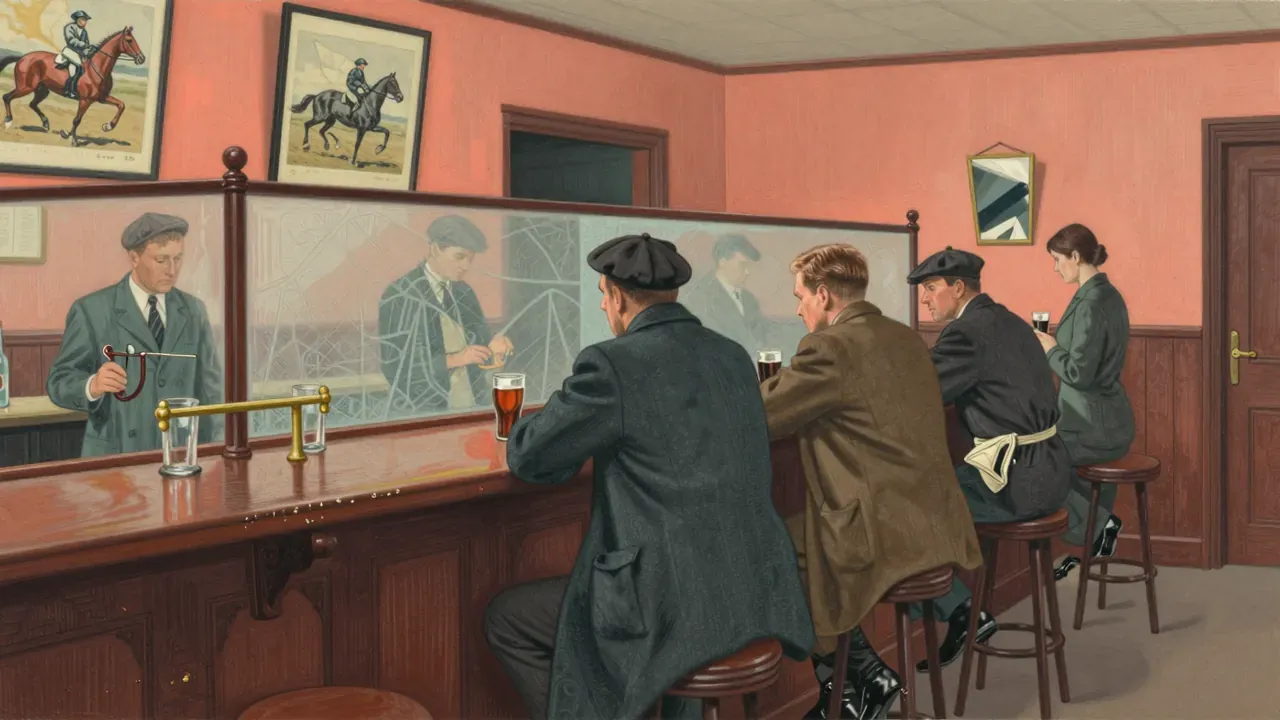
The story follows Farr’s slow, reluctant decision to expose himself publicly in order to stop a blackmail ring preying on gay men. Dirk Bogarde plays him with tightly controlled physicality: shoulders hunched, jaw clenched, eyes rarely meeting others for long. Sylvia Syms gives Laura, his wife, quiet resolve without melodrama; her performance rests on stillness and withheld reaction. Otto Heller’s cinematography uses deep shadows and narrow framing — doorways, stairwells, rain-streaked windows — to convey enclosure without resorting to noir cliché. Philip Green’s score is subdued, mostly piano-led, never underlining emotion. John D. Guthridge’s editing moves deliberately, holding shots longer than necessary to let discomfort settle. Janet Green’s script avoids exposition by embedding legal context in dialogue — police procedure, courtroom references, newspaper headlines — rather than explanation. The film’s craft choices are unified in their refusal to aestheticise suffering or eroticise difference. Every technical decision serves the film’s ethical stance: this is not about deviance, but about vulnerability created by statute.
The light and the pace
What lands most firmly is the film’s moral clarity and its cumulative sense of institutional pressure. The repeated image of men being watched — in parks, in bars, in cars — gains weight with each recurrence, not because of shock value, but because the camera treats surveillance as routine. The scene where Farr reads a tabloid report on a gay arrest, then looks up to see his own reflection in the glass, works precisely because it is understated. Bogarde’s performance lands not in grand declarations but in micro-tremors: a pause before answering a question, a hand gripping a chair back too tightly, a glance at his wedding ring when asked about loyalty. The film’s restraint makes its political point more forceful — it does not ask for sympathy, only for recognition of injustice. Even minor characters register: Nigel Stock’s nervous clerk, Norman Bird’s wary garage owner, Peter McEnery’s vulnerable Boy Barrett — all occupy space without needing backstory. The film trusts the audience to infer consequence from silence, hesitation, and the spaces between lines.
The silences
What does not land is the film’s attempt to reconcile Farr’s personal conflict with its broader social argument. The script insists he has ‘never given way’ to homosexual impulses, framing repression as heroic — a choice that now feels dated and psychologically thin. This undermines the film’s otherwise progressive stance, reducing same-sex desire to something to be resisted rather than understood. The marriage subplot, while intended to show fidelity and stability, ends up reinforcing heteronormative ideals instead of questioning them. Laura’s character, though sympathetically drawn, exists largely to affirm Farr’s respectability. The film also struggles with class: it shows working-class gay men as victims but rarely grants them interiority beyond fear or shame. There is no equivalent to Farr’s moral arc for them — they appear, suffer, and vanish. The structure leans heavily on procedural logic — following leads, gathering evidence — which suits its legal focus but flattens emotional texture. Some scenes feel dutiful rather than dramatic, as if the script prioritises argument over character.
The law as character
The themes that matter are not homosexuality per se, but the weaponisation of secrecy by law; the distinction between private conduct and public harm; and the social cost of codifying shame. The film treats blackmail not as an aberration, but as a predictable outcome of criminalisation — what contemporaries called the ‘blackmailer’s charter’. It shows how the law distorts relationships: between husband and wife, employer and employee, friend and friend. Class recurs not as backdrop but as mechanism — the law hits harder where there is less money, less influence, less access to legal defence. The film also explores visibility as both danger and necessity: Farr’s decision to speak out is framed not as confession but as civic duty. Yet it stops short of imagining solidarity — there are no meetings, no networks, no shared language beyond victimhood. Its vision of justice is individual and legal, not collective or cultural. That limitation reflects its time: it argues for reform, not revolution; for tolerance, not liberation.
Who it is for
This film is for viewers interested in British social history, mid-century legal reform, or the evolution of screen representation of sexuality. It rewards attention to craft — particularly Bogarde’s performance and Heller’s lighting — and benefits from knowledge of the Wolfenden Report and the 1967 Sexual Offences Act. It is not for those seeking psychological depth in queer characters, narrative complexity, or stylistic innovation; its form is deliberately conventional, even cautious. Some modern viewers may find its moral framing alienating — especially the insistence on Farr’s chastity as proof of his worthiness. Those who expect historical films to offer contemporary frameworks for identity may feel frustrated by its silence on community, joy, or desire outside coercion. A viewer who values thematic precision over emotional range will find it compelling; one who prioritises character-driven storytelling may leave unmoved. Its value lies in what it dared to name, not in how fully it imagined what came after.
Why it lasts
Yes, it is worth your evening — not as entertainment, but as a calibrated act of historical witness. At ninety-six minutes, it moves with unhurried gravity, refusing to rush its argument or soften its implications. Its power resides in its specificity: the rain-slicked pavements of Covent Garden, the typewriter clatter of a law office, the muffled tones of a 1961 BBC radio bulletin. It asks for patience, not empathy — and repays it with clarity. Those who dismiss it as dated miss how precisely it diagnoses a mechanism still operative today: laws that create vulnerability, then punish those they endanger. It is not a film about gay life, but about the architecture of stigma — and that architecture remains legible. Anyone who believes cinema cannot shape conscience should watch it. Those who expect catharsis or resolution will be disappointed; Victim offers no healing, only testimony. Its endurance lies not in beauty, but in its unblinking alignment of form, fact, and moral purpose.