What it is trying to do
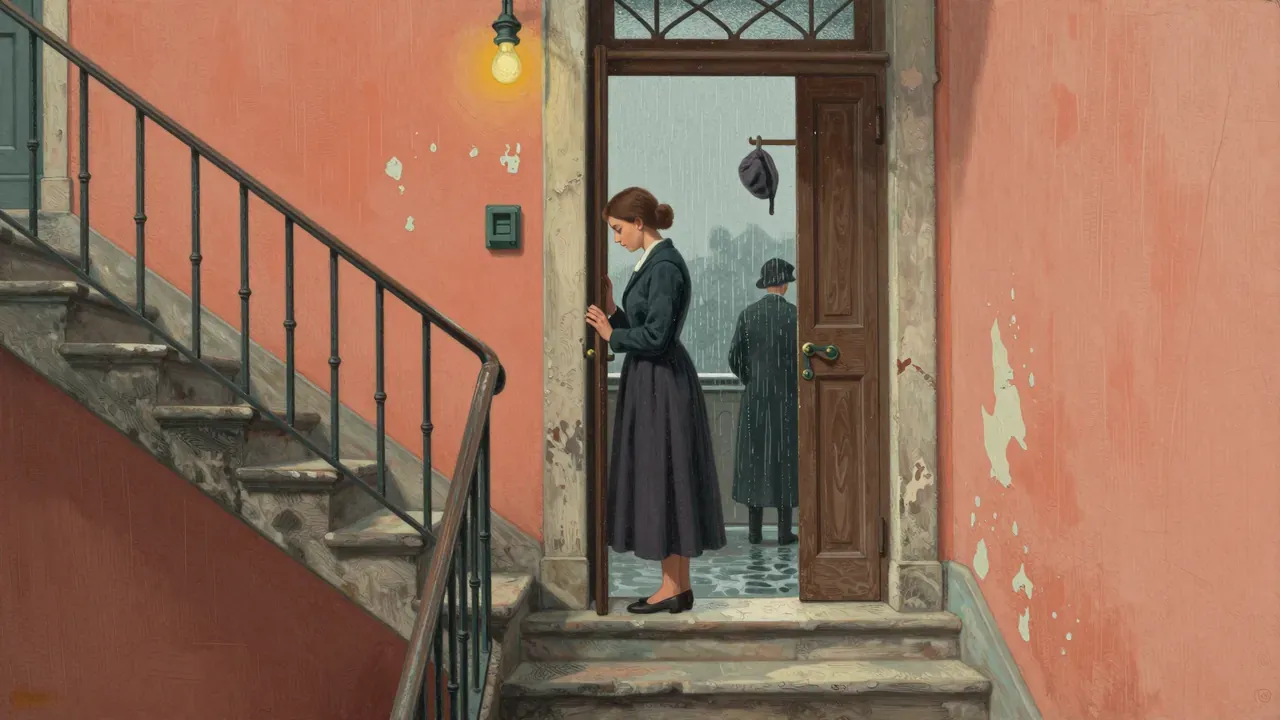
Chains is a 1950 Italian melodrama directed by Raffaello Matarazzo, built to test the durability of moral tension within domestic space. It does not seek realism or social diagnosis but operates as a pressure chamber for fidelity, shame, and paternal duty — tightening its coils around a married woman torn between past love and present obligation. The film’s structure follows classical melodramatic logic: a return, a confrontation, a threat, a crisis, a trial, and a reconciliation that restores order without erasing consequence. Its ambition is formal and emotional rather than ideological: to make guilt visible in posture, silence, and withheld glances; to let a blackmail letter function as both plot device and moral fulcrum; to treat Naples not as location but as emotional weather system — humid, watchful, unforgiving. It assumes an audience familiar with Catholic-inflected notions of sin and redemption, and it trusts music, editing, and performance to carry weight where dialogue remains restrained. At eighty-six minutes, it moves with the pace of a held breath — deliberate, unblinking, calibrated to land each beat like a door closing behind the viewer. (158 words)
How it works
The story unfolds through tightly controlled cause-and-effect: Emilio’s theft triggers Guglielmo’s suspicion, which triggers Rosa’s panic, which triggers the blackmail, which triggers the violence. Carlo Montuori’s cinematography keeps interiors dim and shallow, favouring medium shots that trap characters in doorways or behind window frames. Mario Serandrei’s editing avoids cross-cutting suspense; instead, it holds on reactions — Rosa’s face after Tonino shoves her, Guglielmo’s pause before reading the letter — letting duration do the work of implication. Amedeo Nazzari plays Guglielmo with physical restraint: his anger is in clenched shoulders, not shouting; his grief in how he folds his hands when told Rosa may be lost. Yvonne Sanson’s Rosa carries contradiction without explanation — devotion and despair coexist in the same glance. Gino Campese’s score underlines but never overstates: strings swell only when Rosa lifts the gun, then cut abruptly at the gunshot. There are no flourishes, no digressions. Every prop has purpose: the ignition coil, the birthday trip to Naples, the Christmas setting — all serve the central question of whether love can survive being weaponised. (159 words)
What lands
What lands is the cumulative weight of small betrayals — not just Emilio’s coercion or Rosa’s near-surrender, but Tonino’s instinctive rejection of his mother, Angela’s quiet alert to her father, Anna’s silent assumption of childcare. These moments register because they are played without rhetorical emphasis: Gianfranco Magalotti’s Tonino does not cry or plead; he simply blocks the doorway, then stands still after being shoved. Rosalia Randazzo’s Angela speaks few lines, yet her delivery of ‘Mamma ha scritto una lettera’ lands with forensic clarity. The courtroom sequence works not through legal intricacy but through Rosa’s physical collapse when handed the blackmail letter — a collapse that reads as both confession and indictment. The film’s moral resolution avoids piety: Guglielmo’s acquittal rests on self-defence, not virtue; Rosa’s restoration is conditional on endurance, not absolution. Even the final reunion is muted — children re-enter frame one by one, not in embrace but in shared silence at a table. This restraint gives the ending gravity rather than relief. The film earns its emotional payoffs by refusing to oversell them. (157 words)
What does not
What does not land is the character of Emilio Marchi. Aldo Nicodemi plays him with theatrical intensity, but the script gives him no interiority beyond obsession — no motive rooted in class, trauma, or even memory, just repetition of desire. His presence feels less like a force of nature and more like a narrative convenience, especially in scenes where he appears unbidden at festivals or hotel lobbies without plausible cover. The pyrotechnics festival, though visually distinct, serves no structural purpose beyond reuniting Rosa and Emilio; its spectacle sits uneasily beside the film’s otherwise grounded texture. Likewise, the prosecutor (Aldo Silvani) delivers exposition with stilted formality, breaking the film’s otherwise consistent register of hushed urgency. The flashback framing — Emilio’s account of leaving for America — arrives too late and too briefly to anchor his psychology. These elements do not derail the film, but they create pockets of friction where the tone slips from lived tension into schematic plotting. A tighter focus on Guglielmo’s quiet unraveling, or Rosa’s internal calculus, would have sharpened what is already potent. As it stands, Emilio remains a cipher draped in menace, not a man. (156 words)
The themes that matter
The themes that matter are fidelity as labour, not feeling; parenthood as witness rather than authority; and justice as procedural accident rather than moral verdict. Chains treats marriage not as romance but as covenant — tested not by passion but by silence, by who answers the door, by who holds the child’s hand when strangers look. Rosa’s adultery is never consummated, yet the threat of it reshapes every relationship: Tonino’s behaviour shifts before she acts; Guglielmo’s trust fractures before evidence arrives; Angela’s loyalty becomes a kind of testimony. The film locates morality not in grand declarations but in thresholds — the doorway Rosa crosses to leave her children, the hotel room door Emilio locks, the courtroom door through which Guglielmo walks a free man. Even the title refers less to chains of fate than to chains of consequence: each choice links to the next, unbreakable until broken by law or love. The Christmas framing underscores this — not as redemption but as cyclical return, where time measures endurance, not change. (154 words)
Who should watch it, and who should not
This film is for viewers who value precision of gesture over exposition, who find tension in stillness, and who accept that moral clarity may arrive only after thirty years in prison is avoided by technicality. It rewards attention to costume detail — Rosa’s modest coats, Guglielmo’s mechanic’s smock worn under a jacket — and to spatial relationships — how characters occupy doorways, stairwells, and kitchen tables. It is not for those who require psychological backstory, narrative symmetry, or catharsis delivered with volume. Viewers expecting neorealist grit or post-war political critique will find Chains insufficiently engaged with history beyond its domestic sphere. Those who dislike unresolved ambiguity — such as why Emilio returns, or how Rosa reconciles faith with deception — may feel short-changed. The film assumes familiarity with mid-century Italian social codes: the weight of maternal reputation, the stigma of divorce, the authority of mothers-in-law. Without that context, some motivations read as arbitrary. But for those who meet it on its terms, Chains offers a masterclass in emotional economy. (158 words)
Is it worth your evening
Yes, it is worth your evening — provided you watch it as a study in restraint, not as escapism. Its eighty-six minutes pass without haste, anchored by performances that deepen with stillness, and a structure that tightens like a noose without ever slipping into sensationalism. It repays slow viewing: Montuori’s lighting choices become legible on second glance; Serandrei’s cuts gain meaning when timed against Campese’s score. Those who dismiss it as ‘dated melodrama’ mistake its discipline for cliché — it avoids the very excesses it is often accused of. Critics at the time maligned it for lacking neorealist austerity, but that was its point: to assert that inner life persists even amid poverty, that dignity resides in how one folds a letter, not in whether one owns a coat. To call it ‘old-fashioned’ is to miss how rigorously modern its compression feels. Anyone willing to sit with quiet moral weight will find it resonant. Those needing action, irony, or narrative velocity will not. (159 words)