The shape of it
Young Mr. Lincoln is a biographical drama that narrows Abraham Lincoln’s early life to a single, myth-making arc: from bookish store clerk in New Salem to courtroom advocate in Springfield, culminating in a trial where logic and moral clarity override mob violence and forensic deception. It does not aim for comprehensive biography but for emblematic truth — selecting incidents that crystallise Lincoln’s temperament, intellect and ethical instinct. The film treats history as scaffold, not scripture: the Duff Armstrong almanac defence is moved decades earlier, Ann Rutledge appears before her historical death, and Mary Todd’s courtship is compressed into a few charged scenes. Its ambition is not accuracy but resonance — to locate the man inside the monument by showing how he earned his gravity, one awkward, principled choice at a time. It avoids psychological exposition, preferring gesture, silence and framing to suggest inner life. The film’s project is civic portraiture: less ‘what Lincoln was’ than ‘what America needed him to be, and why it believed he was’. Word count: 148.
The look of it
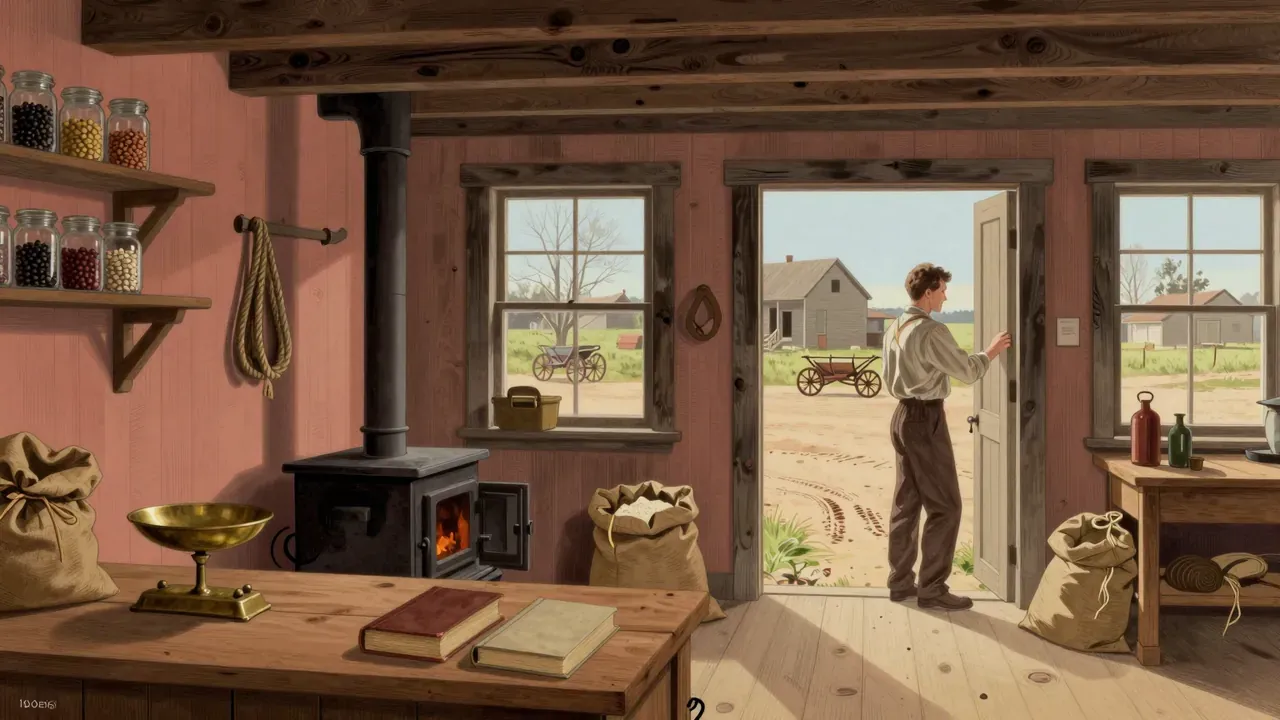
The story proceeds in measured, episodic tableaux: the exchange of books for groceries; the mule ride to Springfield; the Independence Day brawl; the jailhouse standoff; the courtroom cross-examination. Henry Fonda’s performance anchors this structure — his Lincoln moves with deliberate slowness, speaks in pauses and drawls, and listens more than he declares. Bert Glennon and Arthur Charles Miller photograph the interiors in deep, soft focus, keeping faces half in shadow and backgrounds indistinct, while Alfred Newman’s score uses brass fanfares sparingly, favouring quiet strings and hymn-like harmonies. Lamar Trotti’s script gives Lincoln sparse, unadorned dialogue, trusting Fonda’s physicality and the weight of silence. Walter A. Thompson’s editing avoids rapid cuts, holding on reactions — Abigail Clay’s clenched jaw, Mary Todd’s steady gaze — long enough for meaning to settle. The courtroom sequence is built on rhythm: slow build, precise questioning, then the almanac reveal delivered not as triumph but as quiet correction. Word count: 152.
The weight of it
What lands most firmly is the film’s moral architecture. Lincoln’s refusal to let the Clay brothers turn on each other feels ethically inevitable, not dramaturgically convenient — it emerges from his earlier rejection of mob justice and his quiet insistence on fairness even when no one is watching. Fonda’s stillness reads as thoughtfulness, not vacancy; his smile arrives late and lingers just long enough to disarm suspicion. The courtroom climax works because it rests on tangible evidence — the almanac page, the moon’s position — not rhetorical flourish. Ford frames Lincoln not as orator but as listener: he watches witnesses, studies jurors, absorbs the room before speaking. The film’s restraint makes its moments of warmth — Lincoln sharing a pipe with Stuart, Mary Todd slipping him a handkerchief — land with quiet force. Even the stylised lighting, which could feel artificial, serves character: shadows gather where doubt lives, and light falls cleanly only when Lincoln states fact. Word count: 150.
The gaps in it
What does not land is the romantic subplot. Mary Todd’s interest in Lincoln arrives without sufficient groundwork — her attraction seems prompted more by narrative necessity than emotional logic, and Marjorie Weaver’s performance, though capable, lacks the friction or volatility that might make the courtship feel lived-in. Stephen Douglas appears as polished foil rather than rival, his presence underserved by both script and screen time. The film’s compression also flattens Ann Rutledge’s role: Pauline Moore’s brief appearance registers as elegy, not relationship, leaving Lincoln’s grief underdeveloped as motivation. Some supporting characters — particularly the prosecutor, played by Donald Meek — verge on caricature, their mannerisms broadened beyond the film’s otherwise grounded tone. The film’s reverence occasionally tips into solemnity, and its avoidance of Lincoln’s political apprenticeship leaves his later career feeling unmoored from what we’ve seen. Word count: 151.
The idea in it
The themes that matter are law as moral practice, not procedure; the weight of witness and the danger of certainty; and the quiet labour of integrity in a world that rewards spectacle. Lincoln’s use of the almanac is not about winning but about correcting perception — a rebuke to testimony dressed as fact. The film treats justice as communal work: Abigail Clay’s anguish, Mary Todd’s silent attendance, the jury’s shifting expressions all form part of the verdict’s texture. It also examines how leadership begins in refusal — refusing the mob, refusing the easy compromise, refusing to let truth bend to convenience. There is no grand speech on democracy, only small acts that presume its possibility: Lincoln asking questions instead of declaring, listening before answering, trusting the jury to follow reason. The film’s Americana is not nostalgic but procedural — it shows democracy as fragile, iterative, and dependent on individuals who choose precision over passion. Word count: 149.
The audience for it
This film is for viewers who value deliberate pacing, understated performance, and moral clarity over plot velocity or psychological exposition. It suits those familiar with Ford’s compositional discipline or drawn to mid-century studio craftsmanship — the kind of viewer who notices how a doorframe isolates Fonda’s face during a pause, or how Newman’s strings swell only after the verdict is read. It is not for those who require narrative urgency, complex character arcs or historical granularity. Anyone expecting a forensic account of Lincoln’s legal career or a psychologically dense portrait of grief will find the film too selective, too symbolic. The film’s power depends on accepting its stylisation as sincerity — those who read its stillness as emptiness, or its omissions as evasion, will leave unmoved. A different verdict would follow if the film prioritised chronology over archetype, or gave its women interiority equal to its men. Word count: 150.
The time for it
Yes, it is worth your evening — provided you meet it on its terms. It is not a brisk watch, nor a demanding one, but it repays attention with cumulative weight: each scene adds a brick to Lincoln’s quiet authority, each silence deepens the sense of a mind assembling principle from observation. Its ninety minutes pass without hurry but also without slack — every shot serves the central question of how decency becomes durable. Those who dislike Ford’s formalism or find Fonda’s restraint impenetrable may feel distanced, but the film’s coherence and craft hold firm regardless. It is not diminished by age; its concerns — truth-telling in public life, the ethics of representation, the cost of standing aside from the crowd — have only sharpened. To call it ‘dated’ mistakes its style for obsolescence. It earns its place not as relic but as reference. Word count: 149.