What it is
The Ballad of Gregorio Cortez is a biographical Western crime film aiming to render the 1901 Texas manhunt for Mexican-American farmer Gregorio Cortez with documentary restraint and historical fidelity. It adapts Américo Paredes’s 1958 scholarly study With His Pistol in His Hand—not as myth-making spectacle, but as sober archival reenactment. Directed by Robert Milton Young, the film treats its subject as both legal case and cultural symptom: a collision of Anglo authority and Tejano landholding, miscommunication and jurisdictional overreach. Its method is procedural rather than psychological: it charts the sequence of events—the fatal misunderstanding, the twelve-day flight, the seven trials—without embellishing motive or interiority. The ambition is not dramatic amplification but structural clarity: to show how law, language, and local power conspired to turn a man into a symbol before he became a folk hero. It avoids stylisation in favour of location authenticity, shooting in the actual Gonzales courthouse where Cortez was tried. This is history as deposition, not legend as ballad.
How it works
The story unfolds in measured, cause-and-effect steps: a mistranslated question leads to gunfire; a pursuit becomes a manhunt; a trial becomes a series of trials. Edward James Olmos plays Cortez with minimal inflection—his silence is neither stoic nor inscrutable, but functional, a refusal to supply the narrative cues the Anglo legal system demands. Rosanna DeSoto, as his wife, anchors the domestic interludes with quiet precision. Reynaldo Villalobos’s cinematography keeps compositions uncluttered and light even-tempered, favouring medium shots and shallow depth of field that flatten hierarchy between characters and setting. There are no musical stings, no slow motion, no flashbacks. Dialogue is sparse and often untranslated, preserving linguistic asymmetry as a formal device. The editing, by Sidney Levin, maintains a steady, almost bureaucratic rhythm—cuts land on courtroom doors closing, on jury foremen rising, on prison gates clanging shut. Every craft choice serves the principle that the facts themselves carry weight; interpretation is deferred to the viewer, not embedded in the frame.
What lands
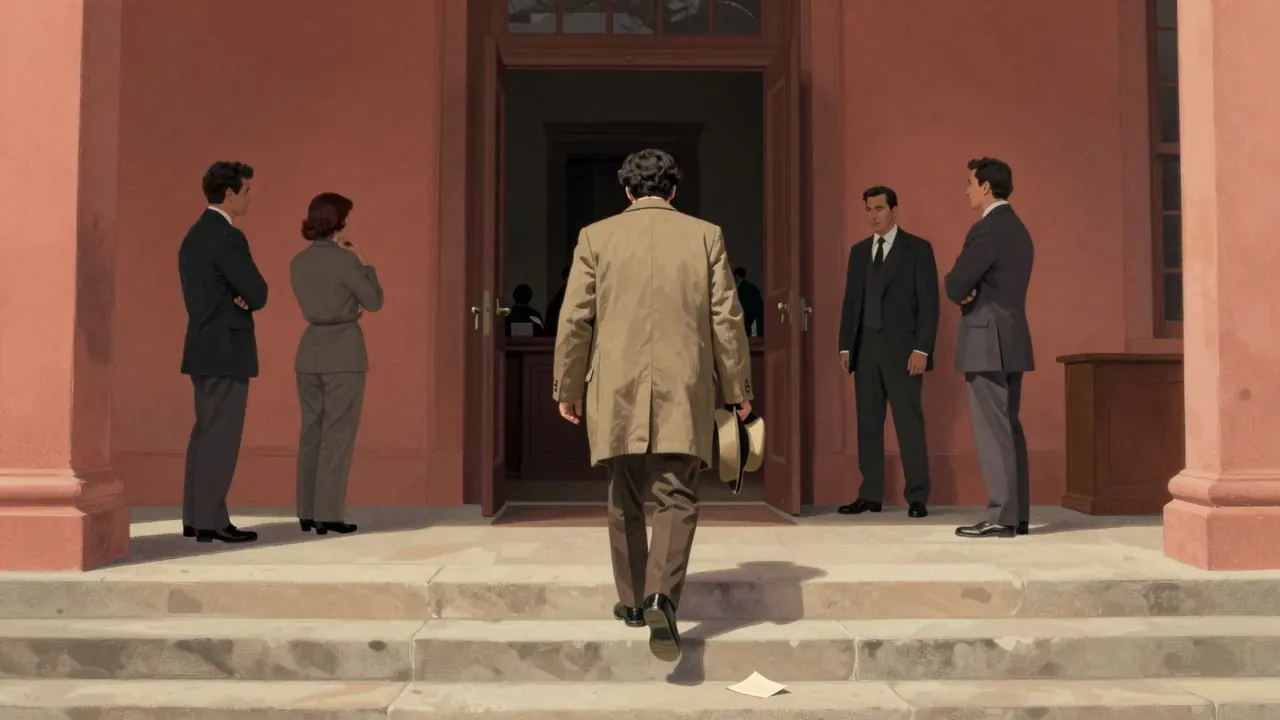
What lands is the cumulative force of repetition: the same courtroom, different juries, the same charges, shifting verdicts. The film’s rigour makes the injustice legible not through outrage but through accumulation—twelve years in prison for a killing born of translation failure, followed by release without apology. The authenticity of place—Gonzales, Belmont, the actual courthouse—grounds the narrative in geography rather than allegory. Olmos’s performance lands because it refuses to perform: he does not plead, explain, or emote beyond what the record implies. The film also lands as a corrective document: it insists on Cortez’s agency, his literacy, his legal awareness, countering decades of Anglo press that painted him as bandit or brute. When the final trial ends in acquittal, there is no triumphal music—only a cut to Cortez walking away, shoulders level, face unreadable. That restraint earns its gravity. The film succeeds where it stays within its own methodological bounds: as evidence, as chronicle, as counter-archive.
What does not
What does not land is emotional resonance beyond the schematic. The film’s commitment to plainness becomes a barrier: characters remain figures in a legal diagram rather than people with contradictory desires or private grief. Cortez’s wife, though well-acted, has no inner life beyond her role as witness and widow. The Anglo officials are functionaries, not individuals—neither villains nor fools, but instruments of a system whose logic remains opaque to the viewer. There is little sense of community texture: no songs, no gossip, no informal justice outside the court. The absence of folkloric framing—the very ‘ballad’ of the title—is felt as a structural omission, not a virtue. Janet Maslin’s observation holds: the film lacks spark, surprise, immediacy. It documents the making of a legend without showing how the legend took hold—no campfire retellings, no corrido verses, no children repeating fragments. Its austerity risks mistaking silence for depth, and procedural accuracy for psychological access.
The themes that matter
The themes that matter are jurisdictional erasure, linguistic dispossession, and the slow violence of due process when applied unequally. The film treats the border not as a line on a map but as a zone of unstable translation—where Spanish and English do not merely fail to meet, but actively produce lethal outcomes. It foregrounds how law operates as ritual rather than remedy: seven trials do not seek truth but reaffirm institutional control. Class and ethnicity are not subtext but infrastructure: land deeds, arrest warrants, jury selection all presume Anglo normativity. The film also engages with historiography itself—how stories become official, how archives exclude, how preservation (as later confirmed by the National Film Registry) is an act of restitution. Its quietest theme is endurance as resistance: Cortez survives not by fighting back, but by outlasting the system’s capacity to name, try, and contain him. That endurance is neither heroic nor passive—it is the only available grammar of survival under settler legality.
Who should watch it
This film is for viewers who value historical precision over emotional catharsis, and who approach cinema as a site of civic reckoning rather than personal identification. It suits students of border studies, legal history, or Chicano literature, and those attentive to how craft choices encode ideology—Villalobos’s flat lighting, Young’s refusal of close-ups, the untranslated dialogue as deliberate estrangement. It is not for viewers seeking narrative propulsion, character intimacy, or stylistic invention. Those who expect Westerns to deliver moral clarity, visual grandeur, or mythic scale will find it withholding. A viewer who values Janet Maslin’s critique—that the film lacks verisimilitude of feeling—would reasonably reject it as emotionally inert. What would change the verdict? A single scene of Cortez singing, writing, or teaching—a moment where folklore enters the frame—not as ornament, but as counter-evidence to the court’s monopoly on narrative.
Is it worth your evening
Yes, it is worth your evening—if you watch it as a primary source, not a story. Its ninety-minute duration feels neither rushed nor padded; it moves at the pace of a deposition, and rewards attention to procedural detail. You will not leave stirred, but you may leave recalibrated: aware of how much legal drama happens off-camera, how much injustice wears the mask of procedure, how much resistance looks like silence. It is not entertainment in the conventional sense, but it is ethically engaged, formally coherent, and historically anchored. Those who demand immediate affective returns will find it thin; those who accept that some truths arrive slowly, without fanfare, will find it substantial. Its value lies not in what it shows, but in what it refuses to show—and why. It asks you to sit with the weight of fact, not the relief of resolution. That is a rare and necessary discipline in film, and one that justifies the time.