filmbriefs
Topic

The United States

A country that argues with its own founding documents in public.

11
in film
13:00
average
143 min
in total
19
across the network
The United States across the network →
All briefs11
13:00

And the Pursuit of Happiness

Louis Malle · 1986

And the Pursuit of Happiness (1986) is a television documentary directed by Louis Malle for HBO’s America Undercover series. Shot in the mid-1980s, it profiles six immigrants — including General José R. Somoza, poet Derek Walcott, and physicist Franklin Chang-Díaz — as they navigate work, language, and belonging in the United States. Narrated by Malle, the film avoids commentary or advocacy, favouring sustained observation and unvarnished interview. Released on Independence Day 1986, it screened at Cannes in 1987 and won a Peabody Award in 1989.
13:00

Bowling for Columbine

Michael Moore · 2002

Michael Moore’s 2002 documentary uses the Columbine massacre as a lens to examine America’s relationship with guns, fear, and violence. Through staged interventions, selective interviews, and associative editing, it builds a case against cultural complacency — not by proving single causes, but by exposing patterns of denial, profit, and performance. It won the Academy Award for Best Documentary and remains a touchstone for debates about advocacy filmmaking.

13:00

12 Angry Men

Sidney Lumet · 1957

Sidney Lumet's first feature takes Reginald Rose's 1954 teleplay and confines it almost entirely to a jury room, where eleven men ready to convict a teenager of murder are worked, one by one, toward doubt. Shot in three weeks on a budget of $340,000, it turns a single set into an escalating study of temper, prejudice and procedure, carried by an ensemble led by Henry Fonda, who also produced.

13:00

All the President's Men

Alan J. Pakula · 1976

Robert Redford and Dustin Hoffman play Washington Post reporters Woodward and Bernstein chasing a break-in story that grows into the reporting that helped end a presidency, told almost entirely from inside the newsroom.

13:00

Jaws

Steven Spielberg · 1975

Steven Spielberg's 1975 thriller sends police chief Martin Brody, a marine biologist and a professional shark hunter after a great white attacking swimmers off a New England resort town. Adapted from Peter Benchley's novel and shot on location at Martha's Vineyard, it went over budget and schedule when its mechanical sharks repeatedly failed, forcing Spielberg toward a suggestive, Hitchcock-influenced style built around John Williams's two-note theme. It became the highest-grossing film in history at the time and established the modern summer blockbuster model.

13:00

North by Northwest

Alfred Hitchcock · 1959

An advertising executive mistaken for a nonexistent spy is chased across the United States toward a crop-duster in an empty field and a climax on the carved faces of Mount Rushmore. Built by Hitchcock and Ernest Lehman around set pieces conceived before the plot that justifies them, it is Cary Grant at his most physically tested and Hitchcock's biggest production to date.

13:00

One Flew Over the Cuckoo's Nest

Miloš Forman · 1975

Miloš Forman's adaptation of Ken Kesey's novel puts Jack Nicholson's disruptive new patient against Louise Fletcher's controlled head nurse inside the Oregon State Hospital, an operating psychiatric facility used as the actual set. Made for $3 million after a development history stretching back to 1962, it became one of only three films to sweep the top five Academy Awards, and it still plays as a study of institutional control rather than a simple underdog story.

13:00

The Adventures of Mark Twain

Will Vinton · 1985

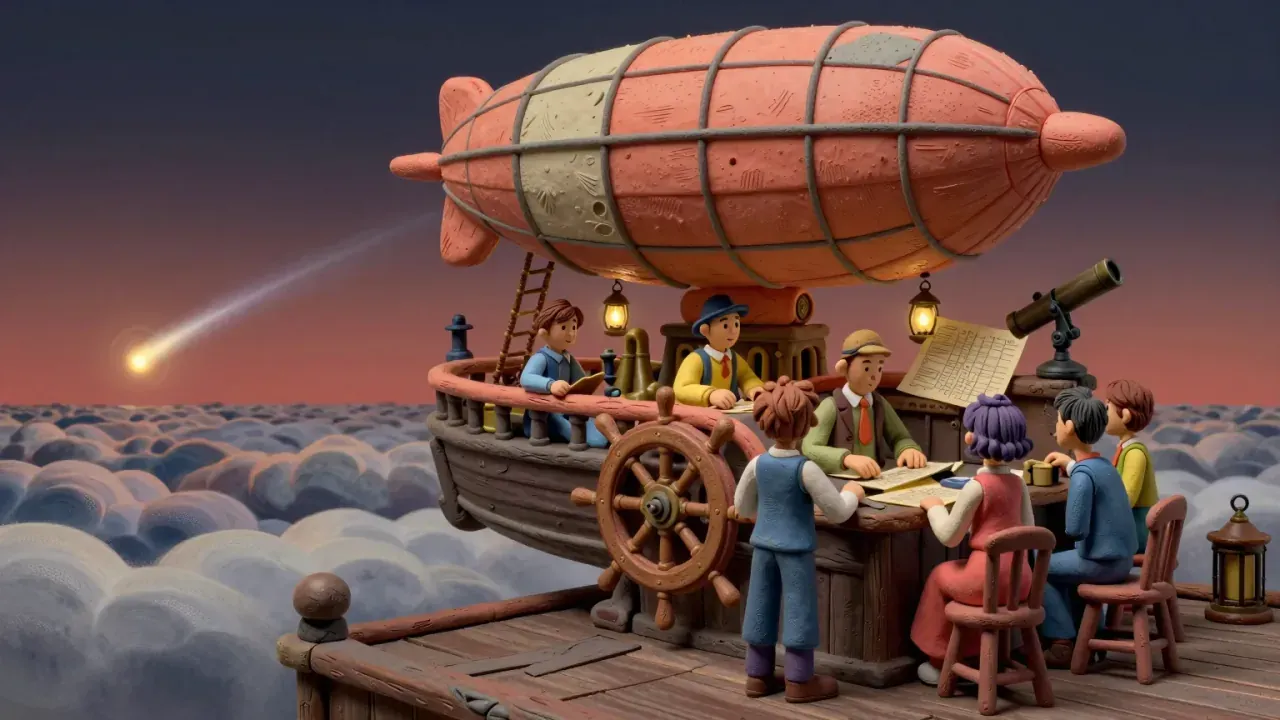
Tom Sawyer, Huckleberry Finn and Becky Thatcher stow away on an airship piloted by Mark Twain, who is travelling to keep what he believed was his destined appointment with the returning Halley's Comet, and along the way the children hear vignettes drawn from Twain's own stories, from a jumping frog to a vision of heaven. Vinton's stop-motion studio spent three and a half years and $1.5 million building the film in a converted Portland house, developing new computer-controlled camera and lighting systems along the way, only for a distributor to release the finished, distinctly adult-toned film as children's matinee programming.

13:00

The Deer Hunter

Michael Cimino · 1978

The Deer Hunter follows three steelworkers from a Russian-American mill town through a wedding, a hunting trip, the Vietnam War, and its long aftermath. Michael Cimino's film, shot partly in Thailand and built around Robert De Niro, Christopher Walken and John Savage, uses an unusually long, unhurried domestic opening to set up a war sequence built on captivity and Russian roulette, then spends its final third on men who came home changed in different, irreversible ways.

13:00

The Wolf of Wall Street

Martin Scorsese · 2013

The Wolf of Wall Street follows Jordan Belfort's rise from a junior broker to the head of Stratton Oakmont, a firm built on pump-and-dump stock schemes, told almost entirely through his own boastful narration. Martin Scorsese directs Leonardo DiCaprio, Jonah Hill and Margot Robbie in a three-hour account, adapted by Terence Winter from Belfort's memoir, that stages fraud as slapstick and addiction as spectacle without ever pulling back to show what any of it cost the people on the other end of the trades.

13:00

There Will Be Blood

Paul Thomas Anderson · 2007

There Will Be Blood follows Daniel Plainview, a silver miner turned oilman, across roughly three decades of the Californian oil boom, loosely adapting Upton Sinclair's novel Oil! Daniel Day-Lewis plays Plainview opposite Paul Dano's preacher Eli Sunday, with Jonny Greenwood's score and Robert Elswit's cinematography setting a tone closer to horror than period drama. Anderson's screenplay narrows Sinclair's sprawling novel to its first chapters and lets one man's ambition curdle into something closer to a diagnosis than a character study.