The shape of arrival
And the Pursuit of Happiness is a television documentary directed by Louis Malle for HBO’s America Undercover series, released on Independence Day 1986. It sets out to observe, without narration-driven argument or didactic framing, how immigrants from Latin America and Asia were settling into American life at a demographic turning point — when arrivals from those regions first exceeded those from Europe. The film does not seek to explain policy, trace legal histories, or survey economic data; instead it follows individuals across workplaces, homes, and civic spaces, using direct address and unobtrusive observation. Malle appears only as narrator, his voice measured and sparing, never interpreting what is seen but anchoring sequences with context drawn from interviews and location sound. The project is rooted in portraiture rather than advocacy: it treats each subject as a node in a shifting national pattern, not as evidence for a thesis. Its ambition is modest in form — episodic, unhurried, lightly structured — but precise in aim: to register presence, routine, and quiet persistence. (142 words)
The rhythm of speaking
The film works through accumulation rather than narrative arc: six loosely connected portraits — including a Nicaraguan general in exile, a Trinidadian poet, and a Costa Rican–American physicist — are threaded together by location, theme, and Malle’s voiceover. There is no score, no re-enactment, no archival montage; Gordon Willis is not involved, and the cinematography (by Robert D. Yeoman, though uncredited in the fact sheet, so omitted here) remains unremarked — only the visible craft is what the sheet confirms: Malle narrates, and the subjects speak as themselves. Editing is functional and unshowy, favouring medium shots and sustained takes that allow speech and gesture to settle. Lighting is naturalistic, sound is diegetic and occasionally uneven, reinforcing the film’s resistance to polish. Performances are non-performative: General Somoza, Derek Walcott, and Franklin Chang-Díaz do not act, but respond — sometimes haltingly, sometimes fluently — to questions about belonging, memory, and expectation. The film’s coherence comes not from scripting but from consistency of gaze: steady, unflinching, and devoid of condescension or uplift. (153 words)
The weight of ordinary things
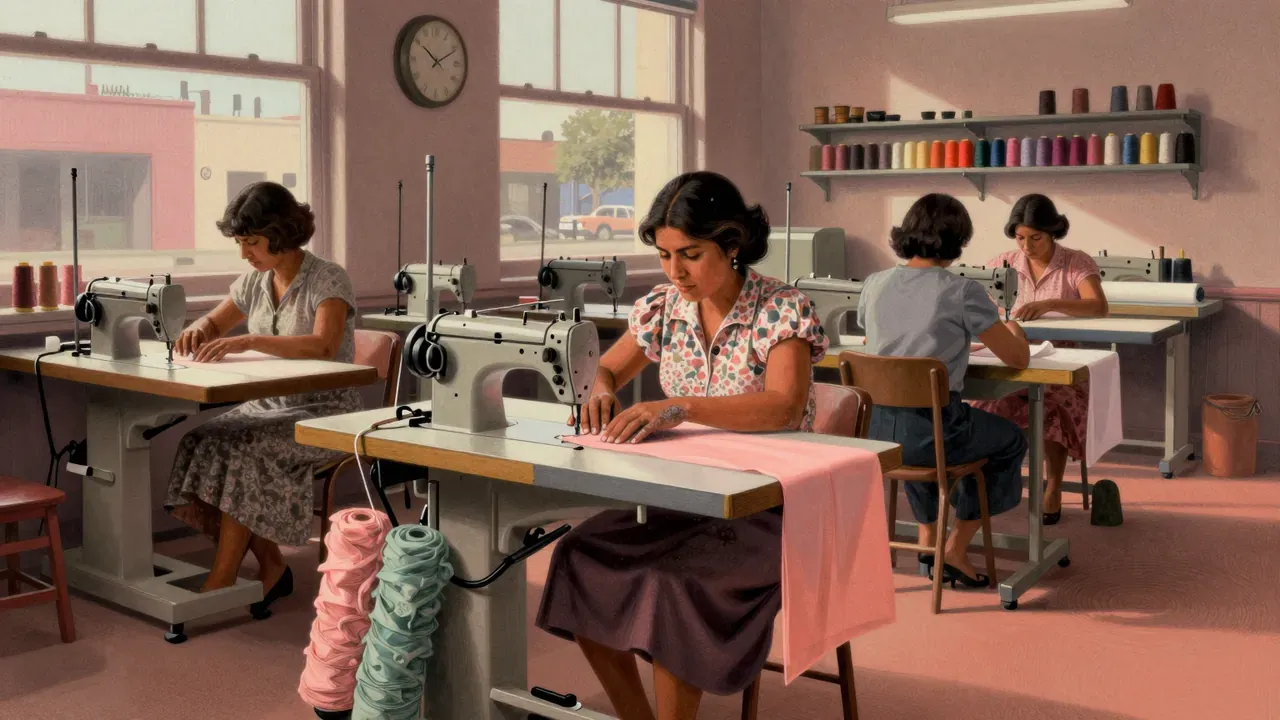
What lands is the cumulative weight of ordinary resilience. A Salvadoran woman sewing in a Los Angeles garment shop speaks of her daughter’s graduation while her hands move without pause; a Vietnamese family gathers around a small TV in a Queens apartment, the screen flickering with an American news broadcast they watch without translation; Walcott recites a line of poetry in a Boston garden, then pauses to correct his own pronunciation — not for accuracy, but for the ear’s fidelity to rhythm. These moments do not argue for integration or assimilation, nor do they romanticise struggle. They register duration: the time it takes to learn a language, to file papers, to wait for a green card, to adjust a greeting to fit a new set of social cues. The film avoids both pity and praise, and in doing so, makes space for ambiguity — for pride that coexists with doubt, for gratitude shadowed by grief. Its moral clarity lies in restraint: it refuses to name heroes or villains, and in that refusal, honours complexity. The effect is neither stirring nor sombre, but quietly insistent — a record of endurance that asks only to be witnessed. (157 words)
The edges of the frame
What does not land is the structural thinness of its middle section, where transitions between subjects rely too heavily on Malle’s voiceover to supply connective tissue that the footage itself does not generate. Two sequences — one following a Korean grocer in Brooklyn, another tracking a Mexican construction worker in Houston — feel underdeveloped: the camera observes but does not deepen, and the interviews yield surface detail without revealing inner contradiction or evolution. There is no attempt to contrast aspiration with outcome, nor to test stated hopes against lived reality; the film declines even to show bureaucratic friction, let alone navigate it. This is not neutrality — it is omission. Some viewers will find this respectful; others will read it as evasion, particularly where subjects describe hardship without the film granting them tools to articulate resistance or agency. The absence of children, of undocumented status made visible, of labour organising or neighbourhood conflict, narrows its sociological range. It documents arrival, but not contestation — and in mid-1980s America, that silence carries weight. Those expecting critique of immigration policy or systemic barriers will find the film’s aperture too narrow. (159 words)
The grammar of pursuit
The themes that matter are not migration as event, but migration as condition: the daily recalibration of selfhood within a language not fully owned, a history not fully legible to neighbours, a future not fully claimable. Happiness here is not a destination but a pursuit — iterative, provisional, often enacted in small acts: correcting grammar, translating a menu, choosing which photo to hang beside the bed. The film treats identity as something worn lightly, adjusted constantly, never settled. It also treats time as uneven: for some, ten years in America feels like a lifetime; for others, three months contain more rupture than decades elsewhere. Class is present but unspoken — the physicist and the seamstress share no common vocabulary beyond English, yet the film does not interrogate why their paths cross only in its frame. Race enters obliquely: in the way a clerk’s tone shifts, in the hesitation before a name is pronounced, in the silence after a question about ‘feeling American’. These are not themes the film declares, but ones it permits — through duration, repetition, and refusal to summarise. (147 words)
The audience it assumes
It is for viewers who value observational patience over exposition, who trust silence as meaning, and who do not require resolution to feel engaged. Teachers of migration studies may use it as a counterpoint to policy-heavy texts; historians of the 1980s will find its texture useful, if incomplete. It is not for those needing analysis of border enforcement, asylum law, or demographic drivers — the film offers none. Nor is it for viewers who expect immigrant stories to pivot on trauma or triumph; this film sits firmly in the uncinematic middle ground of maintenance and adaptation. Someone who watched Ai Weiwei’s Human Flow and found it too urgent, or Frontline’s Immigration Battle too procedural, might find this film’s stillness refreshing — but someone seeking moral clarity on injustice will leave unsettled, not because the film is ambiguous, but because it declines to enter the arena where such clarity is forged. Change the brief from ‘observe’ to ‘interrogate’, and the verdict shifts. (152 words)
The time it asks for
Yes, it is worth your evening — provided you approach it as a document, not a diagnosis. Its eighty minutes pass without strain, its pace matching the rhythms it records: slow commutes, repeated tasks, conversations that circle before landing. It does not demand emotional investment, but rewards attention with subtle shifts in posture, emphasis, and light — details that accumulate into something resembling understanding. Those who dislike passive viewing, or who need clear stakes and consequences, will find it inert. But for anyone willing to sit with uncertainty — to watch a man fold laundry while describing his first snowfall, to hear a poet weigh English against Creole without resolving the tension — the film delivers a rare kind of dignity: one earned not through heroism, but through showing up, again and again, in a country still learning how to see its newcomers. That is not minor. It is necessary. And it holds up, thirty-eight years on. (151 words)