An oilman’s rise, told without shortcuts
There Will Be Blood follows Daniel Plainview from a solitary silver miner in 1898 to an oil baron controlling much of California’s early twentieth-century boom, loosely drawn from the opening chapters of Upton Sinclair’s 1927 novel Oil! Paul Thomas Anderson, who wrote and directed after abandoning an unrelated script, narrows Sinclair’s larger political novel to Plainview’s personal ascent and his conflict with a young preacher, Eli Sunday, whose family’s land sits on oil Plainview wants. Daniel Day-Lewis plays Plainview as a man who treats every relationship, including his adopted son H.W., as a tool for the next deal. The film’s ambition is to trace how a specific, self-made kind of American ruthlessness compounds over decades rather than to tell a conventional rise-and-fall story.
Day-Lewis and Dano, two forms of certainty
The film opens with roughly fifteen minutes of near-silence, following Plainview alone in a mineshaft and then working an early well, before a single line of dialogue arrives. That patience carries through the rest of the film: Robert Elswit’s cinematography, which won the film’s other Academy Award, holds wide, still frames on the oil fields that let the derricks and landscape do work a script would otherwise need to do. Paul Dano, who replaced original cast member Kel O’Neill partway through filming, plays Eli Sunday’s religious fervour as a mirror of Plainview’s own certainty rather than its opposite, and their scenes together, particularly a public baptism Plainview is forced to endure, generate the film’s sharpest confrontations. Jonny Greenwood’s score avoids melody almost entirely in favour of dissonant strings that read as dread rather than accompaniment.
The wells, the fire, the silence
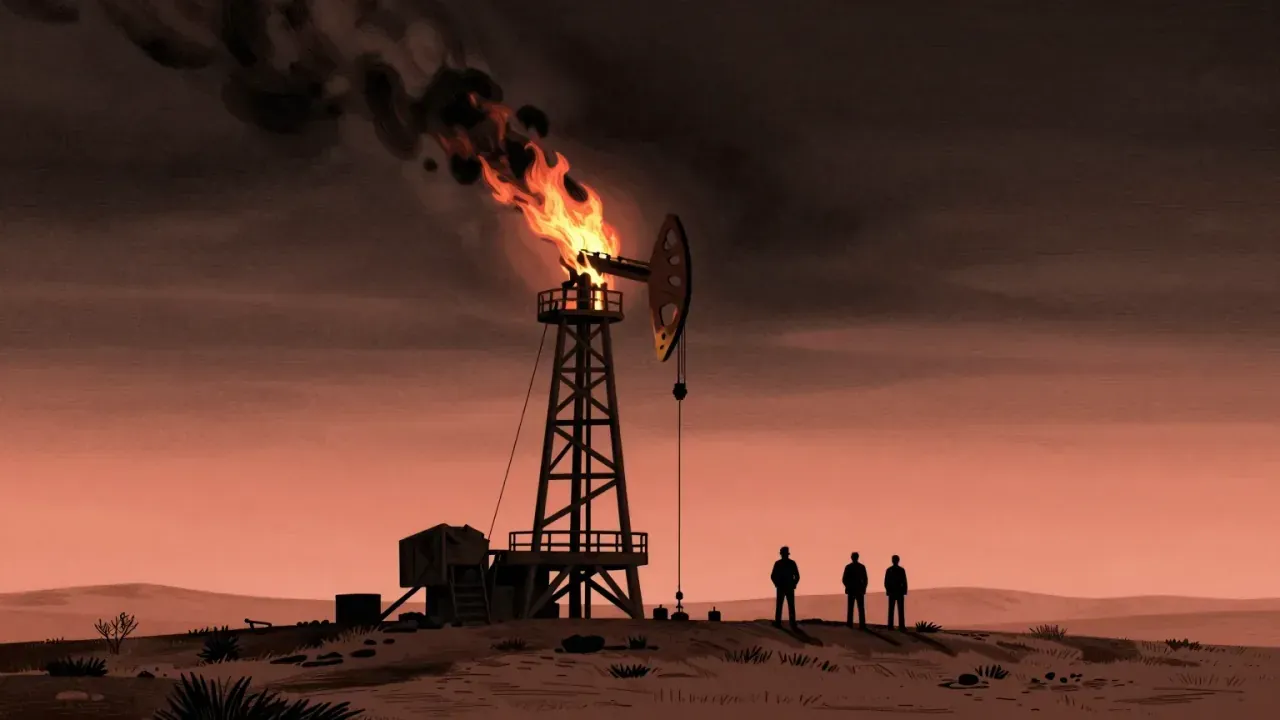
The film is at its best when it trusts silence and scale over dialogue. The derrick fire sequence, in which a well blows and burns through the night while Plainview watches with something closer to satisfaction than alarm, is staged with almost no cutting away for exposition. Day-Lewis’s vocal choice for Plainview, built partly from recordings Anderson sent him of turn-of-the-century speech and a viewing of John Huston’s The Treasure of the Sierra Madre, gives the character a formal, almost theatrical register that makes his rare moments of plain speech land harder. The final confrontation between Plainview and Eli, decades later in Plainview’s mansion, escalates into open theatricality that the film’s slow build has fully earned by that point.
Where the film asks a lot of its audience
The deliberate pace, especially across the film’s middle stretch of land deals and pipeline negotiations, will test viewers expecting Plainview’s ambition to generate more conventional incident along the way. Women barely register as characters at all, and Plainview’s family life, including his relationship with H.W. after an accident leaves the boy deaf, is treated more as another site of control than as an emotional core the film is interested in for its own sake. Some will also find the escalation in the final scene, where Plainview’s contempt for Eli tips into outright grotesque comedy, a jarring departure from the restraint of everything before it, even if the tonal risk is clearly deliberate rather than a lapse in control.
Family, faith and what money replaces
Ambition here is presented less as a virtue with a dark side than as something closer to an illness that consumes everyone near it, H.W., Eli, Plainview’s supposed half-brother Henry, in turn. Religion and capitalism are staged as competing, structurally similar claims on other people’s land and belief, with Eli’s Church of the Third Revelation offering the same kind of certainty and control that Plainview extracts through oil leases. The film has comparatively little interest in labour, community, or the wider consequences of the boom it depicts; its subject is one man’s interior logic, and how completely that logic isolates him from everyone who might have mattered to him.
Who gets the most from this one
This is built for viewers who want a character study that accumulates rather than resolves, and for anyone who wants to see Day-Lewis at his most extreme and most controlled in the same performance. Fans of Greenwood’s more dissonant compositional work, and of Anderson’s slower, more classical filmmaking compared with his earlier ensemble pieces, will find plenty here. It asks little patience for plot mechanics but a great deal for tone and pace, and it offers no one to root for in any conventional sense. Anyone wanting a female perspective, a sympathetic protagonist, or a story with clear moral stakes should look elsewhere; the film has no interest in supplying any of those.
A long evening that closes on its own terms
At 158 minutes, There Will Be Blood commits fully to its own logic, closing on a scene of such deliberate excess that it either confirms everything the film has built toward or reads as a rupture, depending on how much goodwill the preceding two hours have earned from you. Day-Lewis’s Oscar-winning performance alone justifies the evening, and Elswit’s photography rewards a proper screen rather than a phone. It isn’t an easy watch, and it offers no comfort or resolution at the end of it, but for anyone willing to sit with a character this unyielding for two and a half hours, it delivers on everything it promises early on.