Thirteen years from page to production
One Flew Over the Cuckoo’s Nest reached cinemas in November 1975, adapted from Ken Kesey’s 1962 novel by Bo Goldman and Lawrence Hauben, and directed by Miloš Forman. Kirk Douglas had optioned the book the year it was published, intending to play the lead himself, but no studio would commit, and the project sat for over a decade until his son Michael Douglas took it on as producer with Saul Zaentz. Forman, by then a director who had fled Czechoslovakia after the Warsaw Pact invasion, was brought in once Douglas and Zaentz saw his earlier Czech feature The Firemen’s Ball. Jack Nicholson plays Randle McMurphy, a criminal who fakes mental illness to serve his sentence in a psychiatric hospital rather than a prison, and Louise Fletcher plays Nurse Ratched, who runs the ward he is committed to.
A ward built from an actual ward
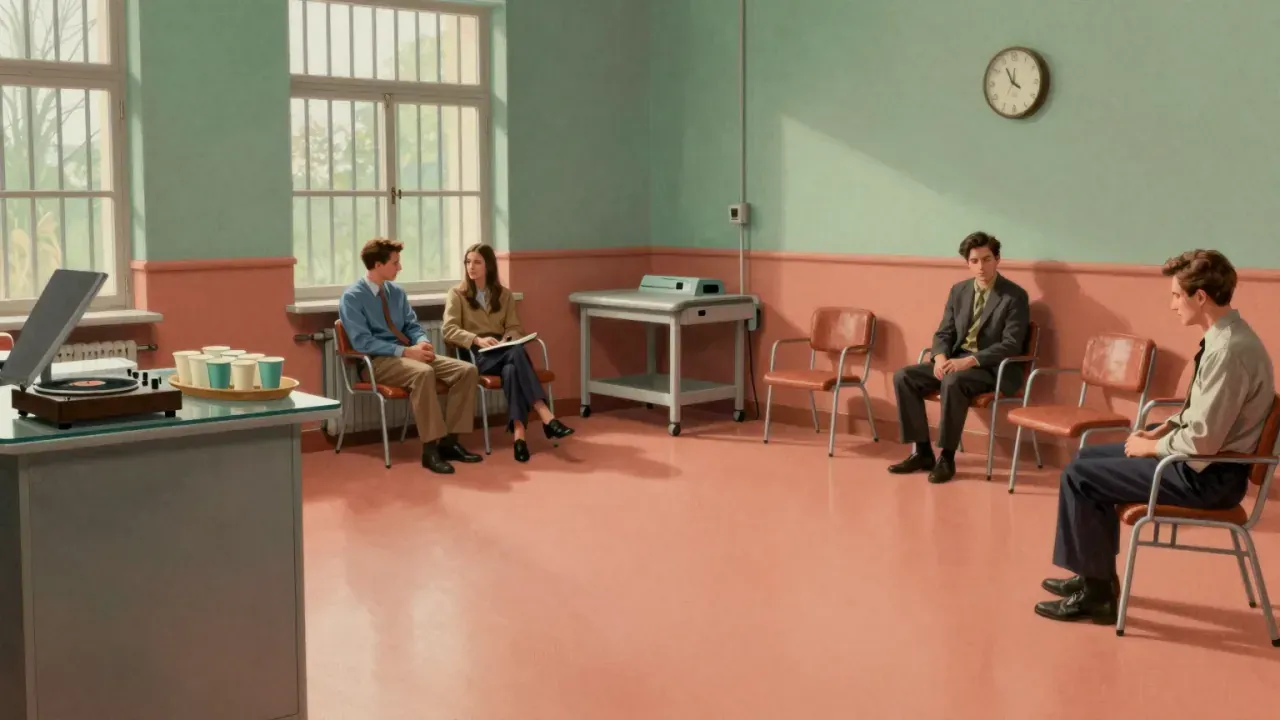
Made on a budget of roughly $3 million, the film was shot over three months on location in and around Salem, Oregon, using the Oregon State Hospital itself, the institution the novel was set in, rather than a constructed set. Casting took years to settle: Nicholson was a delayed choice after several established stars turned the role down, and Fletcher won the part after multiple auditions once an earlier actress dropped out to make another film. Danny DeVito reprised a role he had played on stage, and Will Sampson, cast as Chief Bromden, had no prior acting experience. Cinematographer Haskell Wexler shot much of it in muted, institutional light, and editor Sheldon Kahn cuts the film to hold on reaction shots of the ward’s patients as often as on its two leads.
Two performances built by opposition
The film’s strength is in how little either lead needs to do to register as a threat. Nicholson plays McMurphy’s provocations as almost casual, a man testing how far routine can be pushed before it cracks, while Fletcher’s Ratched answers every outburst with a flattened, procedural calm that is more unsettling than any raised voice would be. Their scenes together work as a series of small power struggles, a card game, a request for a television schedule change, a group therapy session, each one a contest over who sets the terms of the room. The supporting patients, played by actors including Brad Dourif and Christopher Lloyd in their first film roles, are written with enough particularity that the ward reads as a community rather than a backdrop for the two stars.
Where the supporting cast does the quiet work
The film’s account of institutional cruelty runs almost entirely through Nurse Ratched as an individual, which sharpens the central conflict but leaves the wider system she operates in largely unexamined; other staff barely register as characters, and the mechanisms above her, budget, policy, medical oversight, are never shown. That narrows what could have been an argument about an institution into a duel between two people, which is dramatically effective but simplifies the target. The tonal shift is also abrupt: much of the middle stretch plays as comedy, built on McMurphy’s fishing trip and card games with the other patients, before the final act turns to electroconvulsive therapy and a lobotomy with little transition, a change some viewers find the film has not adequately prepared them for.
Where the film flattens its case
What the film keeps returning to is the idea that sanity, inside this ward, is measured by compliance rather than health: McMurphy’s crime is not violence but refusal, and the hospital’s response escalates in direct proportion to how much control he threatens to take from the staff. Chief Bromden’s storyline, largely silent for most of the runtime, supplies the film’s clearest statement of the theme, a man who has learned that appearing harmless is the only way to be left alone. Ratched is not written as sadistic so much as procedurally certain that her order is the correct one, which is what makes the escalation toward invasive treatment feel less like malice than policy carried through to its logical end.
What the ward is arguing about
The film suits viewers drawn to stories about institutions and the exercise of quiet, procedural power, and to anyone interested in an ensemble built from actors early in their careers working against two performers at the peak of theirs. It is a poor choice for anyone who wants the opening act’s comic energy sustained throughout, since the back half commits fully to the consequences of McMurphy’s defiance, including a graphic account of electroconvulsive therapy and its surgical aftermath. Viewers with a personal or professional connection to psychiatric treatment, particularly its more coercive twentieth-century forms, should know the film uses those procedures as its climax rather than background detail, and go in with that expectation set.
Who should watch it, and when not to
The film was made for around $3 million and returned over $109 million at the box office, and it remains one of only three films to win all five top Academy Awards, alongside its high marks across critics’ aggregates decades later. That combination of commercial and critical success suggests a film that worked on more than one register at once, as entertainment and as argument. Watching it now, the mechanics of institutional control it depicts feel dated in their specific medical detail but not in their underlying logic, which is the stronger claim on an evening than any period detail could make. It asks a genuine question about who gets to decide what health looks like, and does not let its ending soften the answer.