A quote about a comet, built into a plot
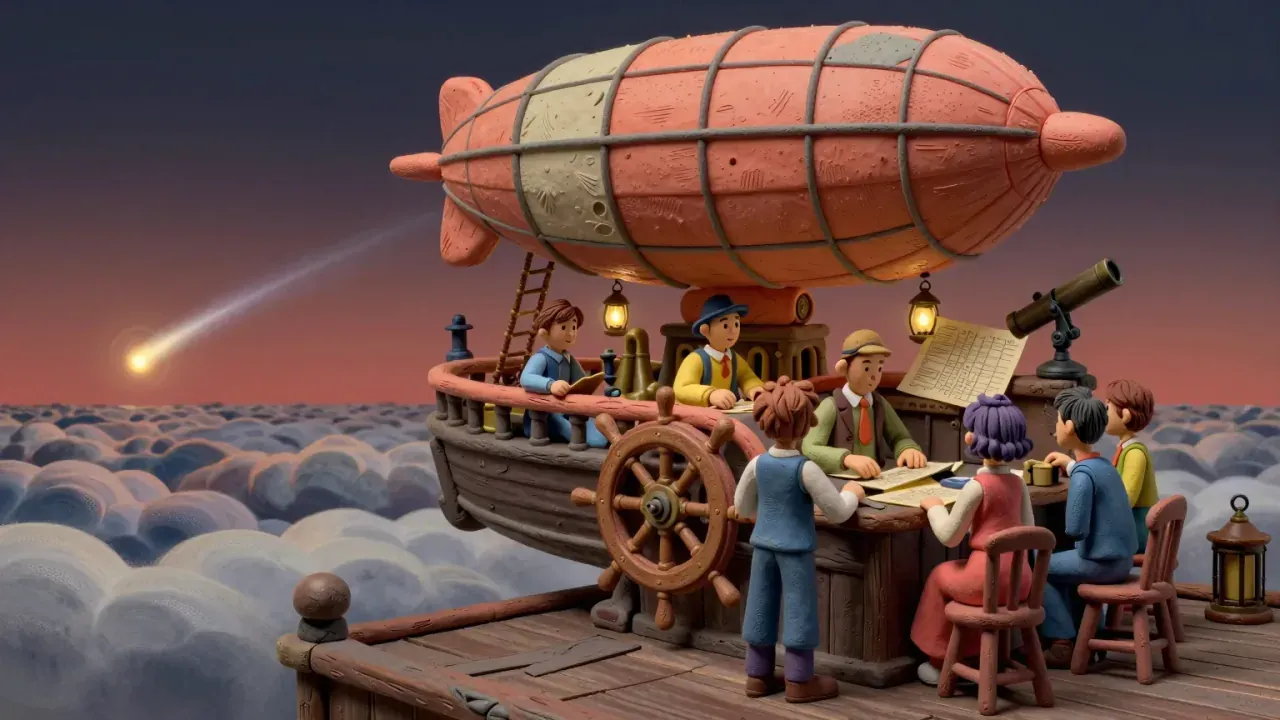
The Adventures of Mark Twain follows Tom Sawyer, Huckleberry Finn and Becky Thatcher as they stow away on an airship piloted by Mark Twain, who intends to fly out and meet Halley’s Comet, believing his life is bound to it. The premise comes directly from a remark Twain made near the end of his life, noting that he’d arrived with the comet in 1835 and expected to leave with it as well — he died in 1910, one day after the comet’s closest approach to the sun that year. Will Vinton directed and produced the stop-motion claymation feature through his own studio, working from a script by Susan Shadburne based on research into Twain’s life and writing by Daniel and Mary Yost.
New machinery built for one production
Making the film required inventing new equipment: animator Gary McRobert developed a computerised motion-control system to replace the older, hand-cranked method of moving clay puppets between frames, while Sam Longoria built a system letting a computer control motor drives that repositioned cameras, lenses and background elements automatically between shots. Low-intensity lighting with long exposure times was used throughout to keep the clay figures from softening or melting under studio lights, a persistent hazard of the medium. Character designer Barry Bruce sculpted the film’s puppets, and Vinton had actors perform scenes on black-and-white film first so animators would have a reference for timing and motion before starting the frame-by-frame work.
A barbershop turned into an animation studio
The film took three and a half years to complete, made by a full-time crew of around seventeen people working out of a converted house in Portland, Oregon — nicknamed the Barbershop Studio after the shop that had previously occupied its ground floor — with musicians, writers and freelance animators supplementing the core team as needed. That scale, tiny compared to a major studio production, shows in the film’s careful, unhurried pacing rather than in any visible shortfall of craft; the claymation itself is detailed and expressive throughout, holding up well against better-funded animation from the same period.
Vignettes carrying more weight than the frame story
Structurally, the airship journey functions mainly as a frame for a series of vignettes drawn from Twain’s own writing — the children encounter dramatisations of The Celebrated Jumping Frog of Calaveras County, an Adam and Eve story built from Twain’s own late writing about his wife’s death, and Captain Stormfield’s Visit to Heaven, among others. These detours carry more emotional and thematic weight than the airship plot itself, particularly the Adam and Eve sequence, which doubles as Twain’s own grief for his late wife Olivia rendered through his fiction. The frame story’s central tension, whether the children can stop Twain from flying to his apparent death, is resolved more through sentiment than through any real dramatic mechanism.
A children’s marketing label for an adult film
Underneath its adventure-story surface, the film is fundamentally about a man who has made peace with dying and is trying, gently, to prepare children too young to understand that idea for his eventual absence. Twain’s darker double, who appears late in the film dressed in black, represents the harsher, more nihilistic side of his writing and thinking, and the film treats the two halves — the humorist and the darker philosopher — as equally real rather than favouring the more comfortable public persona. That’s an unusually direct engagement with mortality for a film eventually marketed to children, and it’s the clearest sign of how much its content diverged from its intended audience.
Who this is for
This suits older viewers and readers already familiar with Twain’s shorter fiction, who will recognise and appreciate how carefully the vignettes are adapted, as well as anyone drawn to stop-motion animation as a serious craft rather than a novelty act. It’s a poor match for young children expecting a straightforward, cheerful adventure, since the film’s tone is considerably more melancholy and philosophical than its G rating and matinee marketing suggested, a mismatch that hurt its original commercial prospects even though it had tested well with teen and college audiences in advance screenings beforehand.
Is it worth the evening
Distributor Atlantic Releasing placed the film under its Clubhouse Pictures children’s matinee label despite a producer’s efforts to test it as a standalone theatrical feature for older audiences, and it grossed under $850,000 against a $1.5 million budget as a result. Critics have been kinder in retrospect than the initial commercial outcome suggests — animation critic Charles Solomon later named it one of the best animated films of the 1980s and called it Vinton’s most mature work — and it currently holds an 80% score on Rotten Tomatoes. Worth the evening for viewers willing to meet it as the thoughtful, adult-minded film it actually is rather than the children’s matinee it was sold as.