Saved
Topic

The Holocaust

The industrialised murder of European Jewry, and how a state arrived at it.

11
in film
13:00
average
143 min
in total
20
across the network
The Holocaust across the network →
All briefs11
13:00

Au revoir les enfants

Louis Malle · 1987

Louis Malle’s 1987 autobiographical drama follows eleven-year-old Julien at a Catholic boarding school in occupied France, where the arrival of three new pupils reveals a secret: one is Jewish, hidden under a false name. As Julien forms a fragile friendship with Jean Bonnet — real name Kippelstein — he witnesses the slow collapse of safety, culminating in a Gestapo raid that takes Jean, two other boys, and their protector, the headmaster Père Jean. Shot with quiet precision by Renato Berta and performed with unshowy authenticity, the film rests its power on accumulation, not climax: in glances, silences, and the unbearable ordinariness of betrayal.
13:00

Diamonds of the Night

Jan Němec · 1964

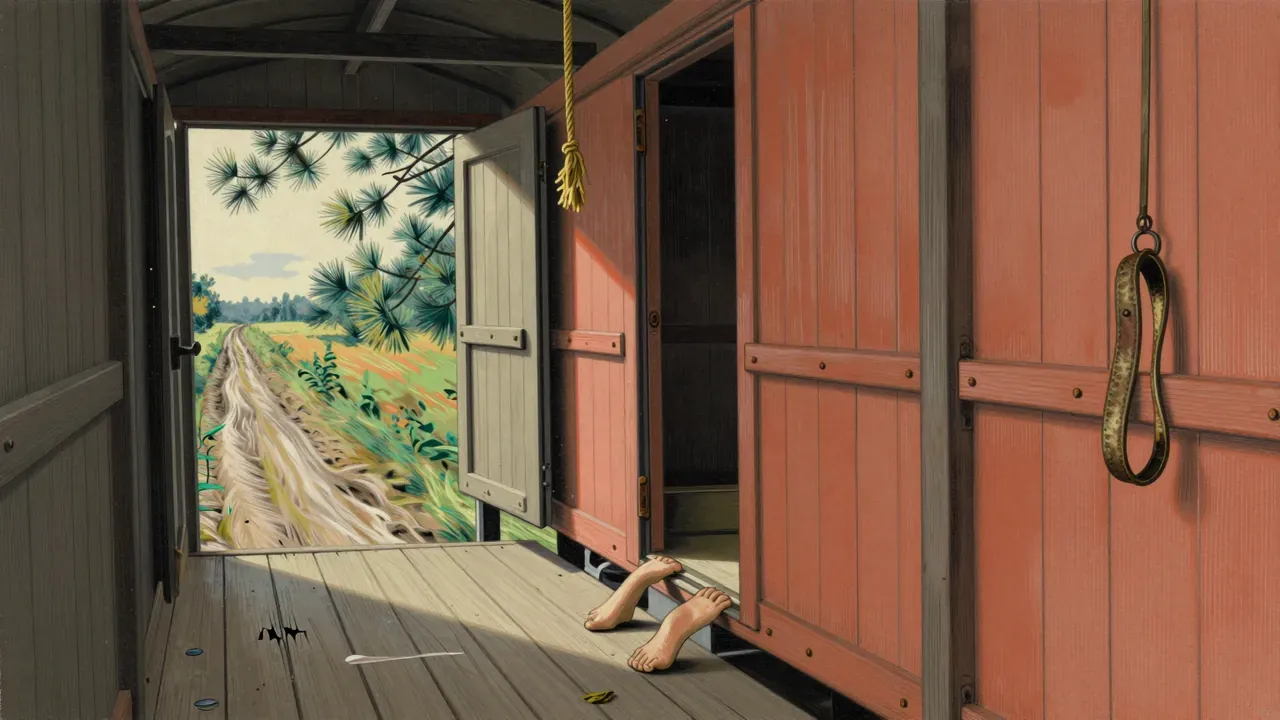
Jan Němec’s 1964 debut Diamonds of the Night follows two teenage boys fleeing a train to a concentration camp. With minimal dialogue and radical editing, it immerses the viewer in their physical and psychological disintegration—hunger, memory, hallucination and exhaustion rendered through stark cinematography, tactile sound design and restrained performances. Adapted from Arnošt Lustig’s autobiographical story, it avoids exposition in favour of embodied realism and surreal rupture. Its power lies in what it withholds as much as what it shows.

13:00

Europa Europa

Agnieszka Holland · 1990

Europa Europa (1990), directed by Agnieszka Holland, adapts Solomon Perel’s memoir of surviving the Holocaust by posing as a German nationalist and joining the Hitler Youth. Shot in German by a French-Polish-German co-production, it follows Solek’s constant recalibration of identity across shifting front lines, languages, and ideologies — avoiding sentiment, exposition, or moral summation in favour of procedural tension and quiet precision.

13:00

Kapò

Gillo Pontecorvo · 1959

Gillo Pontecorvo’s 1960 war film Kapò follows a teenage Jewish girl’s descent into moral compromise as a kapo in a Nazi concentration camp. Shot in Yugoslavia with an Italian-French-Yugoslav co-production team, it was among the first narrative films to depict camp life with graphic realism. Though criticised for melodrama, miscasting, and aesthetic missteps, its ambition — to chart how survival reshapes conscience — remains ethically urgent. Susan Strasberg stars, with Emmanuelle Riva, Laurent Terzieff, and Didi Perego in supporting roles.

13:00

Monsieur Klein

Joseph Losey · 1976

Set in occupied Paris in 1942, Monsieur Klein follows art dealer Robert Klein as he is mistaken for a Jewish namesake and drawn into a vortex of suspicion, paperwork, and erasure. Directed by Joseph Losey and starring Alain Delon, it uses Kafkaesque structure and austere craft to explore identity as a fragile, administratively conferred status — culminating not in revelation, but in the Vel' d'Hiv Roundup and deportation to Auschwitz.

13:00

Night and Fog

Alain Resnais · 1956

Alain Resnais’s 1956 documentary Night and Fog uses stark juxtaposition — new colour footage of abandoned camps alongside archival black-and-white material — to dissect the concentration camp as a functional extension of fascism. Written by survivor Jean Cayrol and Chris Marker, and scored by Hanns Eisler, it avoids sentimentality in favour of structural analysis: architecture, logistics, bureaucracy, and the diffusion of responsibility. Commissioned for the tenth anniversary of camp liberation, it remains a foundational essay film, rigorous, unsettling, and deliberately unresolved.

13:00

Phoenix

Christian Petzold · 2014

Set in ruined Berlin in 1945, Phoenix follows Nelly Lenz, a Jewish Holocaust survivor with a reconstructed face, as she seeks out her husband Johnny — who fails to recognise her. When he asks her to impersonate his presumed-dead wife to claim her inheritance, she agrees, becoming ‘Esther’. Under his direction, she rehearses her old self: voice, mannerisms, songs. But as the charade deepens, so does the tension between resemblance and reality, memory and convenience, love and complicity. Christian Petzold’s tightly controlled drama rests on Nina Hoss’s physically precise performance and a script that treats identity as surface, history as burden, and recognition as moral choice.

13:00

Shoah

Claude Lanzmann · 1985

A nine-hour French documentary directed by Claude Lanzmann, released in 1985. Made over eleven years, it contains no archival footage, no narration, no music — only interviews with survivors, perpetrators and bystanders, filmed on location at former death camps in Poland. Its method is durational, forensic and ethically uncompromising: testimony is left untranslated where necessary, interpreters’ voices remain audible, silence is preserved, and geography is matched to memory. It does not explain the Holocaust but locates it in speech, space and procedure.

13:00

The Night Porter

Liliana Cavani · 1974

Liliana Cavani’s 1974 art film stars Dirk Bogarde and Charlotte Rampling as a former SS officer and a concentration camp survivor who reunite in postwar Vienna. Set almost entirely in a grand but decaying hotel, it explores power, memory, and eroticised dependency through restrained performances, Alfio Contini’s underlit cinematography, and Franco Arcalli’s elliptical editing. It avoids exposition and historical context, focusing instead on behavioural recurrence and moral ambiguity.

13:00

The Shop on Main Street

Ján Kadár, Elmar Klos · 1965

Set in a Slovak town during WWII, The Shop on Main Street follows a carpenter assigned to take over a Jewish widow’s haberdashery under the Aryanization programme. His growing, ineffectual bond with her exposes the slow corrosion of conscience under bureaucratic antisemitism. Made in 1965 at Barrandov Studios, directed by Ján Kadár and Elmar Klos, it won the Academy Award for Best International Feature Film.

13:00

The Touch

Ingmar Bergman · 1971

Ingmar Bergman’s 1971 English-language debut follows Karin, a Swedish housewife whose affair with an American archaeologist unravels her assumptions about duty, desire, and selfhood. Shot on Gotland with Sven Nykvist, it privileges psychological nuance over plot, using restraint and silence to trace a woman’s slow, uncertain reclamation of agency. Though criticised at release for stiffness and imbalance, it remains a rare, transparent record of Bergman adapting his methods to new language, cast, and expectation.