The look of it
Night and Fog is a thirty-two-minute French documentary commissioned in 1955 to mark the tenth anniversary of the liberation of Nazi concentration camps. It does not seek to narrate history as chronology, nor to memorialise individuals, but to anatomise the camp system as a functional extension of fascism — its architecture, logistics, labour extraction, and bureaucratic erasure. Alain Resnais and Jean Cayrol treat the camps not as aberrations but as logical outcomes: the film opens on quiet, overgrown grounds at Auschwitz and Majdanek, then cuts to archival footage of SS officers inspecting blueprints and Himmler touring Dachau. The title refers to the Nacht und Nebel decree of 1941, which mandated disappearance without trace — a framing device that shapes the film’s central question: how does a state make people vanish while keeping the machinery visible? It was made under the auspices of France’s Committee on the History of the Second World War and the Network of Memory, with explicit scholarly intent: to communicate historical research through image and sound, not rhetoric or catharsis. Word count: 158
How it holds the frame
The film works through strict juxtaposition: new colour footage of empty camp grounds — shot by Ghislain Cloquet and Sacha Vierny in Eastmancolor — alternates with black-and-white archive material: Soviet newsreels of liberated camps, Dutch prisoner-made films from Westerbork, French police rounding up Jews, and German propaganda reels repurposed against themselves. Michel Bouquet’s voiceover, written by Cayrol and Chris Marker, avoids emotive phrasing; sentences are clipped, declarative, often grammatically suspended — as if language itself struggles to hold the subject. Hanns Eisler’s score uses dissonant strings and abrupt silences, not to heighten horror but to punctuate moral rupture: the music halts when a train arrives at Auschwitz, then resumes only after the narrator states ‘death makes its first choice’. Resnais edits these layers with forensic rigour — no dissolve, no fade, no music under testimony — treating each frame as evidence, not illustration. The effect is not immersion but estrangement: the viewer is held at a distance, required to assemble meaning across gaps in time, tone, and medium. Word count: 159
What stays visible
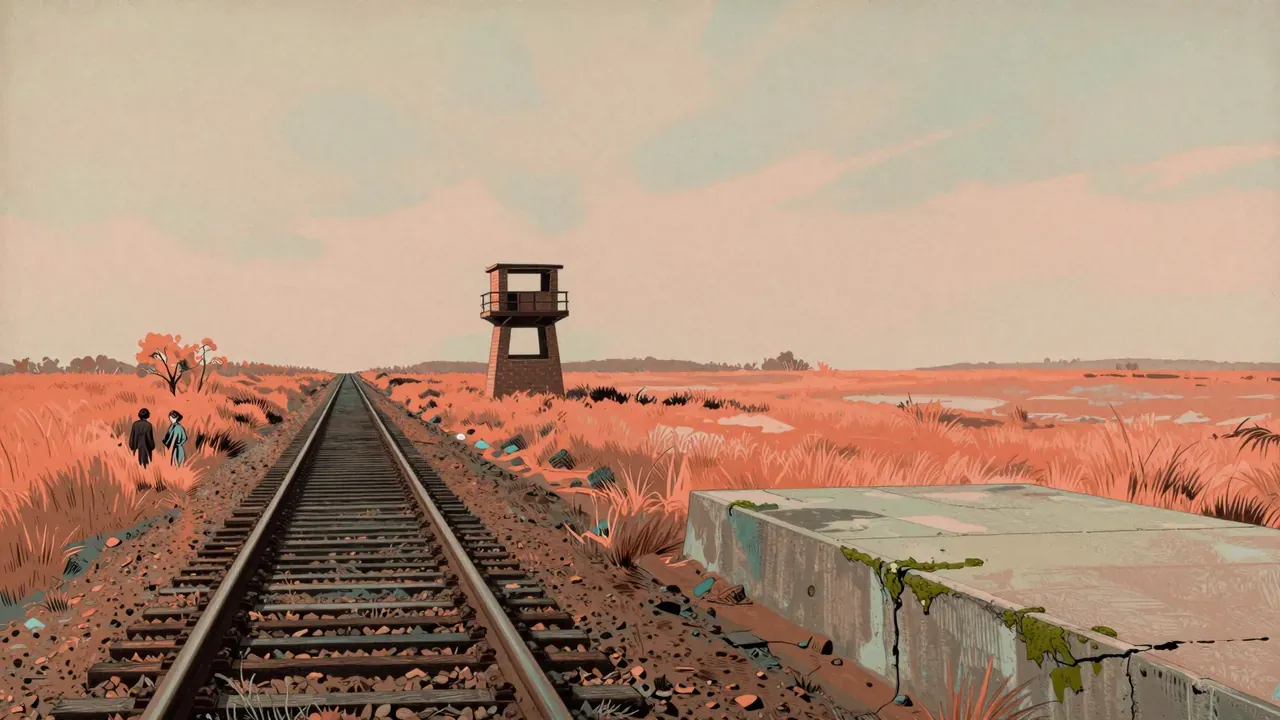
What lands is the film’s refusal of closure. It does not end with liberation, but with the Auschwitz Museum — a site already curated, already institutionalised — and a final, unanswerable question about responsibility. The colour shots of grass growing through barracks foundations do not offer solace; they register time’s indifference. The archival footage of emaciated bodies stacked like timber lands not because it shocks, but because it is presented without commentary, forcing the viewer to confront the banality of scale: not one corpse, but hundreds, then thousands, then stacks, then pits. The sequence on the ‘techniques of extermination’ avoids graphic close-ups; instead, it lingers on rusted showerheads, labelled Zyklon B cans, and architectural plans — making bureaucracy the true subject. Even the infamous soap claim, now known to be inaccurate, functions here not as error but as symptom: a rumour that spread because the industrial logic of the camps made such perversion plausible. The film lands where it insists on ambiguity — in the shot of a French gendarme directing deportees, in the lingering pan across a Polish guard tower still standing in 1955, in the silence after Eisler’s music cuts. Word count: 157
Where the line blurs
What does not land is the attempt to compress the full scope of Nazi persecution into a single structural logic. The film treats all camps — political, racial, penal, transit — as variations on one system, eliding distinctions between Auschwitz-Birkenau’s industrial murder and Buchenwald’s forced labour, or between Jewish victims and Roma, disabled, or homosexual prisoners. Its focus on economic rationality flattens the ideological specificity of antisemitism: the genocide of European Jews appears as one component of a broader administrative machine, not as its organising principle. This reflects the French historiographical context of 1955 — when the Holocaust remained a ‘blind spot’, even for scholars like Henri Michel and Olga Wormser — rather than a failure of intent. Also strained is the film’s implied universality: Resnais’s stated fear of repetition during the Algerian War gives the work urgency, but the parallel remains implicit, never argued. Without that context, the warning feels abstract — a moral axiom rather than a political diagnosis. Some viewers may find the restraint alienating: no survivor interviews, no names, no dates beyond 1941–1945. That is by design, but it leaves little room for grief, only for reckoning. Word count: 159
Who built the walls
The themes that matter are not memory or trauma, but infrastructure and accountability. The film treats the camp not as a place of suffering but as a built environment — with railway sidings, electrified fences, gas chambers disguised as bathhouses, and factories run by I.G. Farben. It asks how ordinary materials — concrete, steel, rail, chlorine — become instruments of annihilation when placed under a specific administrative will. Responsibility is distributed: not only to SS officers, but to architects who designed crematoria, engineers who maintained ovens, clerks who filed deportation orders, and bystanders whose silence enabled logistics. The recurring motif of fog — literal and metaphorical — names the deliberate obfuscation of guilt: not ignorance, but active concealment. Time is another theme: the film refuses linear progression, cutting between 1944 and 1955 without transition, implying that the past is not past but sedimented in the present landscape. The final shot — of a slow pan across barbed wire, then up to a clear sky — does not resolve; it holds the tension between evidence and erasure, visibility and forgetting. Word count: 158
Who walks away
This film is for viewers who can sit with unresolved discomfort, who value precision over catharsis, and who understand that historical clarity requires confronting banality as well as brutality. It is not for those seeking narrative resolution, biographical detail, or emotional release — there are no survivor testimonies, no personal stories, no redemptive arc. Teachers of modern European history will find it indispensable; students encountering the Holocaust for the first time may need scaffolding, as the film assumes familiarity with terms like ‘Nacht und Nebel’ and institutions like the Comité d’histoire. Those who believe documentaries must ‘humanise’ their subjects may reject its clinical tone. Others, particularly readers of Primo Levi or historians of bureaucracy, will recognise its method as essential. A viewer expecting chronological exposition or moral certainty will leave unsettled — not because the film fails, but because it refuses to offer what it considers false comfort. Word count: 159
The time it takes
Yes, it is worth your evening — not as relief, but as obligation. Thirty-two minutes is the minimum time required to absorb its structure, its silences, its calibrated repetitions. To skip it is to accept the very fog the title names: the diffusion of responsibility, the smoothing-over of complicity, the assumption that ‘it could not happen here’. Those who argue it is ‘too bleak’ mistake gravity for despair; those who call it ‘dated’ ignore how its formal strategies — the use of colour to estrange, the refusal of voiceover authority, the foregrounding of architecture over biography — prefigure modes still used in contemporary essay films. It remains urgent not because the past repeats, but because the conditions that enabled the camps — legal erasure, industrial dehumanisation, bureaucratic detachment — have not vanished. Watching it is not an act of commemoration, but of calibration. Word count: 159