The setting is a town, not a timeline
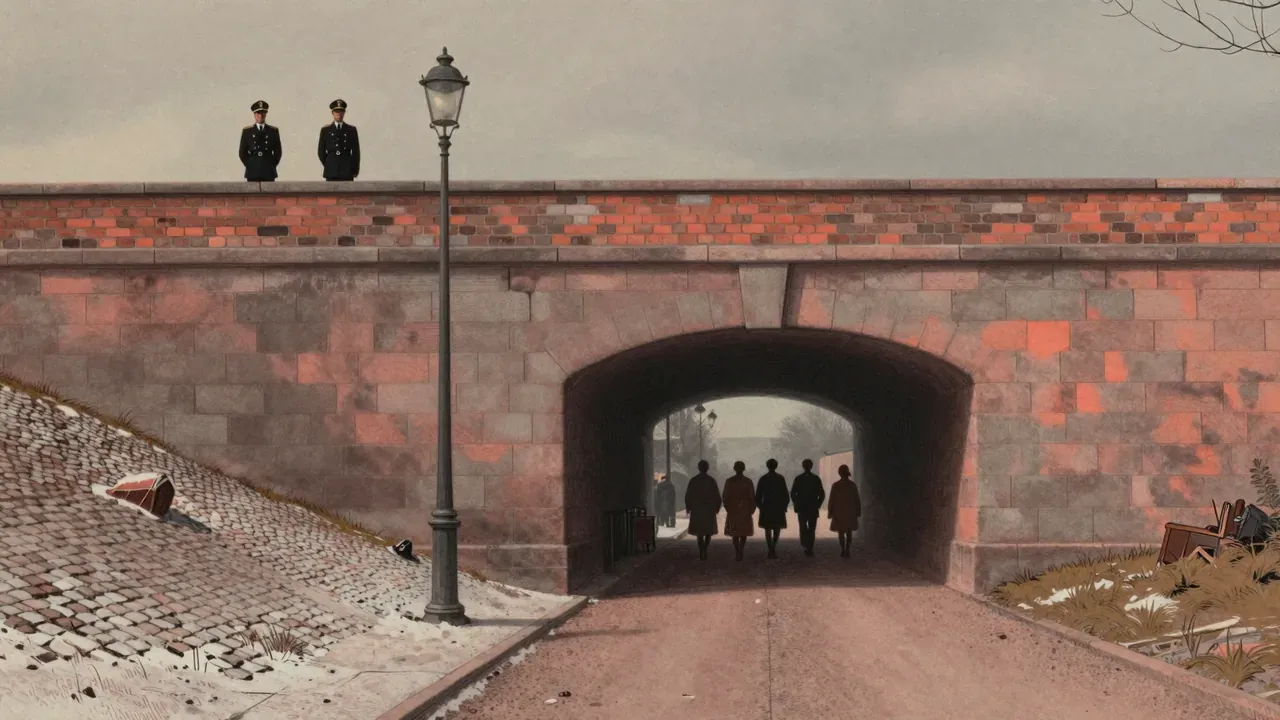
The Shop on Main Street is a Czechoslovak drama set in 1942 in a small town of the Slovak Republic, a Nazi-aligned client state. It follows Antonín ‘Tóno’ Brtko, a mild-mannered carpenter assigned to ‘Aryanize’ the haberdashery of Rozália Lautmannová, an elderly, nearly deaf Jewish widow. The film does not dramatise resistance, heroism or systemic critique; instead, it narrows its focus to the moral erosion of an ordinary man who accepts complicity as routine, then falters at the threshold of violence. It avoids historical exposition, relying instead on behavioural detail — the way Brtko adjusts his voice for Lautmannová’s hearing, how he hesitates before touching her arm, the rhythm of their shared silences. Its ambition is precise: to trace the slow collapse of ethical agency under bureaucratic antisemitism, not as ideology but as daily habit. It treats fascism not as a rupture but as sediment — settled, unremarkable, and therefore more dangerous. The film was made in 1965, three years after the Prague Spring began loosening cultural controls, yet it remains tightly controlled in tone and scope, refusing symbolic grandeur in favour of psychological fidelity. Word count: 158
The look of it
The story unfolds with deliberate, uninflected pacing: Brtko’s initial awkwardness gives way to reluctant care, then to paralysing indecision when the Jewish community is rounded up. Jozef Kroner plays Brtko with physical restraint — shoulders slightly stooped, hands often idle, speech hesitant even when decisive — while Ida Kamińska renders Lautmannová’s disorientation without pathos, her gestures small, her movements governed by habit rather than intention. Vladimír Novotný’s cinematography uses shallow depth of field and muted natural light, especially in the shop’s interior, where dust motes hang in shafts from high windows and shadows pool behind counters. Zdeněk Liška’s score employs period-appropriate brass band motifs, but fragments them — a march dissolves into a single clarinet line, then silence — mirroring the breakdown of social coherence. Jaromír Janáček’s editing avoids emphasis: cuts land on neutral frames, holding just long enough to register weight without underlining it. The script, co-written by Ladislav Grosman, Ján Kadár and Elmar Klos, sustains ambiguity — no character articulates motive clearly, and moral positions are implied through action, not speech. Word count: 159
The sound of it
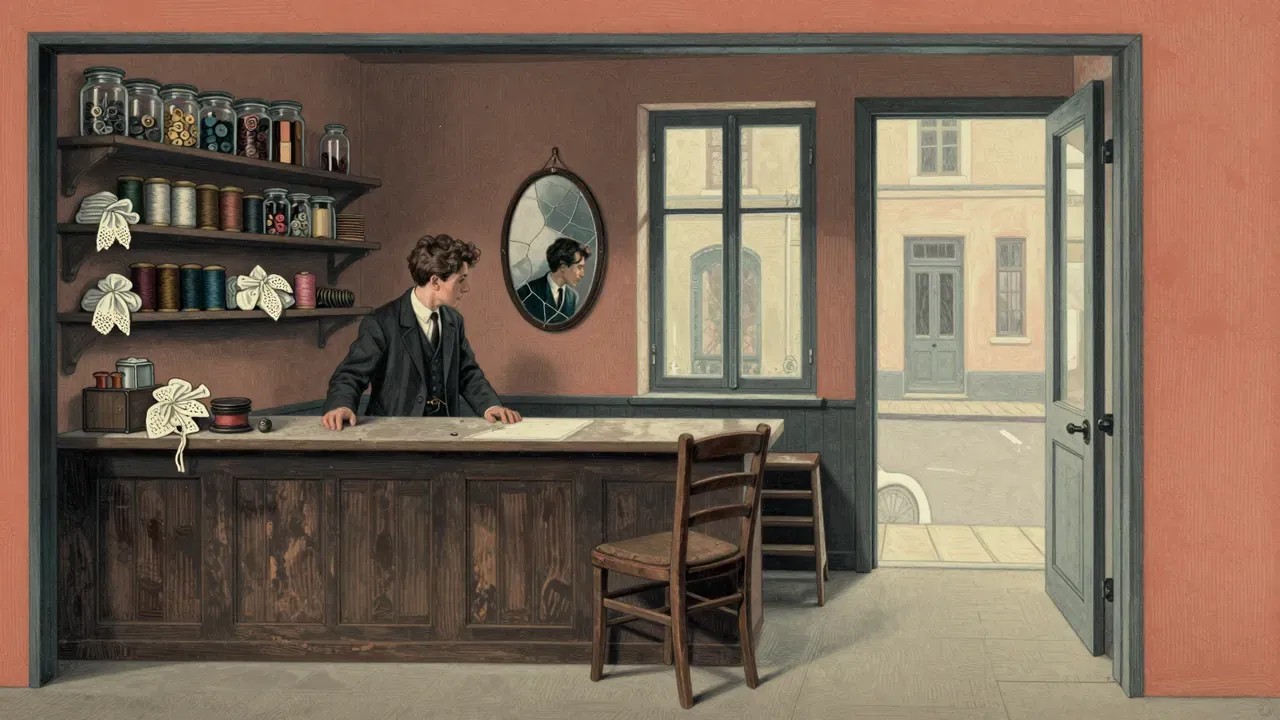
What lands most firmly is the cumulative pressure of small failures: Brtko’s inability to explain his role to Lautmannová, his deferred warnings, his final, aborted attempt to hide her. These are not dramatic turns but quiet accumulations — the kind that make viewers lean forward not in suspense but in dread. The shop itself functions as a contained world: its cluttered counter, thread spools, cracked mirror and narrow staircase become emotionally legible through repetition and subtle repositioning of camera and actor. The film’s restraint pays off in the final sequence — not the suicide, but the fantasy dance through the square — which feels earned because it is withheld until every other possibility has been exhausted. The use of regional Slovak dialect, spoken by locals from Sabinov, grounds the fiction without exoticising it; their voices carry the weight of place, not performance. Kamińska’s Polish accent is not smoothed over but absorbed into the texture of Lautmannová’s isolation — a linguistic marker of displacement that never becomes illustrative. The film refuses catharsis, yet leaves a residue of sorrow that lingers precisely because it is unadorned. Word count: 157
The pace of it
What does not land is the framing device of the opening and closing narration — a detached, almost documentary-style voiceover that names the town and dates events. It sits uneasily beside the film’s otherwise immersive, present-tense realism, introducing a didactic distance the rest of the work carefully avoids. The subplot involving Imrich Kuchár, Brtko’s friend who opposes Aryanization, remains underdeveloped: his arguments are clear but lack emotional counterweight, making him function more as exposition than character. A few scenes in the town square rely too heavily on background extras to convey collective anxiety, their expressions broadened beyond the film’s usual subtlety. The fantasy ending, while resonant, risks sentimentality if viewed outside the film’s rigorous context — its power depends entirely on the preceding austerity, and some viewers may find its release too abrupt, too lyrical, given what precedes it. The film’s commitment to understatement means certain moral complexities — particularly around Slovak collaboration beyond Brtko — remain implicit rather than interrogated, which may frustrate those seeking structural analysis over individual psychology. Word count: 159
The weight of it
The themes that matter are not the Holocaust as historical event but the mechanics of moral surrender: how accommodation becomes habit, how silence acquires weight, how responsibility diffuses across bureaucracy and custom. The film treats antisemitism not as hatred but as administrative routine — paperwork, signage, enforced ‘supervision’ — and shows how easily conscience can be outsourced to procedure. Age and infirmity are not metaphors but conditions that expose the limits of empathy: Brtko’s kindness is real, yet insufficient, because it operates within a system designed to erase its object. The shop is both refuge and trap — a space of temporary autonomy that cannot withstand external force. Memory appears only obliquely: Lautmannová’s muttered Yiddish phrases, her indistinct Hebrew reading, the faded photographs behind glass — all suggest continuity that the state seeks to sever, not through spectacle but erasure. The film’s central tension lies between care and control: Brtko mends her chair, organises her stock, even tries to teach her new pricing — acts that feel tender until their context sharpens into coercion. Word count: 159
The ending of it
This film is for viewers who value psychological precision over narrative propulsion, who can sit with ambiguity and tolerate endings that resolve nothing but feeling. It suits those familiar with Central European history only in outline, because it assumes no prior knowledge — its power lies in behaviour, not context. It is not for viewers who require moral clarity, narrative closure or protagonists with definable arcs; Brtko changes only in degree, not direction, and Lautmannová remains constant to the end. Those who expect historical films to foreground resistance, testimony or institutional critique may find its focus too narrow, its silence too heavy. Some will object to its lack of explicit condemnation — the directors do not name fascism, nor do they indict the town collectively. That choice is deliberate, not evasive, but it demands patience. A viewer who needs explanation, not implication, would leave unsatisfied. Word count: 159
The staying of it
Yes, it is worth your evening — not as relief or entertainment, but as calibration. Its 128 minutes recalibrate attention: teaching the eye to read hesitation, the ear to hear what is left unsaid, the mind to hold contradiction without resolving it. It asks for sustained attention, not passive consumption, and rewards it with a rare kind of emotional honesty — one that refuses to flatter the viewer with righteousness or despair. Those who dismiss it as ‘slow’ mistake deliberation for inertia; those who call it ‘depressing’ miss its quiet insistence on dignity amid dissolution. It is not for casual viewing, nor for those seeking affirmation — but for anyone willing to sit with discomfort as a form of respect. Its value lies not in what it says about 1942, but in what it reveals about how ordinary people inhabit moral grey zones — then and now. Word count: 159