The face after
Phoenix is a postwar German drama set in Berlin in late 1945, built around a single, tightly wound premise: a Jewish Holocaust survivor, Nelly Lenz, returns from Auschwitz with facial injuries requiring reconstruction; she seeks out her husband Johnny, who fails to recognise her, then asks her to impersonate his dead wife to claim her inheritance. Christian Petzold and Harun Farocki’s screenplay adapts Hubert Monteilhet’s French novel but relocates it decisively — stripping away the book’s detective framing, its daughter narrator, its romantic triangulation — to fix attention on the moral and perceptual rupture between survival and recognition. The film does not aim to reconstruct history, nor to explain trauma clinically. It works as a sustained, slow-burning inquiry into identity as performance, memory as liability, and love as complicity. Its method is not exposition but withholding: names are withheld, motives obscured, emotional responses delayed. It treats the immediate aftermath of genocide not as a moment of catharsis or reckoning, but as a landscape of suspended judgment — where seeing is never neutral, and resemblance is always dangerous. (158 words)
The look of it
The story unfolds in deliberate, unbroken sequences: Nelly’s surgical consultation, her first night back in Berlin, the silent walk to the Phoenix nightclub, the rehearsal of gestures and songs in Johnny’s apartment. Nina Hoss performs with minimal inflection — her face, newly rebuilt yet still bearing the weight of absence, registers neither shock nor fury, only a quiet, accumulating calibration of what Johnny says, how he touches her, when he looks away. Ronald Zehrfeld’s Johnny is not a caricature of guilt but a man whose self-preservation has calcified into reflex: he notices resemblance but refuses interpretation, rehearses affection without feeling, and mistakes mimicry for reunion. Hans Fromm’s cinematography keeps interiors dim and shallow, favouring medium shots that hold both characters in frame without granting either psychological privilege. Stefan Will’s score avoids period pastiche; it underscores silence more than action. Bettina Böhler’s editing sustains duration — a pause lasts long enough to become a question, a glance lingers until it feels like trespass. There are no flashbacks, no voiceover, no explanatory documents. Everything is held in the present tense of the body, the room, the street. (159 words)
The rehearsal
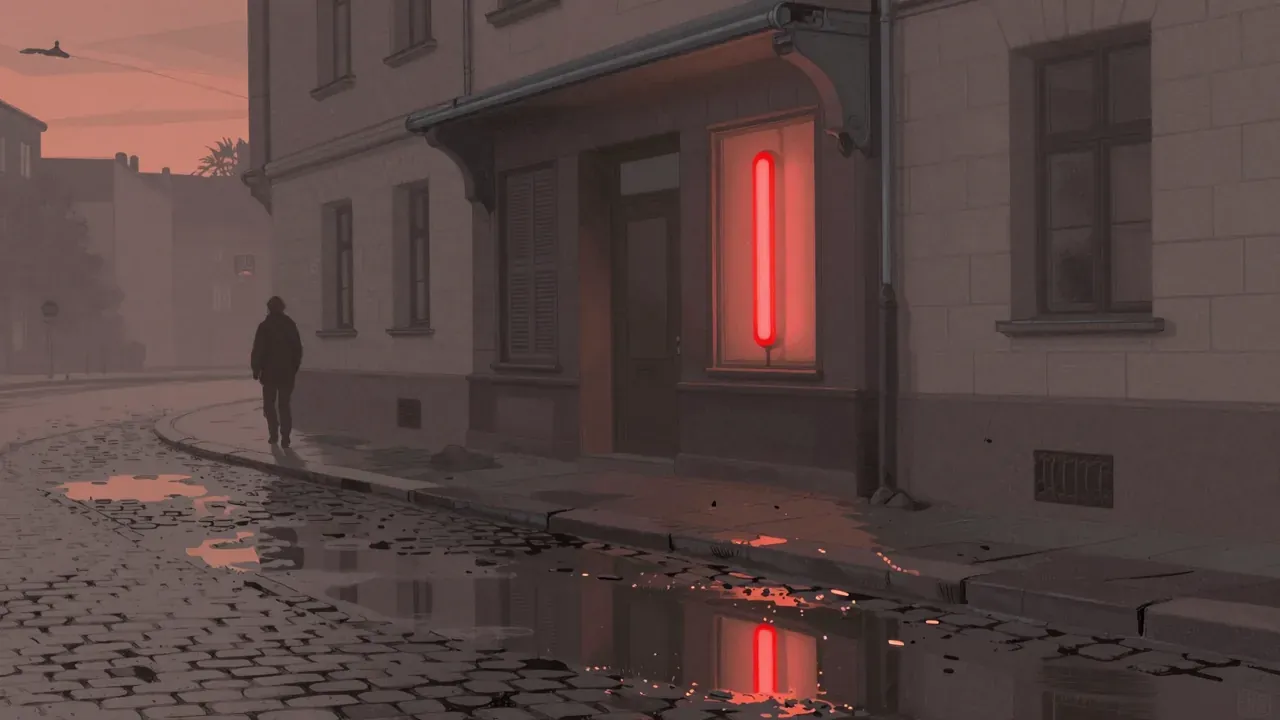
What lands most firmly is the film’s refusal to resolve its central ambiguity: whether Johnny’s failure to recognise Nelly is genuine ignorance or willful blindness. That uncertainty is not a flaw but the structural principle — it forces the viewer to occupy the same epistemic ground as Nelly, who must decide whether to expose herself or continue the charade. The final sequence at the friend’s house, where Nelly sings while Johnny sees her tattoo and stops playing, lands with physical precision: no music swells, no cut to reaction, just the cessation of piano, the continuation of voice, and the quiet exit. The production design — rubble-strewn streets, cramped apartments lit by single bulbs, the neon-lit Phoenix club with its hollow glamour — never gestures toward symbolism; it simply persists as lived environment. Even the use of ‘Speak Low’ and ‘Night and Day’ functions not as nostalgic ornament but as sonic markers of a pre-war self that cannot be retrieved, only approximated. The film’s restraint means nothing is over-emphasised, yet nothing is incidental. Every prop, every line reading, every shift in focus serves the slow accumulation of doubt — about memory, about loyalty, about what constitutes proof of personhood after systematic erasure. (157 words)
The note
What does not land is the character of Lene Winter, whose suicide note arrives as narrative necessity rather than emotional inevitability. Her function — to deliver the divorce decree and thus force Nelly’s confrontation with betrayal — is clear, but her interiority remains underwritten: her political conviction, her grief, her sense of duty to Nelly all feel implied rather than embodied. The film gives her no scene where she speaks her own desire or fear beyond urging emigration to Palestine; her death reads less as culmination than as plot pivot. Similarly, the secondary characters — Elisabeth, the landlady, the friends at the train station — exist primarily as mirrors or obstacles, not as people with independent stakes. The film’s tight focus on the dyad of Nelly and Johnny leaves little room for social texture beyond functional setting: we see rubble, but not rebuilding; displaced persons, but not networks of care; postwar bureaucracy, but not its daily friction. This narrowness is deliberate, but it carries a cost: the world outside the couple’s fraught intimacy feels like backdrop, not context. Some viewers may find the pacing too austere, the withholding too absolute — particularly in the middle stretch, where Nelly’s compliance with Johnny’s plan risks appearing passive rather than strategic. That reading is possible, and the film does not actively refute it. (159 words)
The song
The themes that matter are not those of survival or redemption, but of legibility and consent. Phoenix treats identity not as essence but as surface — something read, misread, performed, erased, and reassembled under duress. The reconstructed face becomes a literal metaphor for the impossibility of returning to who one was: the surgery restores function but not fidelity, and Nelly’s insistence on resemblance exposes the fantasy embedded in that demand. The film also interrogates complicity as habit — Johnny’s betrayal is not dramatised as an event but absorbed as atmosphere, like the dust in Berlin’s air. His moral failure is not in action but in the quiet, repeated choice not to ask questions, not to look closely, not to remember. Memory here is not a faculty but a risk: to recall is to implicate, to name is to accuse. The film’s treatment of Judaism is similarly unsentimental — Nelly’s tattoo is not revealed for pathos but as evidence, a fact that cannot be sung over or played past. There is no invocation of faith or tradition; Jewishness is marked by loss, by law (the divorce decree), by bodily inscription, and by the simple, unremarkable fact of return to a city that tried to erase it. These are not abstract ideas but pressures exerted on posture, on speech, on the length of a pause before answering. (156 words)
The return
This film is for viewers who trust silence as meaning, who accept ambiguity as ethical responsibility rather than narrative evasion, and who value performance as sustained physical intelligence over emotional exposition. It rewards attention to gesture, to lighting shifts, to the weight of a pause between sentences. It is not for those who require clear moral signposting, linear cause-and-effect, or cathartic resolution — the ending offers no reconciliation, no punishment, no explanation, only the quiet termination of a performance and the beginning of an unspoken reckoning. Anyone expecting a conventional Holocaust narrative — one centred on testimony, on historical context, on communal mourning — will find Phoenix withholding. Those who associate arthouse cinema with visual excess or formal experimentation may find its rigour austere. Its power depends entirely on patience: if you leave before the final minute, you miss the only moment where recognition occurs, and it arrives not as dialogue but as cessation — of music, of touch, of pretence. To dismiss it as cold is to mistake control for indifference. (158 words)
The stop
Yes, it is worth your evening — provided you watch it whole, in one sitting, without interruption, and without expectation of comfort or clarity. Its ninety-eight minutes accumulate like sediment: small choices, withheld reactions, minor deviations from expected behaviour all cohere into something heavier than their sum. It does not ask for empathy but for vigilance — over how faces are read, how names are assigned, how history is made visible or invisible in the everyday. Those who find its pace too measured, its tone too restrained, or its conclusion too unresolved may prefer Barbara or Transit, Petzold’s other collaborations with Hoss, which offer slightly more narrative scaffolding. But Phoenix’s singularity lies in its refusal to mediate between horror and habit — it insists they coexist, and that recognising that coexistence is the first, necessary act of witness. It is not entertainment, nor is it instruction. It is a test of attention, and it passes. (157 words)