The shape of it
Ride Lonesome is a 1959 American Western, shot in Eastmancolor and CinemaScope on location at Lone Pine, California. It is the fourth of the five films Budd Boetticher made with Randolph Scott under the Ranown banner — a compact cycle defined by tight budgets, moral compression, and a shared preoccupation with codes of conduct in lawless space. The film sets out to distil the Western down to its structural essentials: pursuit, confinement, delayed reckoning, and a final confrontation that resolves neither cleanly nor redemptively. It does not seek to expand the genre’s geography or psychology but to tighten its hinges — testing how much tension can be sustained between three men bound by mutual distrust, one woman caught between them, and a fourth whose arrival is both inevitable and fatal. Its ambition is formal and economical: to hold character, landscape, and consequence in fixed relation, with no narrative slack. It treats plot not as progression but as pressure building behind a dam — a dam built from dialogue, terrain, and withheld information. The script, written by Burt Kennedy, was original, not adapted, and Boetticher insisted it was the only Ranown film he could end on screen without needing the rider to ride off into the sunset. Word count: 148.
The look of it
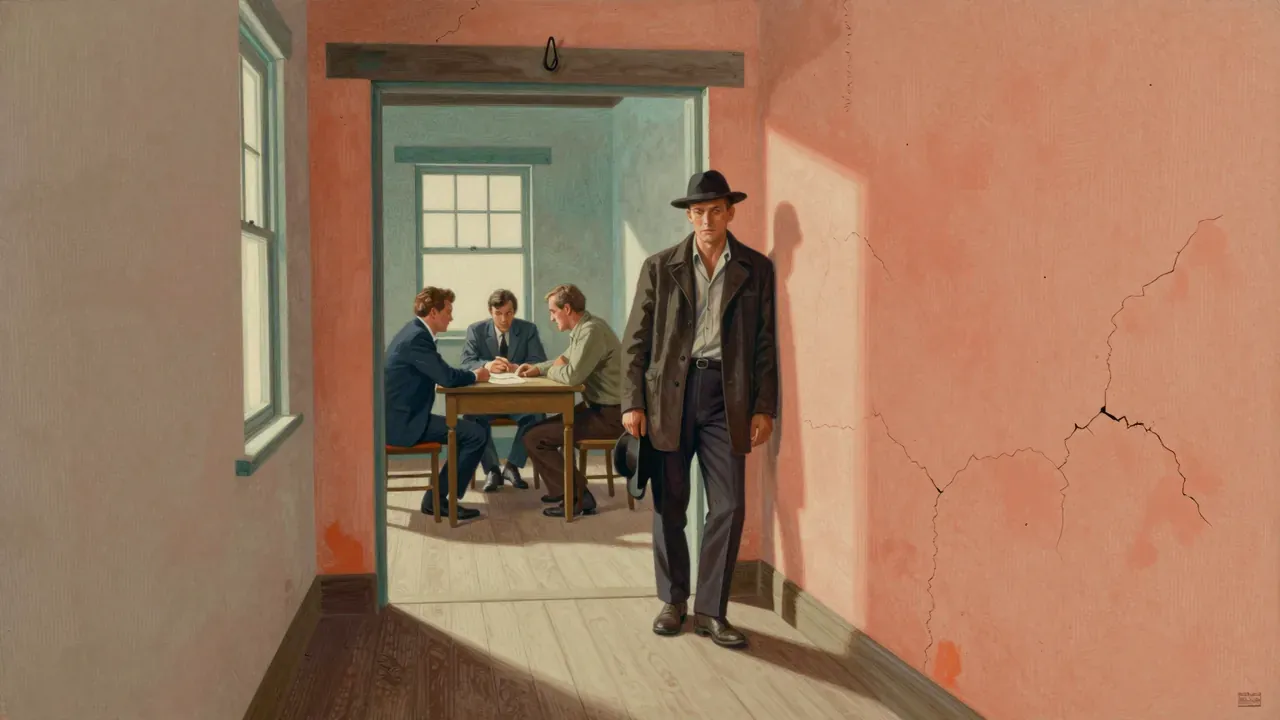
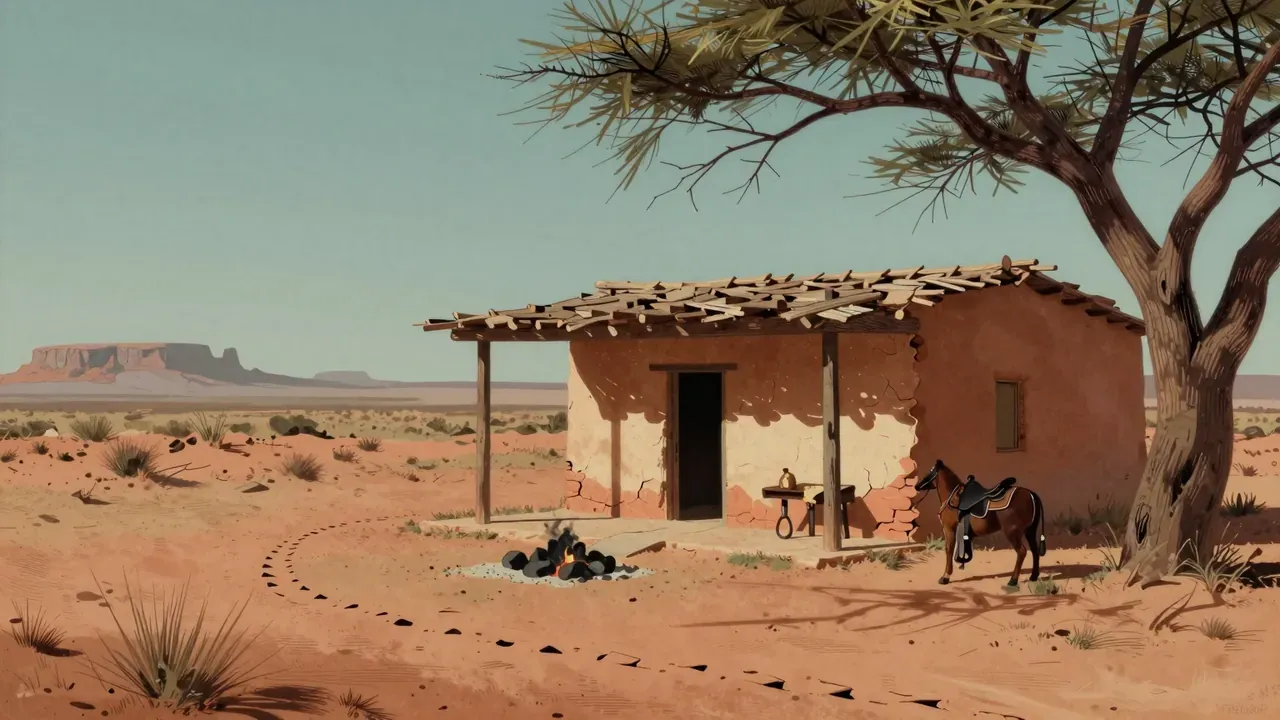
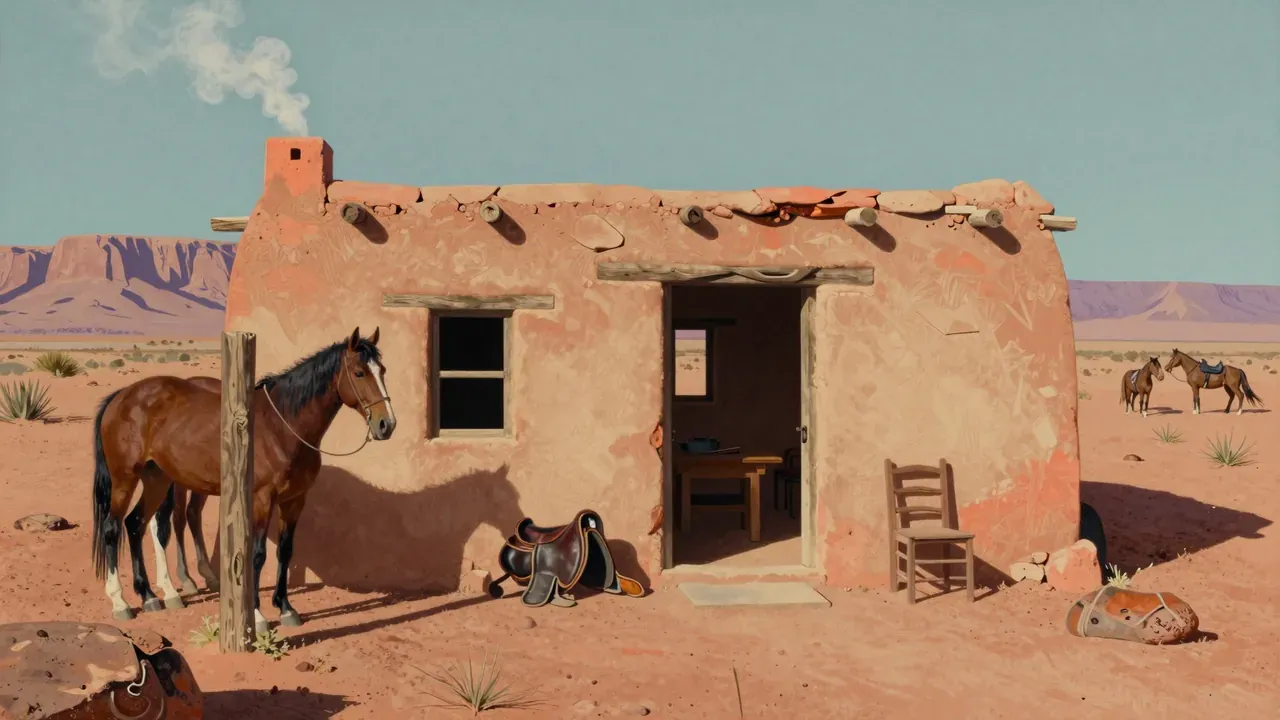
The story moves in deliberate, unadorned steps: bounty hunter Ben Brigade captures Billy John, then becomes entangled with two outlaws, Sam Boone and Whit, at a remote swing station overrun by Mescalero raiders. Karen Steele’s Carrie Lane enters armed and wary; James Coburn and Pernell Roberts appear as Billy’s gang — Coburn in his first film role, Roberts as the more volatile partner. Charles Lawton Jr.’s cinematography keeps the desert light hard and unflattering, the interiors of the adobe shack and station sparse and shallow in focus. Jerome Thoms’ editing sustains rhythm through repetition — the same gestures, the same glances, the same tightening of hands — rather than acceleration. Heinz Eric Roemheld’s score is functional, never intrusive, using brass and strings to mark shifts in intent rather than emotion. Performances are restrained: Scott’s Brigade speaks little and moves less, his stillness calibrated against Coburn’s loose-limbed watchfulness and Roberts’ simmering impatience. Boone (Pernell Roberts) and Whit (Lee Van Cleef) are given room to suggest history without exposition. Word count: 156.
The pace of it
What lands is the film’s unwavering control over tone and tempo. Every line of dialogue serves either exposition or subtext, never both at once — and often neither, leaving silence to do the work. The sequence at the adobe shack, where the group defends themselves against the Mescaleros, gains force from its lack of heroics: shots are fired, people fall, Carrie kills the chief not with flourish but with a single, decisive pull of the trigger. The hanging tree sequence works because it arrives without fanfare: Brigade’s motive is revealed late, his method is procedural, and the violence is abrupt, not cathartic. Even the fire at the end feels less like symbolism than erasure — an act of closing, not commentary. The film trusts its actors to carry weight without speech: Van Cleef’s quiet competence, Coburn’s effortless physical ease, Steele’s gradual shift from suspicion to grim complicity. There is no false uplift, no sentimental concession — the characters live within consequences, not beyond them. That consistency of register, across seventy-three minutes, is rare in studio-era Westerns. Word count: 152.
The gaps in it
What does not land is the attempt to invest Carrie Lane with interiority beyond her function as witness and catalyst. Her grief over her husband’s death is established in a single moment — the recognition of his horse — and then absorbed into the group’s forward motion without further reflection. Her moral objections to Brigade’s trade in lives are voiced once, then dropped; she does not evolve, nor is she asked to. The film gives her a rifle and a voice, but not a trajectory. Similarly, the amnesty bargain Boone and Whit propose lacks grounding: we are told it exists, but not how it operates, who grants it, or why it matters beyond plot convenience. The Mescalero Indians remain purely functional — a threat without language, motivation, or variation. Their presence serves the structure, not the world. These omissions are not flaws of execution but of scope: the film chooses not to explain, and sometimes that choice reads less like discipline than omission. A viewer expecting psychological depth or cultural texture will find neither. Word count: 150.
The weight of it
The themes that matter are accountability, performance of justice, and the cost of self-containment. Brigade is not avenging a wife so much as enforcing a standard he failed to uphold as sheriff — his pursuit is less personal than procedural, a reassertion of order he once embodied and lost. Boone and Whit represent a different kind of contract: their desire for amnesty is not repentance but renegotiation — an attempt to exchange one set of rules for another. Billy John is neither villain nor victim, but a hinge: his body carries the price, his death the terms. The film treats law not as codified system but as shifting agreement between armed men — enforced by proximity, not principle. Landscape reinforces this: the desert offers no shelter, no concealment, no moral high ground — only exposure. Even the cross that Boetticher mentions in interviews is absent from the finished film; what remains is the tree, stripped bare, its meaning unspoken but legible. There is no theology here, only cause and effect, delayed but inescapable. Word count: 149.
The audience for it
This film is for viewers who value precision over spectacle, restraint over revelation, and moral ambiguity over resolution. It suits those familiar with mid-century Westerns — particularly the Ranown cycle — and those willing to sit with silences that do not resolve into epiphany. It is not for viewers who require character backstories, emotional exposition, or narrative closure that soothes rather than unsettles. Anyone expecting the mythic sweep of Ford or the operatic violence of Peckinpah will find Ride Lonesome too lean, too dry, too unwilling to translate its tensions into grand statement. Those who dislike films where music does not cue feeling, where landscapes do not symbolise, and where revenge does not cleanse will leave unsatisfied. A viewer who values psychological realism over structural rigour would likely prefer Decision at Sundown or Comanche Station — both looser, more discursive. Word count: 147.
The time it takes
Yes, it is worth your evening — provided you approach it as a tightly wound mechanism rather than a story waiting to unfold. Its seventy-three minutes pass without drag because every shot, every pause, every line has been placed to serve the central question: what happens when men with incompatible ends are forced to share a path? It rewards attention to gesture, to framing, to the weight of a glance held a beat too long. It is not a film to stream while distracted; it demands the kind of viewing that notices when Lawton lowers the camera to frame Scott’s boots before he draws, or when Thoms cuts to Coburn’s face just after a decision is made, not before. Those who dismiss it as ‘minimalist’ or ‘cold’ miss its quiet insistence on consequence — a quality increasingly rare in contemporary genre filmmaking. Word count: 148.