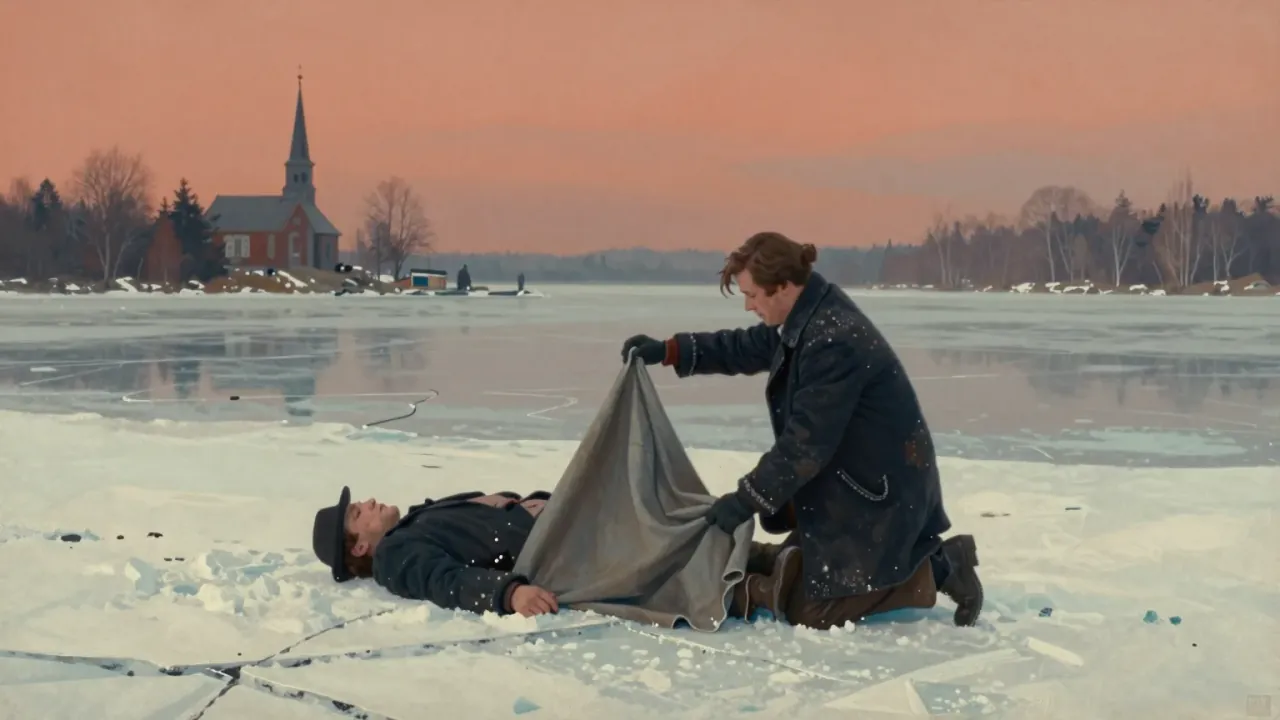
The look of it
Shame is a Swedish civil-war drama set on a rural island, written and directed by Ingmar Bergman in 1967 and released in early 1968. It follows Jan and Eva Rosenberg — former violinists turned farmers — as their isolation unravels under the pressure of armed conflict, arbitrary authority, and moral collapse. Bergman described it as an attempt to depict a ‘little war’: not one with declared ideologies or front lines, but a peripheral, chaotic eruption that exposes how quickly civility, intimacy, and self-regard dissolve when power becomes capricious and survival conditional. The film avoids naming sides, dates, or causes; its war is ambient, unexplained, and psychologically invasive. Its aim is not documentary realism nor political allegory, but anatomical precision: to trace shame not as a feeling but as a structural failure — of language, loyalty, memory, and the body’s capacity to hold itself together. It treats war not as event but as atmosphere, settling into silence, hesitation, and withheld glances long before the first explosion. Bergman shot it on Fårö, using miniature models for battle scenes and handheld camerawork for disorientation — choices that reinforce its focus on subjective erosion rather than spectacle. (159 words)
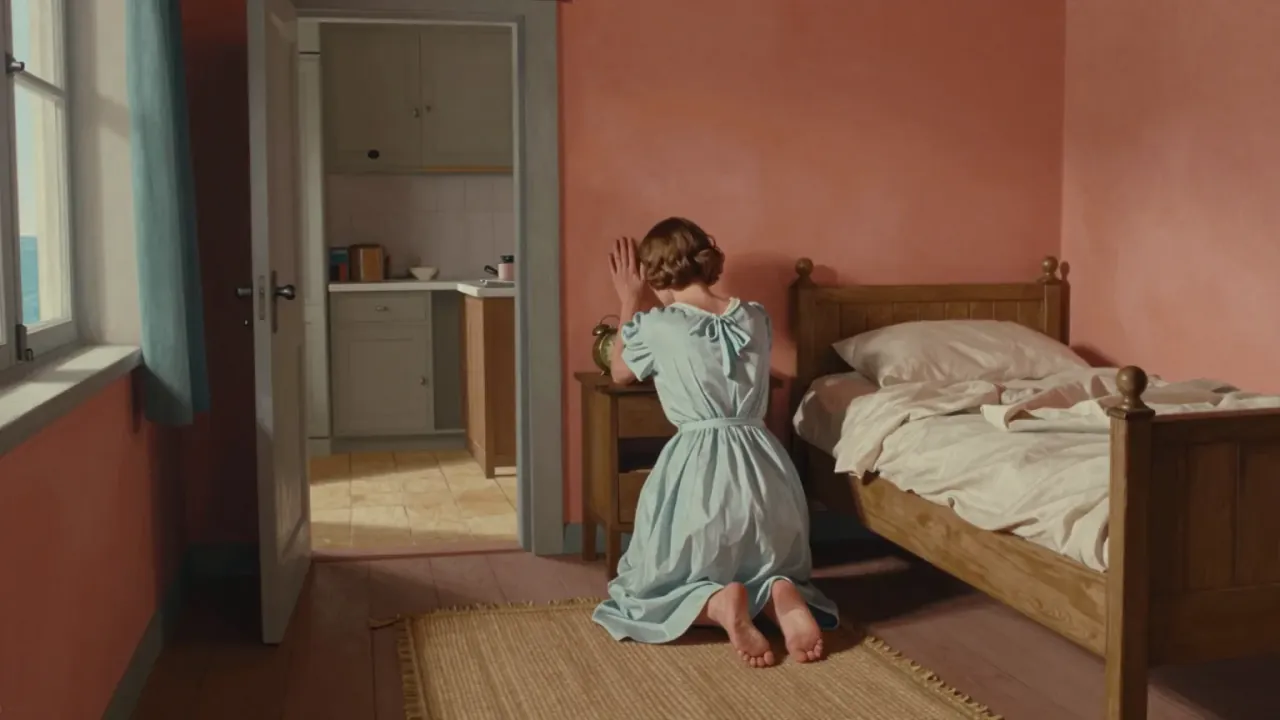
The way they move
The story unfolds through accumulation, not exposition: radio static, burnt churches seen in miniature, a paratrooper descending silently onto a roof, Eva’s voice overdubbed without her consent. Liv Ullmann and Max von Sydow perform with minimal inflection, their restraint making each suppressed flinch or delayed blink legible as crisis. Sven Nykvist’s cinematography keeps interiors dim and exteriors bleached, favouring tight frames and shallow focus that trap characters in corners of the frame or behind glass. The editing by Ulla Ryghe sustains a rhythm of interruption — cuts that land just before resolution, pauses that outlast comfort. Bach’s music appears only diegetically: a few fragmented phrases from a gramophone, then silence. There are no score swells, no leitmotifs — only absence, which makes the moments when sound returns (a cough, a dropped cup, a zipper) feel like violations. The war scenes use trompe-l’œil and forced perspective, refusing immersion in favour of persistent artifice. This is not evasion but method: the miniature flames and toy tanks insist that what matters is not the war’s scale, but how easily it colonises the domestic — the greenhouse, the bedroom, the breakfast table. (158 words)
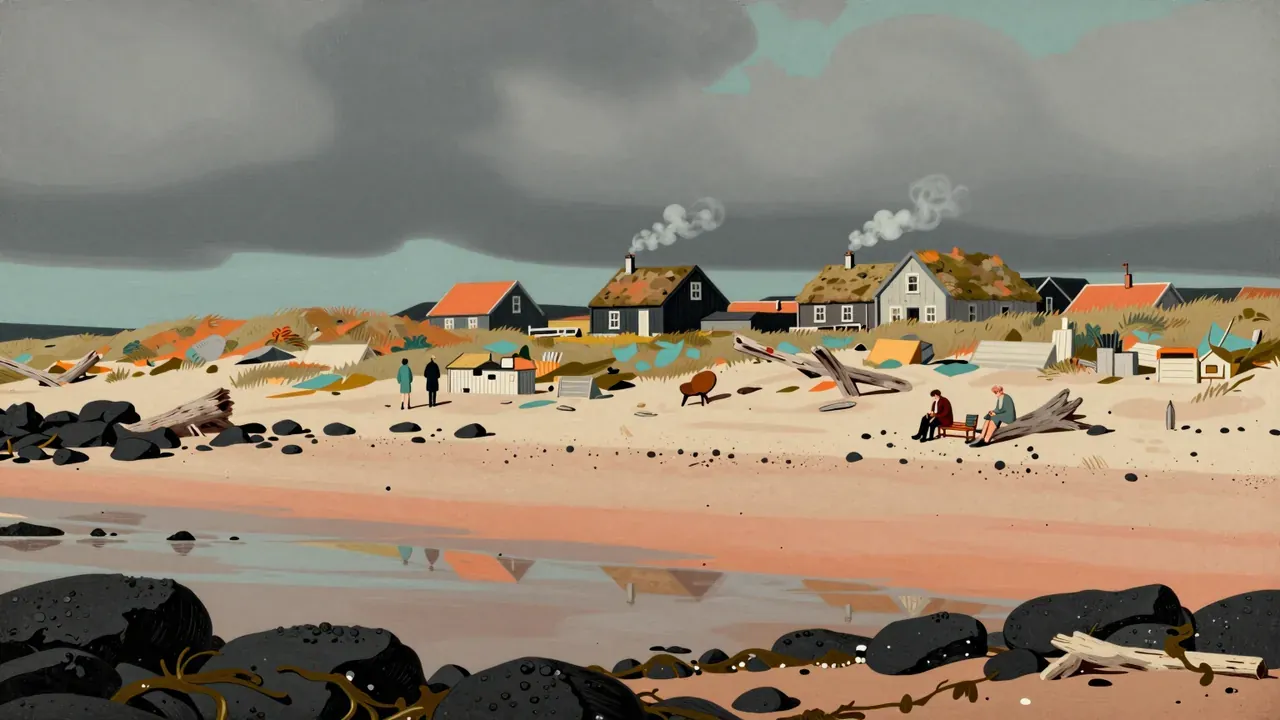
Where it hits
What lands is the suffocating proximity of degradation. The scene where Eva and Jacobi have sex in the greenhouse while Jan sleeps nearby does not rely on exposure or gesture; it lands because of the camera’s refusal to cut away, and because Ullmann holds Eva’s face in a neutral mask until the moment she turns to Jan and delivers her line about sobbing — not as cruelty, but as exhausted administrative fact. The execution of Jacobi works because it is preceded by silence, not tension: Jan’s hand trembles not from fear but from the weight of having withheld the money, and his act feels less like vengeance than surrender to a logic he has already internalised. The final boat sequence lands not through action but stasis — the motor failing, the suicide, the raft adrift among corpses — all rendered without commentary or musical cue. These moments succeed because they refuse to name emotion, instead trusting the viewer to register shame as posture, as delay, as the space between a question and its answer. The film’s power resides in what remains unsaid, unshown, and unreconciled — particularly Eva’s dream of burning roses, which lingers not for its beauty but for its quiet, unresolvable contradiction: devastation remembered as calm. (157 words)
What slips away
What does not land is the film’s framing of political neutrality as moral vacancy. The script insists Jan and Eva are apolitical Social Democrats who subsidise culture, yet gives them no political vocabulary, no reference points beyond vague frustration and private despair. Their debates about having children or escaping feel emotionally real but thematically thin — less existential inquiry than placeholder dialogue. The war’s opacity, while deliberate, begins to read as evasion when no character articulates even basic suspicion, strategy, or rumour beyond ‘they’re coming’. The miniature effects, though conceptually sound, occasionally break immersion: a stream made to look like a river by tilting the camera reads as stagey rather than symbolic. More damagingly, the film’s refusal to locate the conflict geographically or historically leaves its violence unmoored — not universal, but vague. Some viewers will find this generative; others will find it evasive, especially given Bergman’s contemporaneous statements about Vietnam. The film assumes a shared cultural literacy about Swedish postwar consensus that non-Scandinavian audiences may lack, and offers no compensatory texture. Its austerity becomes asceticism, then abstraction — and abstraction without scaffolding risks emptiness. (156 words)
What it’s really about
The themes that matter are shame as contagion, not confession; violence as habit, not rupture; and silence as complicity that cannot be undone. Shame here is not tied to sin or transgression, but to the erosion of self-witness — when Jan cannot name what he has done, or Eva cannot recall what she was meant to remember, the failure is epistemological, not ethical. The film treats moral decline not as a fall but as slow sedimentation: each small compromise — Eva’s compliance, Jan’s withheld money, their mutual refusal to speak plainly — settles like silt, altering the ground beneath them. War is not the cause but the accelerant: it reveals how readily intimacy becomes surveillance, care becomes transaction, and love becomes a ledger of debts. The violin past is not nostalgia but evidence of a self that could once coordinate with another — now replaced by a body that moves independently, reacts unpredictably, and forgets its own rhythms. The recurring motif of failed communication — broken radios, dubbed interviews, misheard rumours — suggests language itself is the first casualty, leaving only gesture, silence, and the physical residue of decisions made too late. (159 words)
Who it’s for
This film is for viewers who trust ambiguity as rigour, who find emotional resonance in withheld information and narrative gaps, and who accept that some questions — why the war began, whose side Jacobi is really on, whether Eva’s dream is prophecy or memory — are left open not from laziness but design. It rewards patience with stillness, attention to micro-expression, and tolerance for extended sequences where nothing changes except light and breathing. It is not for viewers who require clear stakes, causal logic, or catharsis — those who expect war films to clarify sides, assign blame, or resolve trauma will find Shame withholding to the point of obstruction. Some critics argue its moral landscape is too bleak to sustain engagement; others say its refusal to offer redemption is its honesty. A different verdict would follow if Bergman had anchored the conflict in tangible social detail — a specific party platform, a named militia, even a single newspaper headline — but he chose not to, and that choice defines the film’s limits as well as its power. (158 words)
Is it worth your evening
Yes, it is worth your evening — but only if you arrive prepared to sit with discomfort without resolution. It demands full attention, not passive viewing; its 103 minutes unfold at the pace of breath held too long, and its rewards are cumulative, not immediate. The film earns its duration through sustained tonal control and psychological fidelity, not plot turns or revelation. Those who leave dissatisfied often expected a war film in the conventional sense — one that explains, condemns, or memorialises — rather than one that studies how war reshapes the grammar of daily life. Its value lies in its refusal to simplify: Eva’s final line about the burning roses is neither hopeful nor despairing, but lucidly contradictory — and that contradiction is the point. To call it ‘difficult’ mistakes its method for its message. It is not obscure; it is exacting. If you value films that treat human fragility as a condition to be observed, not solved, then Shame repays every minute. If you need narrative propulsion or moral clarity, it will frustrate. Its worth is absolute, but conditional. (159 words)