A product of the First Kaiju Boom
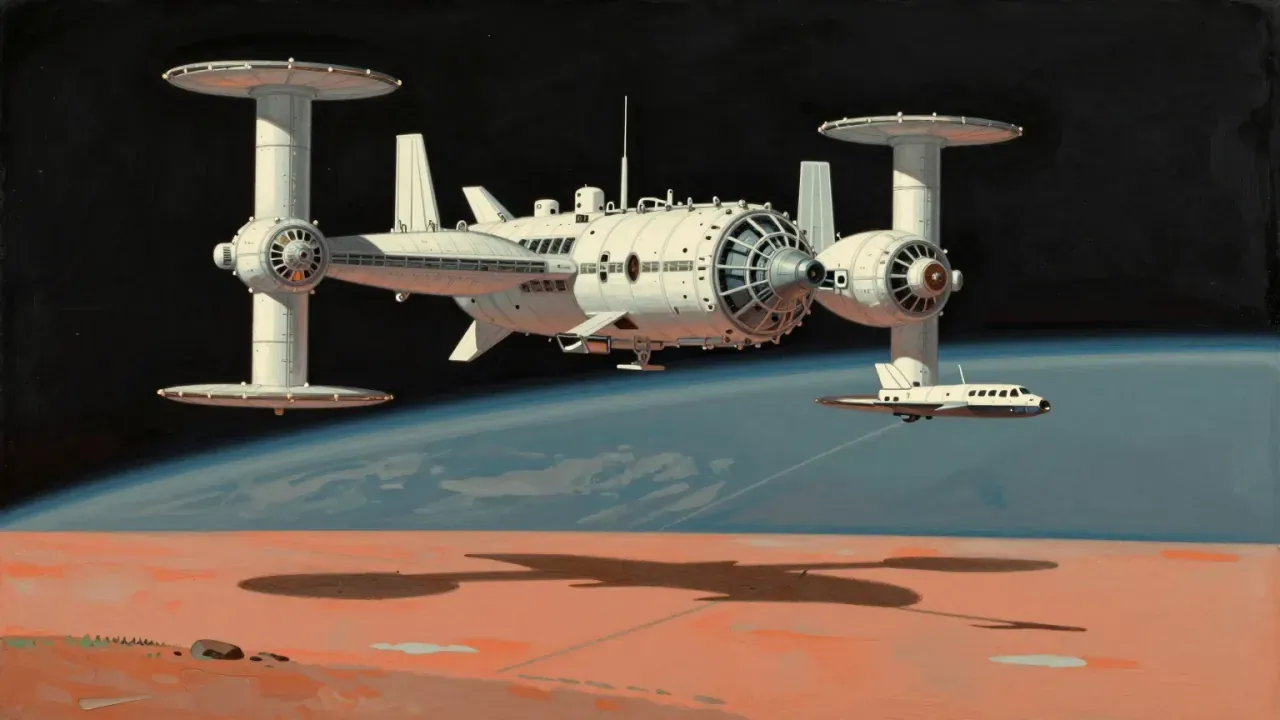
The X from Outer Space is a Japanese kaiju film from 1967, produced by Japan Tokusatsu Production and released by Shochiku. It belongs to the First Kaiju Boom — a state-supported wave of genre films intended to export Japanese pop culture and attract foreign currency. Its aim is straightforward: to deliver a science-fiction monster spectacle with interplanetary stakes, military response, and a creature that grows, consumes energy, and must be neutralised. It does not attempt psychological realism, narrative coherence, or thematic depth beyond the basic premise of cosmic intrusion. The film follows a standard tokusatsu template — a scientific expedition, accidental contamination, rapid escalation, and technocratic resolution — but leans into absurdity rather than gravitas. It treats its own logic as self-evident: spores become chicken-jet hybrids; acid catalyses gigantism; a substance called ‘Guilalanium’ reverses biology on contact. This is not irony or parody in intent, but a functional, low-budget genre exercise built for Saturday matinees and television syndication. Its ambitions are modest, procedural, and rooted in the industrial conditions of mid-1960s Japanese studio filmmaking — tight schedules, shared effects teams, tax-incentivised production. (158 words)
How it moves
The story moves briskly but without internal consistency: the AAB Gamma reaches Mars in days, returns with a single spore, and within hours it has mutated into a city-sized entity that flies like a comet and breathes fireballs. Performances are flat and functional — Eiji Okada as Dr. Kato delivers exposition with detached gravity, while Peggy Neal’s American scientist (dubbed in Japanese by Reiko Mutō) speaks lines that assume her character’s expertise without showing it. Kazui Nihonmatsu directs with minimal camera movement, favouring static medium shots and abrupt cuts between stock footage and live action. Eizo Kaimai’s Guilala suit is visibly stitched, its head a fibreglass jet nose bolted onto a feathered body; it moves stiffly, often obscured by smoke or flames. The score alternates jazzy bossa nova cues with brassy fanfares and theremin stings, never settling into tonal unity. Editing is pragmatic, not expressive: reaction shots linger too long, action sequences cut away before impact. There is no attempt at suspense or character rhythm — scenes exist only to advance the next plot beat or showcase another effect. The film’s craft is serviceable, not inventive: it uses what it has, when it has it, and fills gaps with music or narration. (159 words)
What sticks
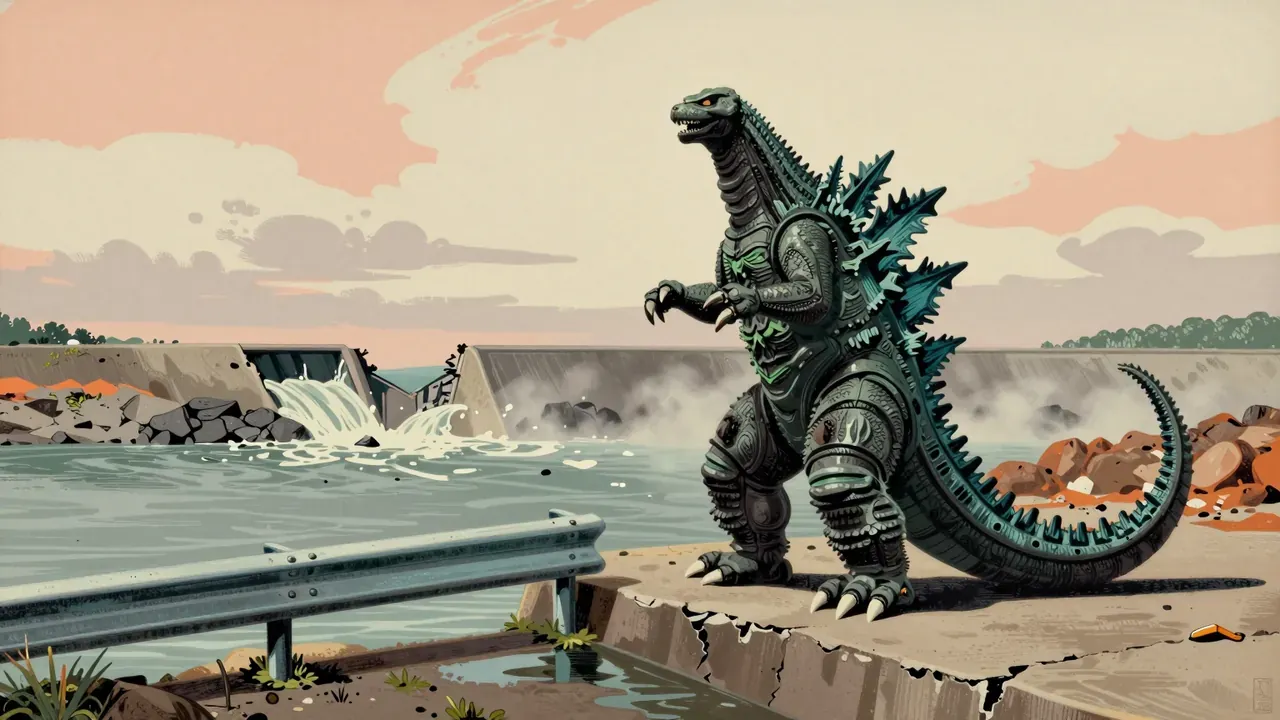
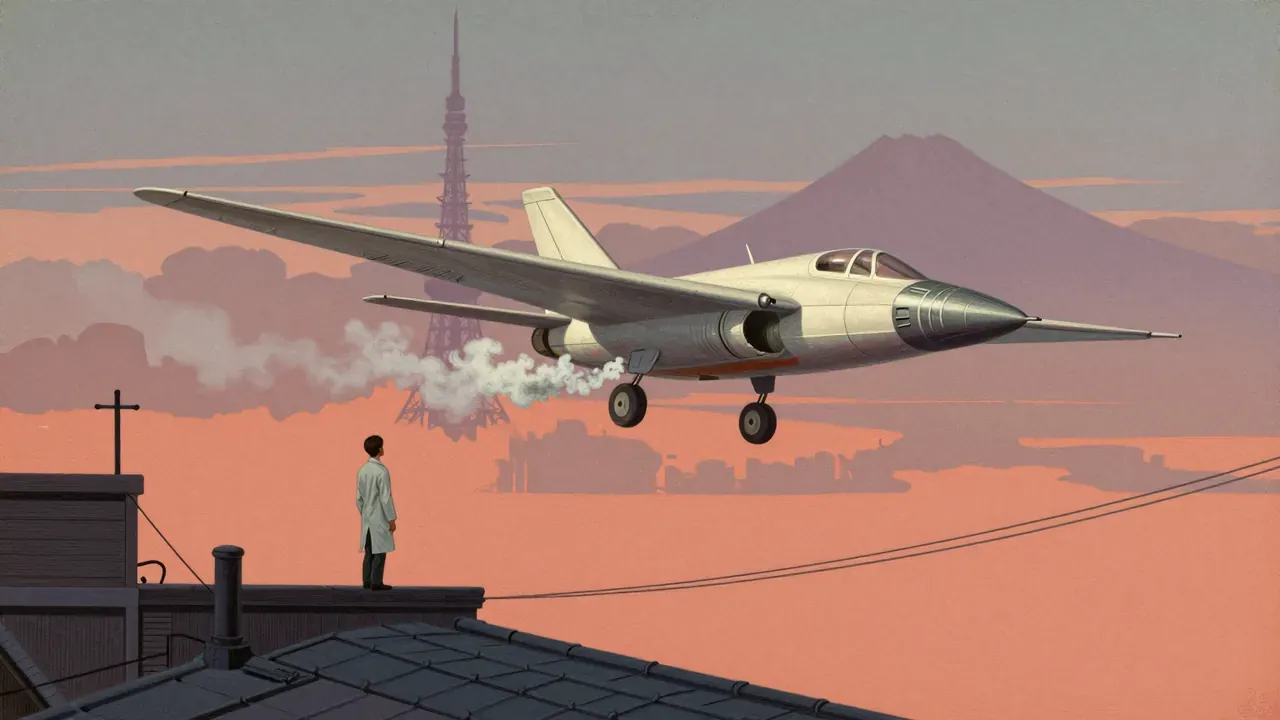
What lands is the sheer, unselfconscious audacity of Guilala itself — a creature that looks like a roasted turkey strapped to a Lockheed F-104, yet moves with the solemn weight of a national symbol. Its design, however clumsy, sticks: the wingless flapping, the head’s rigid forward tilt, the way it hovers just above rooftops before detonating a fireball. The film’s pacing also works — it never pauses to justify its leaps, so the viewer is carried along by momentum alone. The final sequence, where Guilala shrinks into a spore inside a glass vial before being launched into solar orbit, lands with deadpan bureaucratic finality: no fanfare, no reflection, just paperwork completed. The dubbing adds texture — Peggy Neal’s English dialogue, looped over Mutō’s Japanese track in the Criterion release, creates a mild dissonance that suits the film’s tone. Even the stock footage — reused later in Monster X Strikes Back — feels purposeful here: not lazy recycling, but economical world-building. The film’s charm lies in its refusal to apologise for its own logic, treating each absurd development as factually inevitable. It does not ask to be believed, only accepted — and on those terms, it holds attention. (157 words)
Where it gives way
What does not land is any sense of consequence or scale. Buildings topple without debris; tanks fire blank rounds that vanish before hitting Guilala; aircraft explode in silent bursts, then disappear from frame. The human characters remain emotionally inert — no grief, no fear, no exhaustion, even after Tokyo is half-destroyed. Dialogue serves only to name objects or state functions: ‘This is Guilalanium’, ‘It feeds on nuclear fuel’, ‘We must launch it into heliocentric orbit’. There is no subtext, no irony, no satire — just literalism pushed past breaking point. The science is not even metaphorical: acid exposure causes growth, but no other acid appears; Guilalanium disables energy absorption, though its composition, origin, and mechanism are never explained. The film’s visual grammar undermines itself — wide shots show miniature models, close-ups reveal visible seams, and matte lines waver across the sky. Attempts at gravitas collapse under scrutiny: a ‘moon base worker’ (Hiroshi Fujioka) appears for ten seconds and vanishes; Franz Gruber’s Dr. Berman is introduced, then never seen again. These are not quirks of style but failures of execution — omissions that leave the world feeling hollow, not surreal. (159 words)
The quiet machinery of control
The themes that matter are containment, bureaucracy, and the limits of technological control. Guilala is not evil, nor alien in motive — it simply consumes energy, grows, and moves. Its defeat is not heroic but administrative: scientists synthesise Guilalanium, engineers load it onto jets, officials approve orbital disposal. The film presents crisis management as a series of checkboxes, not moral choices. There is no critique of nuclear power, no anxiety about space exploration — only the assumption that problems have technical solutions, and that those solutions can be scaled, packaged, and launched. The international cast (Japanese, American, German scientists) signals postwar cooperation, but their nationalities are decorative, not political: no language barriers, no cultural friction, no diplomatic tension. The real subject is infrastructure — the labs, the airbases, the tracking stations — all functioning smoothly despite the absurdity of the threat. Even the monster’s origin is bureaucratic: it arrives via a government-funded mission, is studied in a state lab, and disposed of through a state-run space programme. The film’s quiet insistence is that systems endure, even when their inputs are nonsensical. (158 words)
Who it is for
This film is for viewers who value sincerity over polish, momentum over meaning, and tactile craft over digital slickness — people who find pleasure in the physical presence of a rubber suit, the hiss of mono soundtracks, the grain of 16mm stock footage. It rewards patience with texture: the stitching on Guilala’s chest, the way light catches the plastic cockpit of the jet-head, the deliberate slowness of a model train crossing a miniature railway bridge. It is not for those who require narrative causality, emotional investment, or visual continuity — viewers who expect cause-and-effect logic, consistent world rules, or character arcs will find it frustrating. Some critics dismiss it as ‘so bad it’s good’, but that misreads its intent: it was never trying to be good in that sense. Those who demand thematic resonance or formal rigour will leave unsatisfied. A viewer who values craftsmanship in constraint — who sees art in limitation — may find more here than in many higher-budget films. But if your threshold for narrative coherence is low, or if you dislike extended sequences of men in lab coats staring at dials, this will not hold you. (159 words)
Why it endures
Yes, it is worth your evening — provided you watch it as a document of its moment, not as entertainment calibrated to current expectations. It occupies a precise niche: mid-1960s Japanese tokusatsu made under tax incentives, shaped by Tsuburaya’s uncredited effects team, released to fill cinema seats and later TV slots. Its pleasures are historical, material, and rhythmic — the clunk of a model landing, the syncopation of a bossa nova cue against a fireball, the quiet pride in a miniature Tokyo that stands up to being crushed. It is not ‘so bad it’s good’; it is exactly as good as it needed to be. Anyone expecting modern pacing, character depth, or visual fidelity will be disappointed — but that is not the film’s failure. It succeeds on its own terms: as a functional, earnest, slightly ungainly piece of industrial pop. To call it ‘worthwhile’ is not to endorse its logic, but to acknowledge its integrity as an artefact — one that, unlike many of its peers, has aged not into obscurity but into a kind of gentle, enduring specificity. (159 words)