filmbriefs
Director · Screenwriter · Producer

Kenji Mizoguchi

9
briefs
13:00
average
117 min
in total
On film.briefs9
13:00

Osaka Elegy

Kenji Mizoguchi · 1936

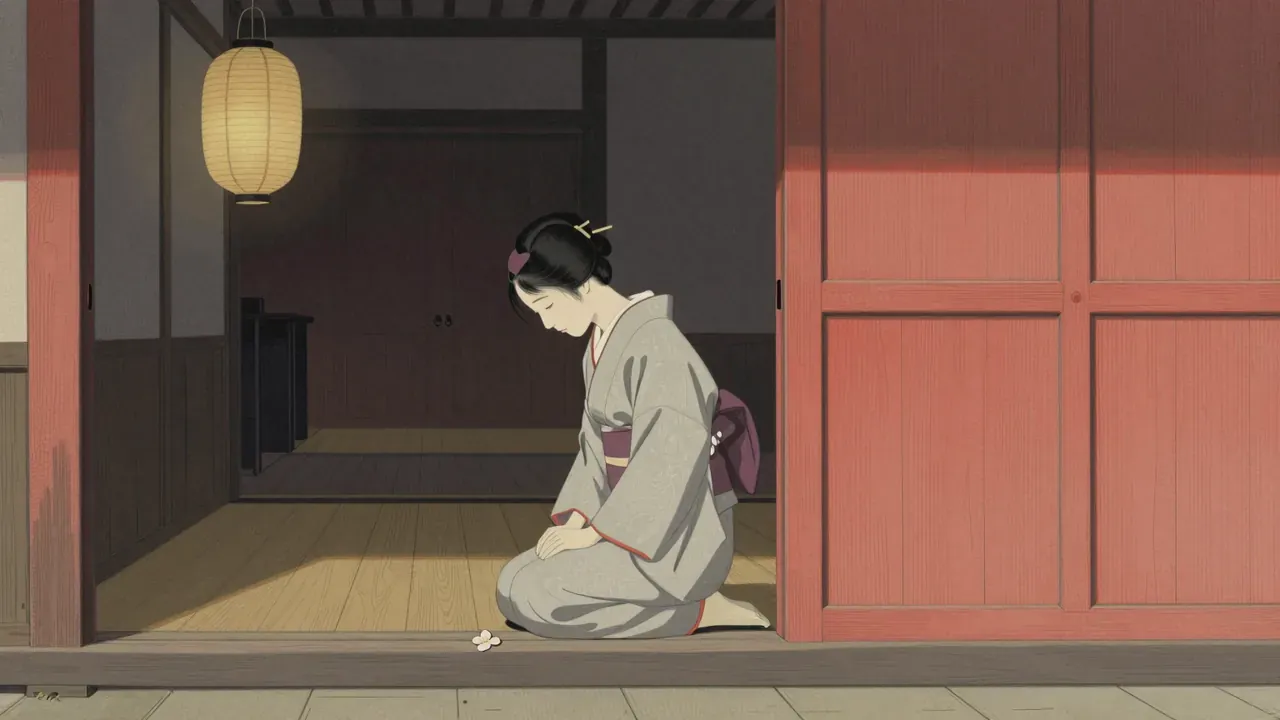
A 1936 Japanese drama directed by Kenji Mizoguchi, following telephone operator Ayako Murai as she navigates debt, exploitation and social censure in Osaka. With Isuzu Yamada in a defining early role, the film traces how family, workplace and law converge to strip her of autonomy — not through violence, but through quiet, systemic pressure. Shot by Minoru Miki and written by Mizoguchi and Yoshikata Yoda, it is a tightly controlled, unsentimental study of gendered constraint.
13:00

Sansho the Bailiff

Kenji Mizoguchi · 1954

Kenji Mizoguchi’s 1954 jidai-geki follows two siblings sold into slavery after their father’s exile. Anchored by Kazuo Miyagawa’s deep-focus long takes and Fumio Hayasaka’s sparse score, it traces Zushiō’s moral fracture and slow reassembly around his father’s injunction: 'Without mercy, man is like a beast.' Its power resides in physical precision — a statuette’s grooves, a lake’s surface, a mother’s blind fingers — not exposition or catharsis.

13:00

Sisters of the Gion

Kenji Mizoguchi · 1936

Kenji Mizoguchi’s 1936 Sisters of the Gion follows two geisha sisters in Kyoto’s Gion district whose opposing strategies for survival — one rooted in loyalty, the other in calculation — both collapse under economic and social pressure. Shot in restrained black-and-white by Minoru Miki, it uses long takes, precise blocking and sparse dialogue to trace how patronage, class and gender function as interlocking systems of control. Adapted from Aleksandr Kuprin’s Yama: The Pit, it forms a diptych with Osaka Elegy and marks Mizoguchi’s artistic maturity.

13:00

Street of Shame

Kenji Mizoguchi, Yasuzō Masumura · 1956

Street of Shame (1956), Kenji Mizoguchi’s last film, follows five women working in a Tokyo brothel as Japan debates abolishing licensed prostitution. With restrained performances, Kazuo Miyagawa’s unemphatic cinematography, and Masashige Narusawa’s faithful adaptation of Yoshiko Shibaki’s novel, it treats prostitution not as moral failure but as labour embedded in debt, family duty, and social exclusion. The film ends not with liberation but with continuity: a young maid begins her first day as a prostitute. Its power lies in its refusal to dramatise change — or to pretend it is imminent.

13:00

The Crucified Lovers

Kenji Mizoguchi · 1954

Kenji Mizoguchi’s 1954 drama adapts Chikamatsu’s 1715 play into a precise, unsentimental study of love and law in feudal Kyoto. Mohei, an apprentice scroll-maker, and Osan, his employer’s wife, flee after a forgery and alleged adultery, pursued not by passion but by property, debt and collective punishment. Shot by Kazuo Miyagawa in long, unbroken takes, the film treats morality as infrastructure — not belief, but rent, reputation and ritual.

13:00

The Life of Oharu

Kenji Mizoguchi · 1952

Kenji Mizoguchi’s 1952 film follows Oharu, a noblewoman whose life disintegrates after a forbidden romance, forcing her through successive roles — concubine, courtesan, servant, wife, nun, prostitute — each ending in expulsion. Adapted from Ihara Saikaku, it uses long takes, restrained performance, and sparse design to trace how Edo-period Japan’s hierarchies erase women not with violence but with quiet, repeated exclusion.

13:00

The Story of the Last Chrysanthemum

Kenji Mizoguchi · 1939

Kenji Mizoguchi’s 1939 film follows Kikunosuke Onoe, an onnagata striving to master his craft in Meiji-era Japan. His progress is inextricable from Otoku, the wet nurse who becomes his critic, partner, and eventual sacrifice. Shot in extended takes by Minoru Miki and written by Shōfū Muramatsu and Yoshikata Yoda, the film charts fourteen years of ambition, exile, and quiet endurance — culminating not in reconciliation but in belated recognition, delivered too late to alter outcome.

13:00

Ugetsu

Kenji Mizoguchi · 1953

Kenji Mizoguchi’s 1953 Ugetsu adapts two Edo-period ghost tales into a quiet, devastating portrait of war’s domestic toll. Set in 16th-century Japan, it follows a potter who abandons his wife for wealth and prestige, only to be ensnared by a spirit, while his brother-in-law pursues samurai status at his wife’s expense. Shot by Kazuo Miyagawa in low light and fluid crane movements, with a sparse, harp-accented score by Fumio Hayasaka, the film treats the supernatural not as spectacle but as consequence — a formal and thematic extension of loss. It won the Silver Lion at Venice and remains a benchmark of Japanese arthouse cinema.

13:00

Women of the Night

Kenji Mizoguchi · 1948

Kenji Mizoguchi’s Women of the Night (1948) follows three women in post-war Osaka as each enters prostitution under distinct but converging pressures: infant mortality, syphilis, police raids, and familial rejection. Shot on location with Kinuyo Tanaka in a restrained, physically grounded performance, it avoids melodrama in favour of structural clarity — showing how poverty, gendered law, and institutional neglect produce outcomes with clinical precision. Though some characters remain schematic and its pacing resists modern expectations, its rigour and historical immediacy make it a vital, unsentimental reckoning with survival.