The ground it stands on
Drunken Angel is a postwar Japanese drama set in the rubble-strewn, black-market fringes of Osaka, where a tubercular yakuza enforcer and an alcoholic physician circle each other in mutual contempt and reluctant care. Akira Kurosawa wrote it with Keinosuke Uekusa as a direct response to the visible rise of organised crime in occupied Japan — not as myth or stylised ritual, but as a public health crisis, a moral infection spreading through poverty and institutional collapse. The film’s central sump — a stagnant, open cesspool near the doctor’s clinic — is neither metaphor nor set dressing: it is the literal and symbolic ground on which the story stands, a site of contamination, stagnation, and failed renewal. Kurosawa intended the film to denounce the yakuza’s growing social foothold, but he refused caricature: Matsunaga is neither noble nor irredeemable, Sanada neither heroic nor sober. Their conflict is grounded in physiology, habit, and class — not ideology or honour codes. It is a film about what happens when authority collapses, and the only people left to enforce consequence are broken ones.
The look of it
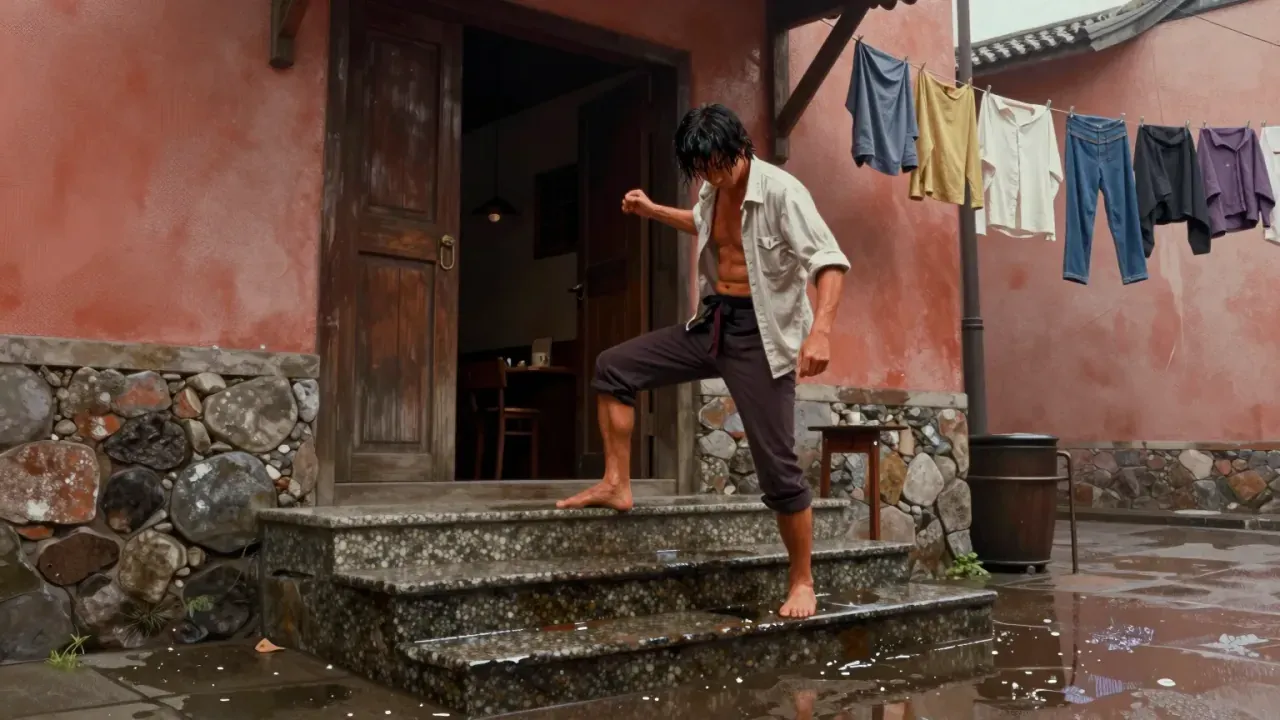
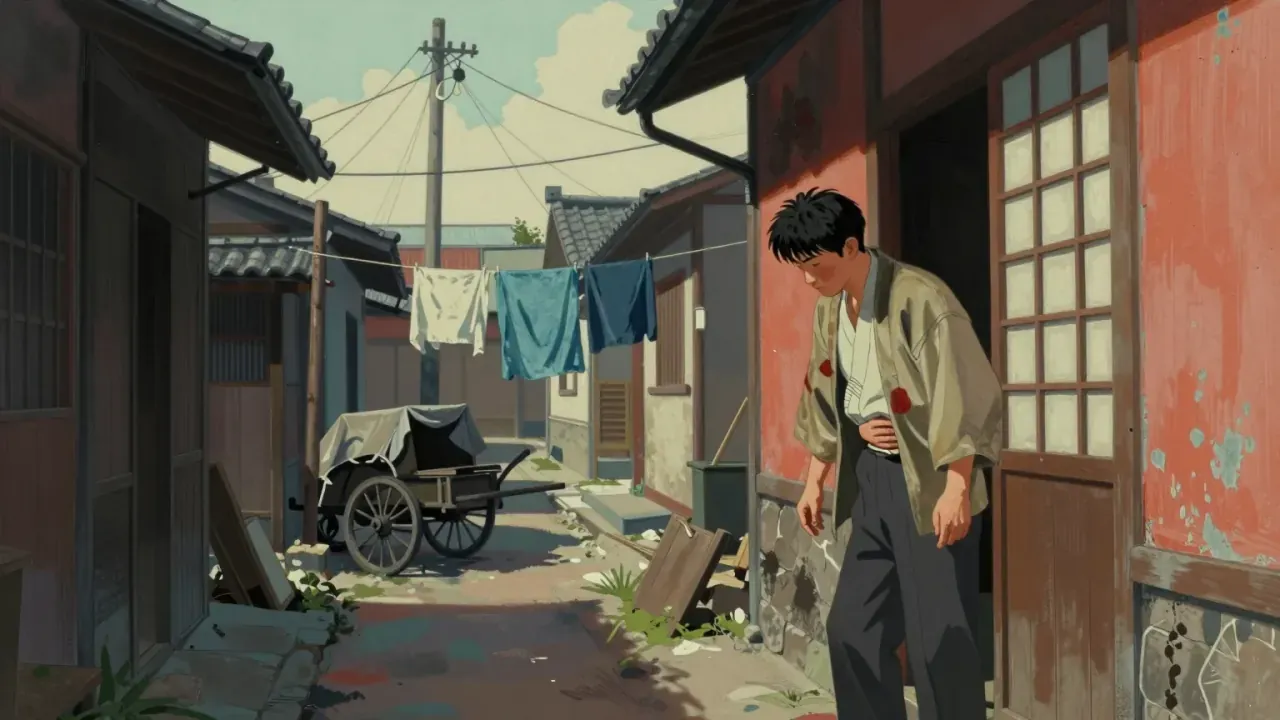
The story unfolds in tight, unembellished episodes: Matsunaga’s diagnosis, his expulsion from the syndicate, his descent into paranoia and violence, Sanada’s repeated interventions, and the final confrontation beside the sump. Takashi Shimura plays Sanada with physical weariness and quiet precision — his hands tremble, his posture slumps, his voice rarely rises above a rasp. Toshirō Mifune’s Matsunaga is all nervous energy: jerking limbs, darting eyes, sudden laughter that cuts off like a snapped wire. Takeo Itō’s cinematography keeps the black market street low-contrast and humid, the clinic interiors shadowed and cramped, the sump itself filmed at eye level, never romanticised. Fumio Hayasaka’s score uses jaunty waltzes ironically — ‘The Cuckoo Waltz’ underscores Matsunaga’s humiliation — while silence dominates the scenes between Sanada and his patient. Editing by Akikazu Kōno avoids rhythm for its own sake; cuts land where breath stops, not where emphasis demands. There is no music cue for the death scene. No slow motion. No close-up on the face at the end — just the body, the water, the mud.
What sticks
What lands is the film’s unrelenting physicality: the coughs, the sweat, the way Matsunaga clutches his side when the pain flares, the way Sanada’s fingers fumble with a syringe after a drink. The sump works because it is never explained — it simply exists, reappearing without commentary, its presence felt more than seen. Shimura’s performance lands because it refuses dignity: his doctor is not wise or saintly, but stubborn, irritable, and professionally isolated. Mifune lands because he makes Matsunaga’s volatility legible as fear, not temperament — his outbursts read as symptoms, not character flaws. The film’s moral weight comes not from speeches but from repetition: the same alley, the same clinic door, the same sump, each return tightening the sense of inevitability. Even the censorship compromises — the removal of suicide references, the softened ending — do not blunt the film’s force, because its gravity resides in gesture and setting, not exposition. The film’s restraint is its strength: it shows damage, then shows it again, then shows it one last time, differently.
Where it slips
What does not land is the secondary plot involving the young woman, Nanae, whose function remains underdeveloped — she appears as a narrative placeholder for Matsunaga’s lost innocence, but her agency evaporates once her role shifts to passive witness. Yoshiko Kuga’s performance is measured and sincere, yet the script gives her little to do beyond reacting. Nor does the subplot involving the rival gangster Okada cohere: his menace feels schematic, his motivations vague, and his scenes lack the textural density of the central duet. The film’s pacing also stumbles in its middle third, where Matsunaga’s internal decline is conveyed through repetition rather than progression — the same arguments, the same refusals, the same walk past the sump — which risks monotony without deeper variation in tone or framing. Some viewers may find the absence of resolution frustrating: there is no reckoning, no reform, no catharsis beyond the sump’s quiet, indifferent surface. That is deliberate, but it is not universally persuasive — those expecting narrative closure or moral symmetry will leave unsatisfied.
What it’s really about
The themes that matter are contagion and complicity. Not just tuberculosis, but the transmission of self-destruction — how Matsunaga absorbs the syndicate’s values even as it discards him, how Sanada enables his patient’s survival while refusing to confront his own addiction. The film treats illness as social, not individual: the sump is not a symbol of moral decay so much as infrastructure failure — a literal void where public health should be. Class is rendered physically: Sanada lives above his clinic, Matsunaga sleeps in a room with three other men, Nanae works in a bar that doubles as a brothel. Occupation-era censorship forced Kurosawa to excise explicit references to suicide and prostitution, but the film’s critique of systemic neglect remains intact — it is visible in the cracked pavement, the uncollected trash, the children playing on the edge of the sump. The film’s humanism is qualified: it asks not whether people are good or bad, but whether they can act meaningfully within structures designed to exhaust them.
Who it’s for
This film is for viewers who value psychological realism over plot mechanics, who respond to performances built in micro-gestures rather than monologues, and who accept that moral clarity often arrives too late — or not at all. It suits those familiar with mid-century Japanese cinema’s pacing and restraint, or those willing to adjust their expectations of narrative propulsion. It is not for viewers who require exposition, redemption arcs, or visual polish: the grain is coarse, the lighting flat, the endings abrupt. Those expecting genre thrills — gunfights, chases, gang wars — will find little here beyond tense standoffs and one violent, off-screen beating. Nor is it for those allergic to ambiguity: the film offers no verdict on Sanada’s alcoholism, no explanation for Matsunaga’s loyalty to a system that abandons him. A viewer who values thematic density over emotional payoff will find it rich; one who needs catharsis or uplift will find it withholding — and rightly so, given its subject.
Is it worth your evening
Yes, it is worth your evening — not as entertainment, but as calibration. Its 98 minutes recalibrate attention: you notice how light falls on a wet pavement, how a hand hesitates before touching a wound, how silence stretches after a lie. It rewards patience not with reward, but with precision — every frame serves its purpose, nothing is decorative. Some will argue it is too bleak, too static, too tied to its historical moment to resonate today. They are not wrong — its power depends on understanding postwar Japan’s material scarcity and moral exhaustion. But its concerns — the erosion of care, the normalisation of decay, the difficulty of resisting corruption when all institutions are compromised — remain legible. To skip it is to miss the origin point of Kurosawa’s mature style, the first full statement of his belief that character is revealed not in crisis, but in the small, repeated choices made while exhausted, ill, and out of options.