The shape of the beginning
The Lord of the Rings: The Fellowship of the Ring is a 2001 English-language fantasy film, produced in New Zealand by WingNut Films and released internationally on 19 December. It adapts the first volume of J. R. R. Tolkien’s 1954 novel, aiming to establish Middle-earth as a coherent, historically textured world rather than a succession of set pieces. Peter Jackson, Fran Walsh and Philippa Boyens structure it as both origin story and covenant: Frodo inherits the Ring not as a hero but as a reluctant steward; the Fellowship forms not through choice but necessity, binding nine characters across race, age and allegiance to one fragile task. Its ambition is structural and tonal — to sustain awe without sacrificing intimacy, scale without losing moral clarity, and mythic weight without slipping into abstraction. It treats Tolkien’s text not as scripture but as architecture: the script omits or compresses passages (the Council of Elrond runs shorter than the book’s chapter), yet retains its theological gravity — the Ring as object, burden, and test. It does not seek to explain evil but to show how it spreads, how resistance begins quietly, and why some choices cannot be unmade. (158 words)
The look of it
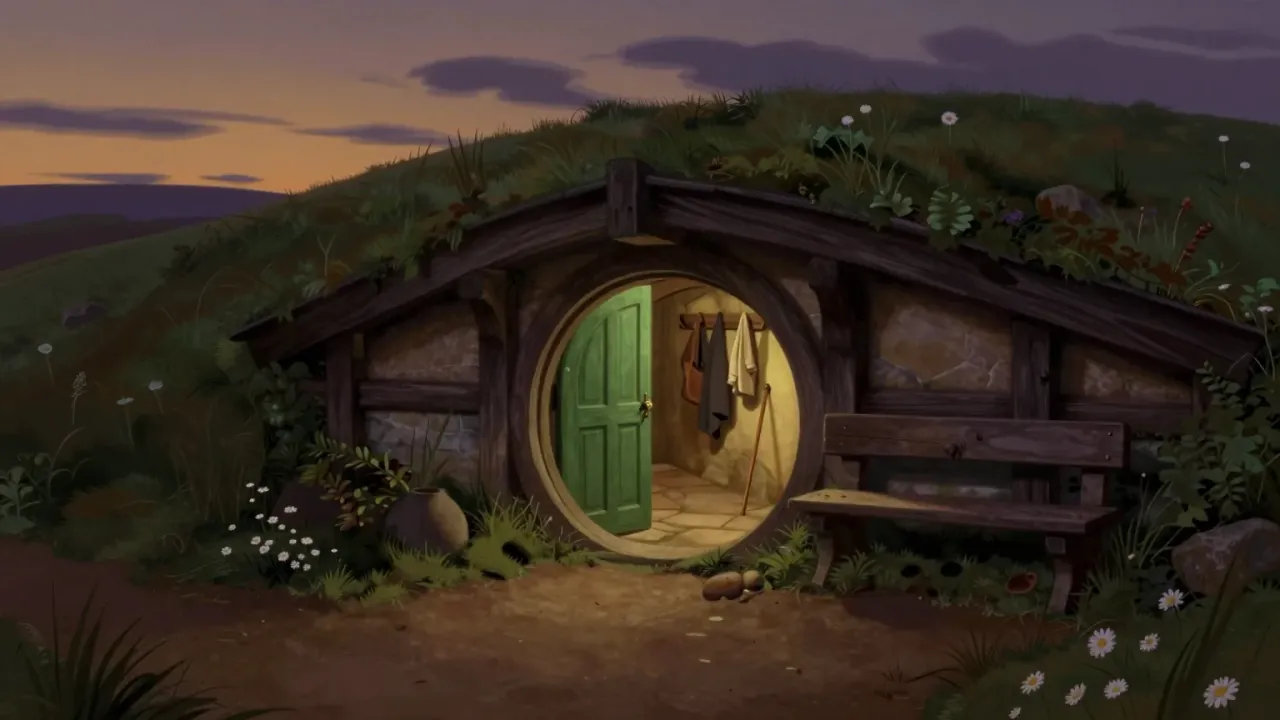
The film works through accumulation: geography, gesture, sound, and rhythm all reinforce its central idea — that small things endure. Andrew Lesnie’s cinematography anchors the epic in tactile detail: rain on stone, dust in sunbeams, the weight of chainmail on shoulders. Howard Shore’s score uses leitmotifs not for exposition but for memory — each theme returns like a vow. Performances avoid declamation: Elijah Wood conveys Frodo’s dread through stillness, Ian McKellen gives Gandalf authority without grandeur, and Sean Astin’s Sam is loyal not because he believes in destiny but because he believes in Frodo. Editing by John Gilbert sustains pace across 178 minutes by cutting on movement — a horse’s gallop, a sword’s draw, a leaf’s fall — never on exposition. The production design, led by Grant Major and Richard Taylor, treats every culture as archaeologically legible: Elvish grace is in carved wood and flowing lines; Dwarven craft is in hammered metal and tight seams; Hobbit homes are dug into earth, not built upon it. Even the Nazgûl feel less like monsters than consequences — their presence registered first in sound design, then in the recoil of horses, then in the slow dimming of light. (159 words)
What stays with you
What lands is the sense of consequence. Every decision has weight because the film refuses to let actions vanish: Frodo’s hesitation at Bag End echoes in his trembling hand before the Council; Arwen’s choice to ride with Frodo matters because her immortality is not abstract but tied to a specific river, a specific tree, a specific vow. The landscapes of New Zealand are not backdrops but participants — the mist over the Misty Mountains obscures paths but also thoughts; the narrow pass at the Gates of Argonath forces the Fellowship into single file, tightening their bond physically before it tightens morally. The Ring’s corruption is shown not in monologues but in glances — Bilbo’s fingers twitching over the Ring at his own party, Frodo flinching when Gandalf touches his shoulder after the revelation. Even minor characters land: Cate Blanchett’s Galadriel speaks few lines but her gaze holds centuries of refusal; Christopher Lee’s Saruman radiates calculation, not rage. The film’s fidelity to Tolkien is selective but principled — it keeps the book’s moral architecture while pruning its digressions, so that the journey feels earned, not annotated. The music, too, lands: Shore’s themes recur not as reminders but as emotional landmarks, returning like breath after exertion. (157 words)
Where the frame slips
What does not land is the attempt to compress Tolkien’s narrative logic into cinematic cause-and-effect. Some transitions feel abrupt: Gandalf’s imprisonment in Orthanc arrives without sufficient setup, making his absence from Bree feel like plot convenience rather than consequence. Strider’s introduction lacks the slow build of his book counterpart — his competence is asserted rather than demonstrated, so his leadership of the Fellowship feels willed rather than won. The Nazgûl, though terrifying in motion, lack psychological dimension beyond menace; their pursuit reads as atmospheric pressure rather than agency. Certain supporting characters — Boromir especially — shift tone between scenes without clear internal motivation, making his later temptation feel sudden rather than inevitable. The film also struggles with time: the passage from the Shire to Rivendell spans weeks in the book but feels compressed into days on screen, diluting the physical toll of the journey. The extended edition adds breathing room, but the theatrical cut sacrifices pacing for momentum in places where momentum undermines credibility. Some viewers find the Elves’ serenity alienating rather than dignified; others note the film’s moral certainty sits uneasily beside Tolkien’s deeper ambiguities about power, legacy and sacrifice. (156 words)
What it asks of you
The themes that matter are stewardship, inheritance, and the quiet persistence of care. The Ring is not a weapon but a test of relationship — to place, to people, to self. Frodo does not win by strength but by refusing to claim ownership; Sam does not triumph through skill but through tending — mending cloaks, sharing food, remembering names. The film treats language as sacred: Elvish names carry history, Dwarvish runes encode lineage, even the Common Tongue bears weight — Gandalf’s ‘You shall not pass’ lands because it follows silence, not because it is loud. Time is another theme: the film opens with millennia of history in voiceover, then narrows to seconds — the pause before Frodo puts the Ring on at Weathertop, the breath before Arwen chooses mortality. Loyalty is shown not as fealty but as repetition — Sam saying ‘I can’t carry it for you, but I can carry you’ is not heroic rhetoric but the culmination of dozens of smaller acts of carrying. The film resists nihilism not by denying darkness but by insisting on texture: mud, calluses, frayed hems, cracked lips. Evil is real, but so is the warmth of a hearth, the weight of a shared loaf, the sound of a friend’s footsteps behind you on a dark road. (159 words)
Who it meets, and who it passes by
It is for viewers who value worldbuilding as ethics — those who find meaning in consistency of detail, in the way a costume ages or a landscape changes with season. It rewards patience with coherence: every location, accent and musical motif serves the same grammar. It is not for those who require irony, subversion or psychological realism as primary modes; the film’s moral framework is unapologetically binary, and its characters speak in declarations more often than doubts. Some viewers raised on faster-paced genre films find its pacing stately to the point of inertia; others trained in literary adaptation miss the book’s interiority. A viewer who values ambiguity over conviction, or who finds mythic structure inherently distancing, may feel excluded. But the verdict does not hinge on preference alone: if the film’s central proposition — that small, sustained acts of care constitute resistance — fails to resonate, no amount of craft will compensate. That proposition is either accepted or rejected; nothing in the film negotiates it. (158 words)
What it costs, and what it gives
Yes, it is worth your evening — not as escapism but as calibration. Its 178 minutes ask you to adjust your sense of scale: what feels urgent shrinks; what feels trivial expands. You do not watch it to be thrilled but to be oriented — towards endurance, towards fidelity, towards the labour of keeping promises across distance and time. It works best when viewed whole, uninterrupted, in a space where silence between scenes is allowed to settle. Those who dismiss it as ‘just fantasy’ mistake genre for function: it is a vessel for asking how societies hold together, how individuals bear responsibility, and what survives when institutions fail. Its influence is not in spectacle but in precedent — it proved long-form storytelling could sustain emotional continuity across three films, and that mythic resonance need not come at the cost of human specificity. To skip it is not to miss a film but to miss a reference point — one that reshaped how studios, critics and audiences think about adaptation, scale and seriousness in genre work. (159 words)