The River of Time
Journey to the Beginning of Time is a Czechoslovak science fiction film that uses a literal river journey as a pedagogical device to move four teenage boys—and the viewer—back through geological time. It is not a thriller, nor a character study, nor a satire: it is an illustrated lecture in cinematic form, structured by palaeontological epochs rather than narrative arcs. Karel Zeman and Josef Alois Novotný wrote it as a guided tour of deep time, anchored in mid-twentieth-century scientific consensus—trilobites in the Palaeozoic, pterosaurs in the Mesozoic, mammoths in the Quaternary—with each era introduced by on-screen text and reinforced by visual evidence. The film assumes no prior knowledge but presumes curiosity; it treats prehistory not as spectacle or threat, but as terrain to be observed, named, and contextualised. Its ambition is modest in scale but precise in intent: to make geological time legible, tangible, and continuous through movement, image, and quiet exposition. It does not seek to dramatise discovery so much as to model how one might look at the past without myth or projection. (158 words)
The Boys on the Boat
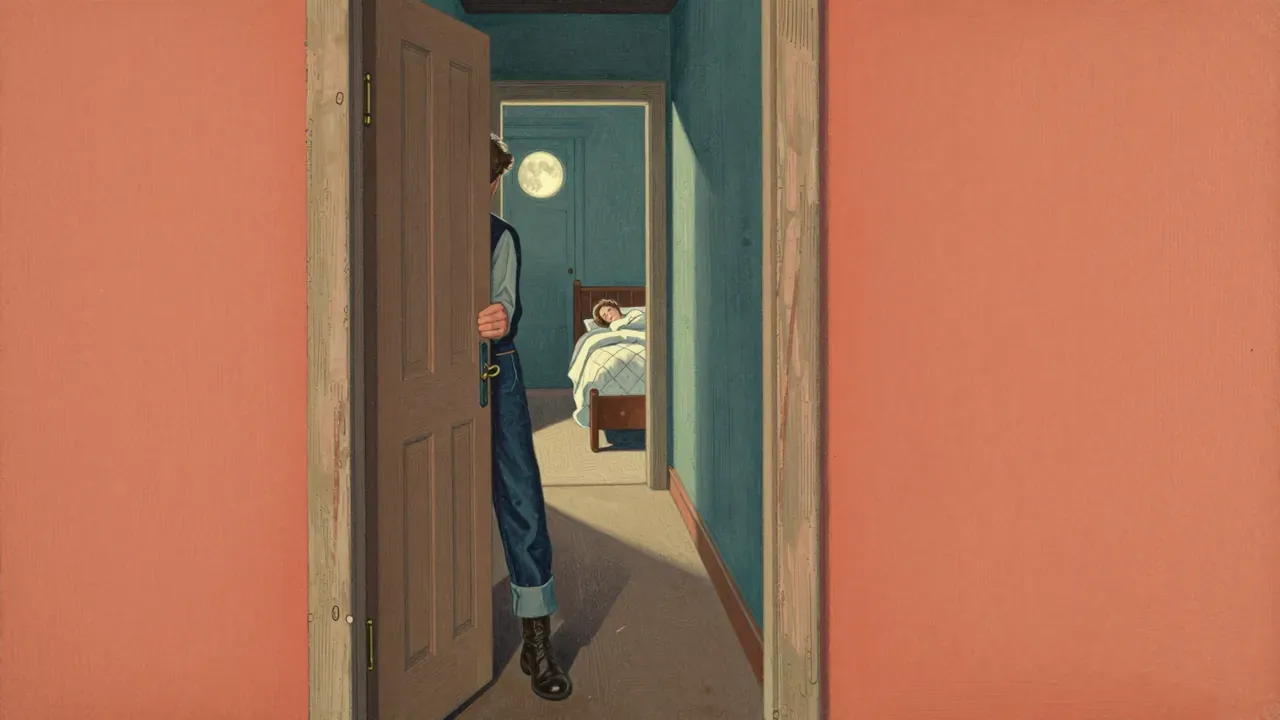
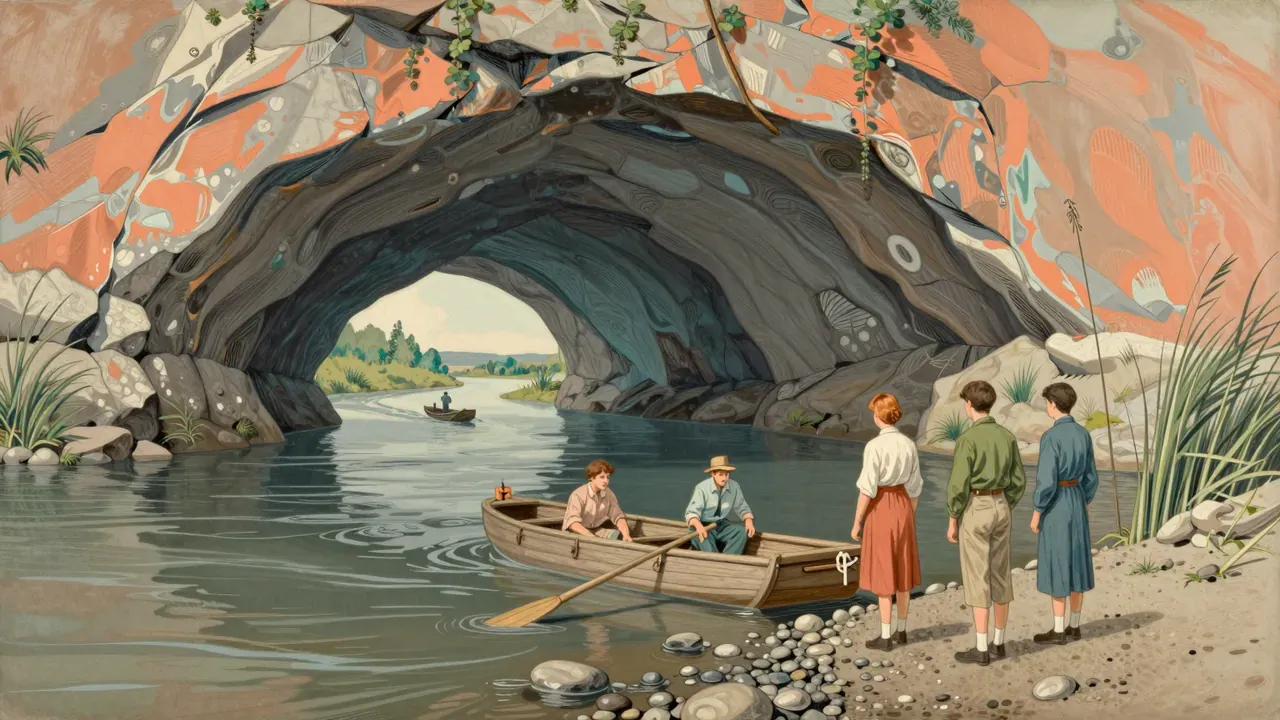
The story follows four boys—Petr, Toník, Jenda, and Jirka—who row upstream into a cave and emerge in successive prehistoric landscapes. Their dialogue is functional, often expository; performances are uninflected, consistent with Zeman’s documentary-inflected approach. No actor dominates; their roles are observational vessels, not psychological subjects. Antonín Horák and Václav Pazderník’s cinematography favours steady, medium-long takes from the boat’s perspective, reinforcing the sense of passive witnessing. Emil František Burian’s score is sparse and tonal, underscoring transitions rather than emotions. The craft lies in Zeman’s integration of techniques: 2-D cut-out profiles of animals filmed in real time, miniature 3-D models animated via concealed rigs, life-sized static props (a dead Stegosaurus, a swimming Brontosaurus), and three brief insertions of live-action footage—none of which disrupts the film’s unified visual grammar. Editing by Zdeněk Stehlík maintains rhythmic continuity across eras, avoiding montage in favour of sequential immersion. The effect is not seamless illusion, but calibrated coherence: every method serves the same pedagogical register. (159 words)
The Look of It
What lands is the film’s unwavering fidelity to its own logic: time as geography, prehistory as habitat, observation as method. The river functions as both literal vessel and conceptual spine—each bend reveals a new stratum, each bank a new fauna. Zeman’s debt to Zdeněk Burian’s palaeo-art is visible not as homage but as infrastructure: animal profiles and behaviours are drawn directly from scientifically informed reconstructions, lending the film a groundedness rare for its genre. The absence of anthropomorphism—no roaring, no eye contact, no chase sequences beyond the single Phorusrhacos moment—makes encounters feel taxonomic rather than dramatic. Even the Ceratosaurus–Stegosaurus fight is brief, dimly lit, and resolved off-screen, preserving the film’s documentary restraint. The Morava and Váh locations provide authentic riverine texture, while studio sets avoid theatricality through deliberate flatness and scale shifts. This consistency allows the film to function as a kind of moving textbook: clear, unhurried, visually specific. Its authority comes not from spectacle but from accumulation—of species, of epochs, of quiet attention. (157 words)
How It Moves
What does not land is the framing device: the boys’ motivation to find a living trilobite feels arbitrary, and their collective voiceover—though earnest—lacks distinction or development. The characters remain schematic, serving exposition rather than embodying adolescence. There is no internal conflict, no growth, no friction between curiosity and fear; even peril is muted, resolved by retreat or passive observation. The film’s refusal to dramatise risks monotony for viewers expecting narrative propulsion. Some transitions between eras rely on title cards alone, creating abrupt conceptual jumps without visual or sonic bridging. The English-dubbed US version further dilutes this by inserting American boys in a museum dream frame, severing the original’s direct address and replacing its quiet authority with condescension. The limited palette of the 1955 colour stock, while atmospheric, occasionally flattens contrast in shadowed scenes—particularly in the Carboniferous forest—making detail harder to parse. And though Zeman avoids Hollywood-style stop-motion jerkiness, some model animation remains visibly mechanical, especially in lateral animal movements. These are not flaws in ambition, but limits of means and intention: the film prioritises clarity over immersion, taxonomy over tension. (159 words)
What Time Is
The themes that matter are deep time, scientific literacy, and the ethics of observation. It treats geological epochs not as backdrops but as inhabited worlds, each with its own logic of survival and scale. The boys never interfere: they watch, name, sketch, and withdraw—modeling a non-invasive relationship to the past. This aligns with mid-century Czech scientific humanism, where knowledge is cumulative, collaborative, and rooted in material evidence. The film also quietly insists on continuity: the same river flows through all eras; the same human impulse—to explore, to classify, to wonder—persists across millennia. There is no nostalgia for lost worlds, no lament for extinction, no moralising about progress. Instead, it presents evolution as process, not parable. The absence of human ancestors until the final stretch underscores that humanity is late, contingent, and ecologically embedded—not central. This is not a film about origins as origin myth, but about origins as stratigraphy: layered, measurable, and indifferent to meaning. Its quietest theme is humility—not before nature, but before time itself. (156 words)
Who Watches
This film is for viewers who value precision over pace, illustration over invention, and patience over payoff—teachers, palaeontology students, animators studying pre-digital technique, or anyone attuned to the rhythm of documentary cinema before television codified its grammar. It rewards attention to texture: the grain of a Burian profile, the weight of a miniature raft, the way light falls on a clay Trachodon. It is not for those who require psychological stakes, escalating tension, or character-driven arcs; its stillness will read as inertia to viewers accustomed to narrative compression or algorithmic pacing. Parents expecting a children’s adventure may misread its tone: it is gentle but not soothing, educational but not didactic, slow but not simple. Those who reject mid-century scientific consensus—or who expect speculative revisionism—will find its factual framing dated, though its methodology remains instructive. A viewer who values worldbuilding as taxonomy rather than fantasy will find it rich; one who reads worldbuilding as escapism will find it thin. Its audience is narrow but exact. (158 words)
Why It Lasts
Yes, it is worth your evening—if you accept its terms. It occupies ninety minutes not as duration to be filled, but as space to be traversed: each minute corresponds to a stretch of river, a shift in flora, a new silhouette on the horizon. Its value lies in its singularity: no other 1950s film merges field location, studio craft, and scientific exposition with this level of integrated control. It repays rewatching not for hidden meaning, but for accumulated detail—the way a python’s coil tightens across two frames, or how the vultures’ wings catch the same light as the boys’ oars. Those who dismiss it as ‘slow’ or ‘old-fashioned’ mistake its tempo for deficiency; its slowness is structural, not incidental. Anyone who has watched Walking with Dinosaurs and wondered how such a tone was first achieved will find here its clearest prototype. It is not entertainment in the transactional sense, but engagement in the archival one: a record of how one filmmaker thought time could be shown. (157 words)