filmbriefs
Composer · Actor · 1899–1983

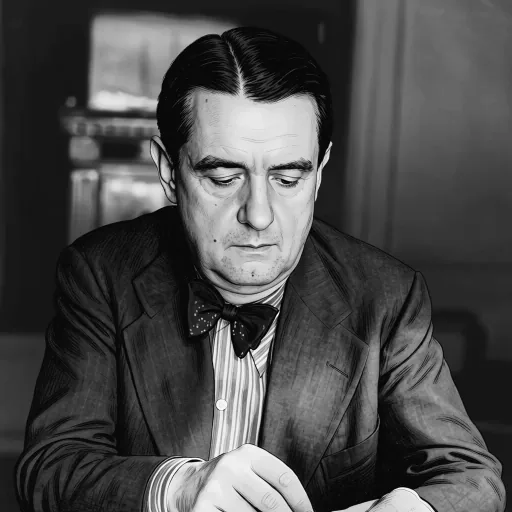
Georges Auric

11
briefs
13:00
average
143 min
in total
On film.briefs11
13:00

À Nous la Liberté

René Clair · 1931

René Clair’s 1931 À Nous la Liberté follows two convicts — one who becomes a tramp, the other a phonograph magnate — and their reunion in a factory whose assembly line echoes the prison they fled. With Georges Auric’s music supplying much of the diegetic sound, and Georges Périnal’s cinematography framing both institutions as variations on the same geometry, the film stages a precise, unsentimental satire of mechanisation, class and the illusion of upward mobility. It is formally inventive, politically light-footed, and built on recurrence rather than revelation.
13:00

Caesar and Cleopatra

Gabriel Pascal · 1945

Gabriel Pascal’s 1945 Technicolor film adapts George Bernard Shaw’s 1901 play with near-verbatim fidelity. Starring Vivien Leigh and Claude Rains, it follows Cleopatra’s tutelage under Caesar during the Siege of Alexandria. Lavish in scale but restrained in execution, it privileges dialogue, idea and historical procedure over spectacle or sentiment. Though a financial failure on release, it endures as a rare example of British studio craft applying philosophical seriousness to ancient subject matter.

13:00

Gervaise

René Clément · 1956

René Clément’s 1956 Gervaise adapts Émile Zola’s L’Assommoir with forensic restraint, following Maria Schell’s laundress through a decade of incremental collapse in mid-nineteenth-century Paris. Shot by Robert Juillard and scored sparingly by Georges Auric, it locates tragedy not in grand gestures but in the weight of wet linen, the silence after a slammed door, the slow emptying of a shopfront. Its power lies in accumulation, not revelation.

13:00

Lola Montès

Max Ophüls · 1955

Max Ophüls’s 1955 film frames the life of courtesan Lola Montez as a circus spectacle, using CinemaScope, tri-lingual production, and systemic colour to examine how memory, gender, and power shape reputation. Martine Carol stars in a formally rigorous, emotionally restrained portrait that prioritises structure over psychology and spectacle over sentiment.

13:00

Orpheus

Jean Cocteau · 1950

Jean Cocteau’s 1950 Orpheus recasts the Greek myth as a post-war Parisian fable, where poetry, death and mirrors operate under shared, unspoken rules. Jean Marais stars as a poet drawn into a bureaucratic underworld by María Casares’ enigmatic Princess of Death. Shot in ruined academies and Paris streets, with practical effects that foreground craft rather than conceal it, the film sustains a poetic logic across 95 minutes — demanding attention, not explanation.

13:00

Testament of Orpheus

Jean Cocteau · 1960

Testament of Orpheus (1960) is Jean Cocteau’s black-and-white fantasy film starring himself as an 18th-century poet moving through a mythic France. With cameos from Picasso, Marais, Brynner and others, it forms the third part of his Orphic Trilogy. Structured as a series of symbolic vignettes rather than a narrative, it reflects on mortality, authorship and artistic legacy through repetition, doubling and formal restraint. Georges Auric composed the score; Marie-Josèphe Yoyotte edited it. It is an essay-film in cinematic form — elliptical, self-referential, and addressed to those already familiar with Cocteau’s work.

13:00

The Blood of a Poet

Jean Cocteau · 1932

Jean Cocteau’s 1932 debut feature is a 55-minute avant-garde fantasy structured in four discontinuous sections. An artist sketches a mouth that migrates to his palm, then to a statue’s lips; he passes through a mirror into a hotel where he is instructed to shoot himself; a marble snowball kills a boy; a card game unfolds over the corpse while a guardian angel absorbs him and departs. Shot by Georges Périnal, scored by Georges Auric, and narrated by Cocteau, it avoids psychology and narrative logic in favour of symbolic recurrence and formal rigour. Financed by Charles de Noailles, it was delayed over fears of blasphemy and remains the first part of Cocteau’s Orphic Trilogy.

13:00

The Innocents

Jack Clayton · 1961

Jack Clayton’s 1961 adaptation of Henry James’s The Turn of the Screw sustains a rigorous ambiguity: are the ghosts real, or projections of the governess’s repressed psyche? Shot by Freddie Francis in stark CinemaScope, scored by Georges Auric with early electronic textures, and carried almost entirely by Deborah Kerr’s tightly coiled performance, the film refuses resolution. Its power lies in what it withholds — no confirmation, no diagnosis, no moral anchor — making it a landmark of psychological horror and arthouse restraint.

13:00

The Wages of Fear

Henri-Georges Clouzot · 1953

Henri-Georges Clouzot’s 1953 thriller follows four desperate men hired to drive nitroglycerin across treacherous South American roads. With minimal dialogue and relentless physical detail, it sustains unbearable tension through craft rather than plot — a masterclass in cinematic endurance that won both the Palme d’Or and Golden Bear.

13:00

Rififi

Jules Dassin · 1955

Rififi (1955), directed by Jules Dassin, is a French crime film centred on a meticulously detailed, nearly silent jewellery heist in Paris. Made on a low budget after Dassin’s Hollywood blacklist, it strips away music, exposition, and glamour to focus on process, consequence, and the collapse of a thieves’ code. Its enduring power lies in its restraint: no score during the heist, no close-ups for emphasis, no redemption offered.

13:00

Entr'acte

René Clair · 1924

A 1924 French Dada short directed by René Clair, made as a prologue and entr’acte for the Ballets Suédois production of Relâche. Twenty-two minutes of silent, non-narrative experimentation: reverse motion, tilted frames, rooftop absurdities, and Erik Satie’s score. Cameos by Duchamp, Man Ray, Satie, and Picabia. It treats cinema as a site of playful sabotage — not storytelling, but syntax-breaking.