The look of it
Place de la République is a 94-minute French documentary directed by Louis Malle and released in January 1974. It records unscripted activity at the Paris square of the same name over an unspecified stretch of time, likely several days or weeks. The film makes no argument, advances no thesis, and avoids voice-over, interviews, or explanatory text. Its intention is observational: to hold a steady, uninflected gaze on the square as a living cross-section of urban France — commuters, vendors, children, police, lovers, idlers, protesters, tourists — all moving through shared space without narrative framing. Malle does not select for drama or anomaly; he treats a man tying his shoelace with the same compositional weight as a demonstration passing through. This is not vérité in the sense of revealing hidden truth, but rather a sustained act of attention: a refusal to interpret, and thus a quiet challenge to the assumption that public space must be legible. It belongs to a strand of non-fiction that treats duration and repetition as structural principles, not flaws.
How it holds still
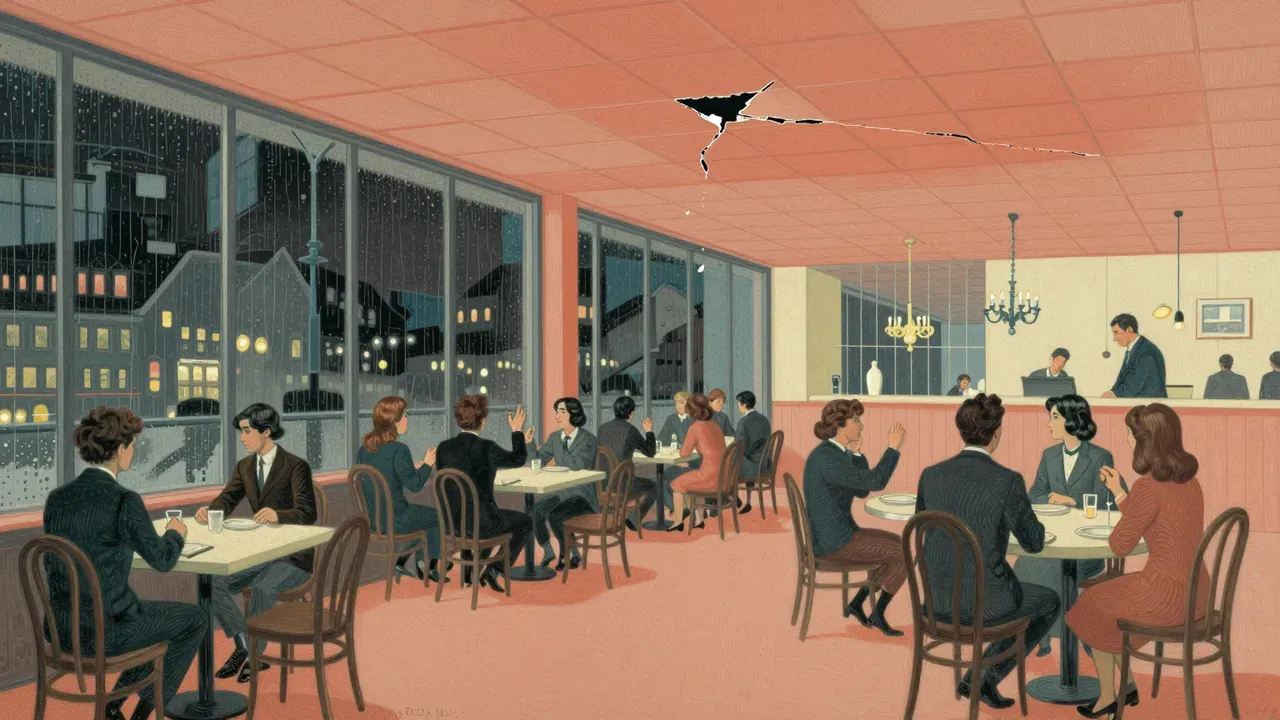
The film works through strict formal discipline: static wide shots, mostly from elevated vantage points, with long takes that rarely cut before thirty seconds have passed. Malle and cinematographer Pierre-William Glenn use natural light and avoid repositioning the camera mid-shot; movement enters only through the square itself — buses, bicycles, pedestrians crossing frame. There is no score, no diegetic music beyond what drifts in from cafés or street performers, and no sound design beyond unfiltered location recording. Performances are incidental and unorchestrated: a woman argues on a payphone, teenagers lean against railings, a dog circles a lamppost. Editing is sparse and rhythmic, favouring temporal continuity over juxtaposition. The craft is anti-expressive: no close-ups isolate emotion, no slow motion heightens gesture, no tilt reveals hierarchy. What emerges is not character or story but density — the accumulated weight of overlapping routines, minor collisions, and unremarked pauses. This restraint demands patience, but it also prevents the film from settling into either nostalgia or critique.
What stays in the frame
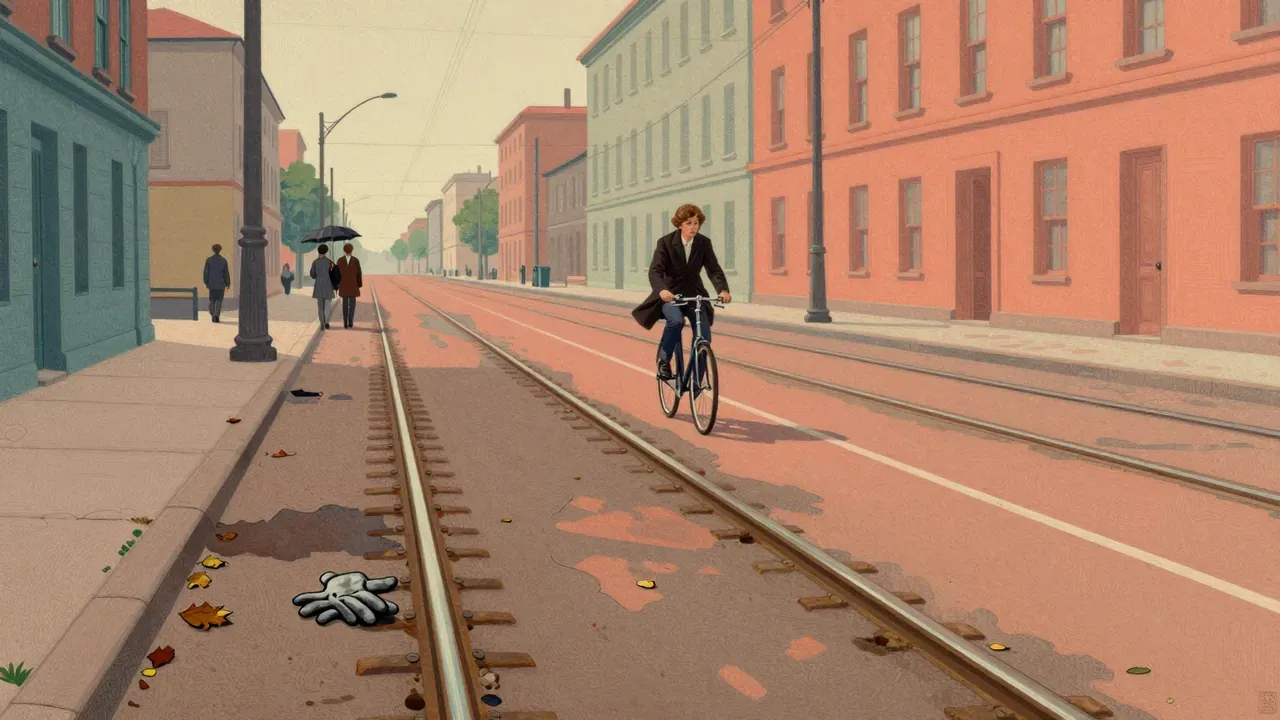
What lands is the texture of ordinary time. The film captures how public space breathes: the lull between tram arrivals, the way sunlight shifts across paving stones over twenty minutes, the sudden compression of bodies during rush hour, then the slow dispersal as evening cools. These rhythms feel unmediated because they are — there is no editorial hand choosing which moment signifies. A group of schoolchildren crossing the square is neither charming nor ominous; it simply is, and its ordinariness becomes quietly resonant. The film also lands its implicit claim about visibility: by refusing to highlight, it forces attention toward what is usually background — the maintenance worker sweeping, the elderly man feeding pigeons, the graffiti half-erased on a wall. These figures do not become protagonists, but their presence accumulates moral weight through sheer persistence. The result is not emotional catharsis but a recalibration of perception: after ninety minutes, the eye begins to register micro-shifts in posture, glance, gait — details usually lost to habit.
What stays out
What does not land is any sense of historical or political specificity. Though filmed in 1973 and released in early 1974 — a period of industrial unrest, rising inflation, and post-1968 political fatigue in France — the film gives no contextual anchor. No banner, no slogan, no radio broadcast, no newspaper headline enters frame. This is not neutrality but erasure: the square’s history as a site of demonstrations, executions, and commemorations remains invisible. Similarly, the film’s refusal to identify social class, ethnicity, or generation flattens difference into uniformity. A North African vendor and a suited civil servant appear with identical visual weight, yet their lived relations to the space are left unexamined. Some viewers will find this omission principled; others will read it as evasion — particularly those who expect documentary to engage with power, exclusion, or change. The film offers no entry point for the viewer unfamiliar with Paris, no guide to its architecture or street logic, and no concession to narrative expectation.
Time in the square
The themes that matter are presence, duration, and the politics of attention. The film treats time not as a vessel for events but as material — something to be measured in footsteps, in the arc of a thrown ball, in the fading of shadows. It asks what happens when we stop asking what is happening and begin asking how long it lasts. Closely tied is the theme of anonymity: the square functions as a machine for dissolving individual identity into collective motion, and the film honours that function without judgment. There is also a quiet meditation on infrastructure — not as engineering but as habit: the tram lines, the benches, the traffic lights, the kiosks — all of which shape behaviour without announcing themselves. These are not abstract ideas illustrated by footage; they emerge from the accumulation of unemphasised detail. The film does not argue for slowness or lament acceleration, but its very structure insists on the significance of uneventful time — a stance that feels increasingly rare, and increasingly necessary, in documentary practice.
Who walks in
This film is for viewers who value sustained attention over exposition, who find meaning in repetition and variation rather than cause-and-effect, and who are comfortable watching without being told what to think. It suits those familiar with the work of Jean Rouch, Frederick Wiseman, or the later films of Chantal Akerman — not as a stylistic reference but as a shared commitment to duration as ethical method. It is not for viewers seeking context, explanation, or emotional payoff; nor for those who require clear authorial position or historical framing. Someone expecting insight into 1970s France — its economy, its youth culture, its tensions — will leave frustrated. A teacher using it to illustrate urban sociology would need to supply all framing externally. The verdict changes if the viewer accepts that observation can be a form of analysis — but that acceptance is itself the first demand the film makes.
Where it leaves you
It is worth your evening only if you are prepared to surrender the expectation that time spent watching must yield information, interpretation, or resolution. Ninety-four minutes here is not a journey but a threshold: cross it, and perception alters; stay outside, and the film feels inert. It rewards no one automatically — its value accrues slowly, like sediment. Those who watch while checking phones or waiting for ‘something to happen’ will find it tedious. But for those willing to let the square settle into their peripheral vision, then gradually sharpen into focus, it offers something rare: a model of looking that refuses to consume, categorise, or narrativise. That refusal is not passive; it is precise, demanding, and quietly radical. Whether it is worth your evening depends not on the film’s merit alone, but on whether you are ready to meet it on its own terms — and few documentaries ask that question so plainly.