The voice of it
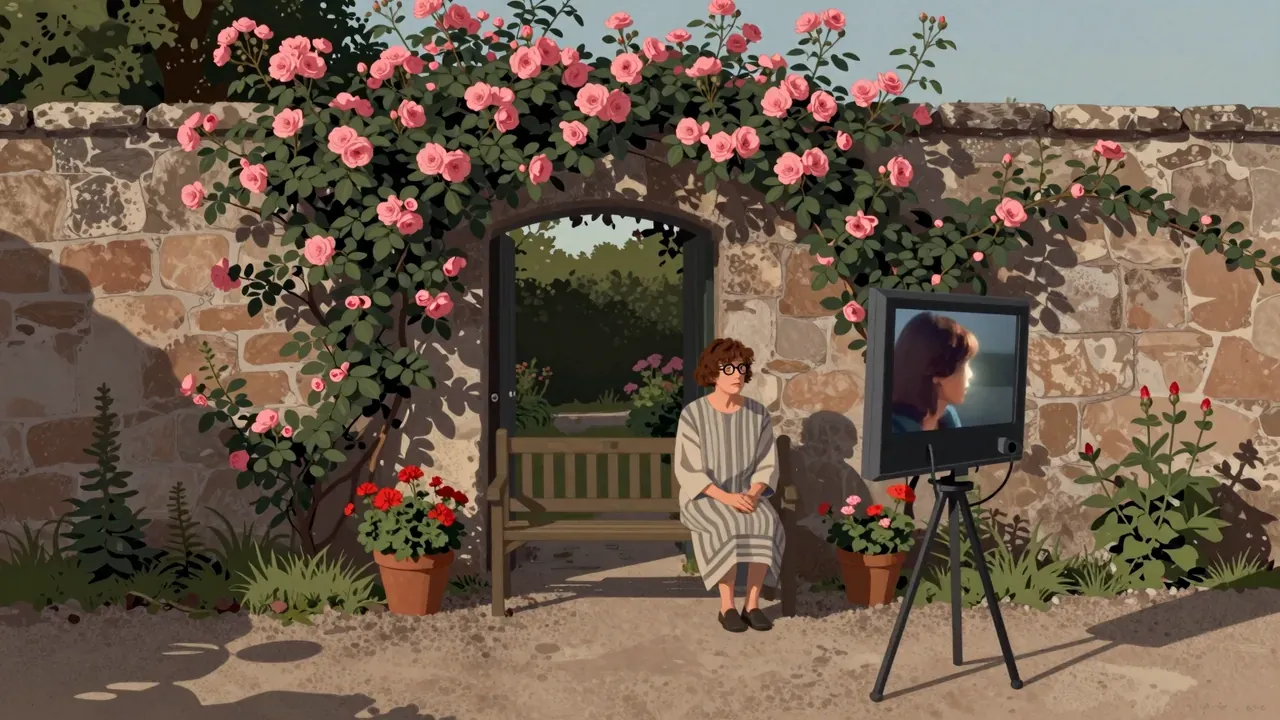
Varda by Agnès is a self-authored documentary in which Agnès Varda, then eighty-nine, surveys her six-decade career across photography and film. It is not a retrospective assembled by others, nor a chronological survey with archival narration; it is Varda speaking directly to camera, often seated in a quiet studio or garden, watching excerpts from her own work and commenting on them in real time. She structures the film around three words she names as central: inspiration, creation, sharing. The film does not seek to explain her influence on the French New Wave, nor to contextualise her within film history — those are external frames she declines. Instead, it offers a sustained act of authorial presence: a filmmaker choosing how and what to remember, how much to reveal, and when to pause. It is less about legacy than about continuity — the same curiosity, playfulness and precision that shaped Cléo from 5 to 7 or Lions Love still animates her voice and gaze here. The film assumes no prior knowledge but presumes attention. (142 words)
The presence of it
The film works through simplicity of means and consistency of voice. Varda appears throughout, mostly seated, sometimes walking slowly, always looking at the camera or at a monitor showing her own films. There are no interviews, no experts, no voice-over narration beyond her own. Didier Rouget co-wrote the script, but every observation, anecdote and reflection bears her cadence and syntax. Editing is by Varda herself, and its rhythm is unhurried: cuts linger on faces, objects, textures — a cat’s fur, a heart-shaped potato, the grain of a beach photograph. Gordon Willis is not involved; this is Varda’s own lighting, her own framing, her own pacing. The sound design is unobtrusive, favouring natural ambience and direct speech. There are no re-enactments, no dramatisations, no illustrative B-roll. What carries the film is her physical presence — the way she tilts her head, pauses before answering, smiles without softening her point — and the clarity of her memory, which is selective but never vague. Her authority is not asserted; it is held in the duration of her gaze. (148 words)
The weight of it
What lands is the quiet force of sustained authorship. Varda’s refusal to separate her life from her work — her husband Jacques Demy, her cats, her love of colour and chance — makes the film feel like an extension of her practice rather than a summary of it. Her commentary on her own films avoids both self-mythologising and false modesty; instead, she notes technical choices, regrets, accidents, and pleasures with equal calm. When she describes shooting Sans toit ni loi on the road with a small crew, or explains why she kept a particular out-take because of the light on a woman’s hair, those moments carry weight not because they are revelatory but because they are precise. The film’s emotional resonance comes from accumulation: repeated motifs — hands, beaches, potatoes, blue — gather meaning across decades without needing explanation. Her warmth is real but never cloying; her wit is dry and situational. Even viewers unfamiliar with her filmography register the coherence of a sensibility that treats image-making as both craft and companionship. (146 words)
The omissions of it
What does not land is any attempt to read the film as a comprehensive account of her career. It omits key collaborations, sidesteps political context — notably the 1968 protests and their absence from her work — and gives little space to her later video installations or multimedia projects. There is no reckoning with critical neglect in the 1970s or with shifts in funding structures for women filmmakers. The film’s intimacy can also narrow its scope: some sequences — particularly extended shots of her sitting silently, or long takes of waves — risk drifting into mannerism if the viewer is not already attuned to her rhythm. A viewer expecting analysis of her editing techniques or her use of non-professional actors may find the film too personal, too associative. It does not argue for her importance; it assumes it. That assumption is justified, but it leaves no room for friction, contradiction or doubt — qualities present in her earlier work but muted here. The film is generous, but not self-interrogating. (144 words)
The making of it
The themes that matter are authorship, memory as selection, and the materiality of making. Varda treats memory not as retrieval but as active curation: she chooses which scenes to show, which anecdotes to tell, which silences to keep. Her emphasis on ‘sharing’ is not rhetorical — it is enacted in the film’s structure, its openness to digression, its willingness to include minor works alongside major ones. The recurring focus on texture — fabric, skin, sand, potato skin — insists on the physical basis of image-making, resisting abstraction for its own sake. Ageing is present but not foregrounded as decline; it appears as continuity — the same eye, same curiosity, same refusal to let technique override feeling. Her marriage to Demy is remembered not through biography but through shared motifs: his use of colour, her return to locations they filmed together. The film treats feminism not as a stance but as a condition of practice — the fact of working outside institutional support, of building her own tools, of trusting her own gaze. These are not themes announced; they are habits made visible. (147 words)
The pace of it
It is for viewers who value voice over velocity, who trust a filmmaker’s right to shape her own narrative without mediation, and who find intellectual pleasure in attentiveness rather than exposition. It suits those already familiar with at least one of her films, but also those new to her work who approach cinema as a conversation between maker and viewer rather than a delivery system for information. It is not for viewers who require narrative propulsion, historical framing or critical distance. Those who expect documentaries to interrogate their subjects — or who read autobiography as confession — may find it withholding. Anyone needing context on French film policy, feminist film theory or 1960s cultural politics will need to look elsewhere. The film’s pace and tone assume patience; its rewards accrue slowly, and only to those willing to sit with it at its own speed. To dislike it is not to misunderstand it — it simply asks for a different contract between film and viewer. (143 words)
The end of it
Yes, it is worth your evening — provided you are prepared to meet it on its terms. Its value lies not in revelation but in resonance: the rare chance to spend time with a mind that has spent sixty years looking closely, thinking quietly and choosing deliberately. It repays attention not with answers but with calibration — adjusting one’s sense of what cinema can hold, how long it can pause, how much weight a single glance can carry. Those who find it slow may be reacting to its resistance to instrumentalisation: it does not teach, persuade or summarise. But its slowness is structural, not incidental — a refusal to compress a lifetime into highlights. It would change its verdict only if viewed as a historical document rather than a final statement; judged as the latter, its economy, honesty and grace make it singular. It earns its length by never wasting a second of it. (142 words)