A Deal with Planet X
Invasion of Astro-Monster is a Japanese-American co-production from Toho and UPA, released in December 1965 as the sixth entry in the Shōwa Godzilla series. It attempts a planetary-scale escalation: two Earth monsters — Godzilla and Rodan — are borrowed by aliens from Planet X to fight King Ghidorah, only for the aliens to betray humanity and turn all three against Earth. The film tries to fuse Cold War anxiety with space-age spectacle, threading nuclear dread through interplanetary diplomacy and kaiju combat. Its structure follows the genre’s established rhythm — scientific briefing, alien contact, monster deployment, betrayal, city destruction — but pushes further into cosmic allegory than earlier entries. Shinichi Sekizawa’s script introduces a new layer: not just invasion, but contractual deception, where humanity’s trust in extraterrestrial goodwill proves catastrophically naive. The film’s ambition lies less in narrative novelty than in scale and synthesis: it gathers the franchise’s three most potent monsters into one battlefield, literalising the idea of global threat as a shared, trans-solar system condition. It is not a reinvention, but a consolidation — an attempt to make the kaiju war feel cosmically consequential. (142 words)
The Pace of Panic
The story moves briskly, shaped by Henry G. Saperstein’s insistence on quicker entry — no opening press conference, just astronauts landing on Planet X within minutes. Nick Adams’ American scientist provides exposition and mild romantic friction with Kumi Mizuno’s Dr. Sakurai, while Akira Takarada anchors the Japanese scientific team. Haruo Nakajima’s Godzilla remains physically commanding, though his new suit — with enlarged eyes and mobile pupils — adds subtle expressivity. Eiji Tsuburaya’s effects rely heavily on recycled footage from Ghidorah, the Three-Headed Monster and earlier films; model cities are sparser, and miniature work feels more economical than elaborate. Akira Ifukube’s score retains its percussive gravity, but some cues are rearranged for the American cut. Yoshio Tsuchiya’s Planet X Controller speaks an invented dialect mixing French, German and literary Japanese, a detail Honda approved but Nakajima opposed. The infamous ‘victory dance’ — added at Tsuchiya’s suggestion — appears after Godzilla defeats Ghidorah, undercutting gravitas with deliberate, awkward anthropomorphism. Cinematography by Hajime Koizumi keeps compositions functional rather than atmospheric, favouring clear monster placement over mood. (153 words)
The Look of It
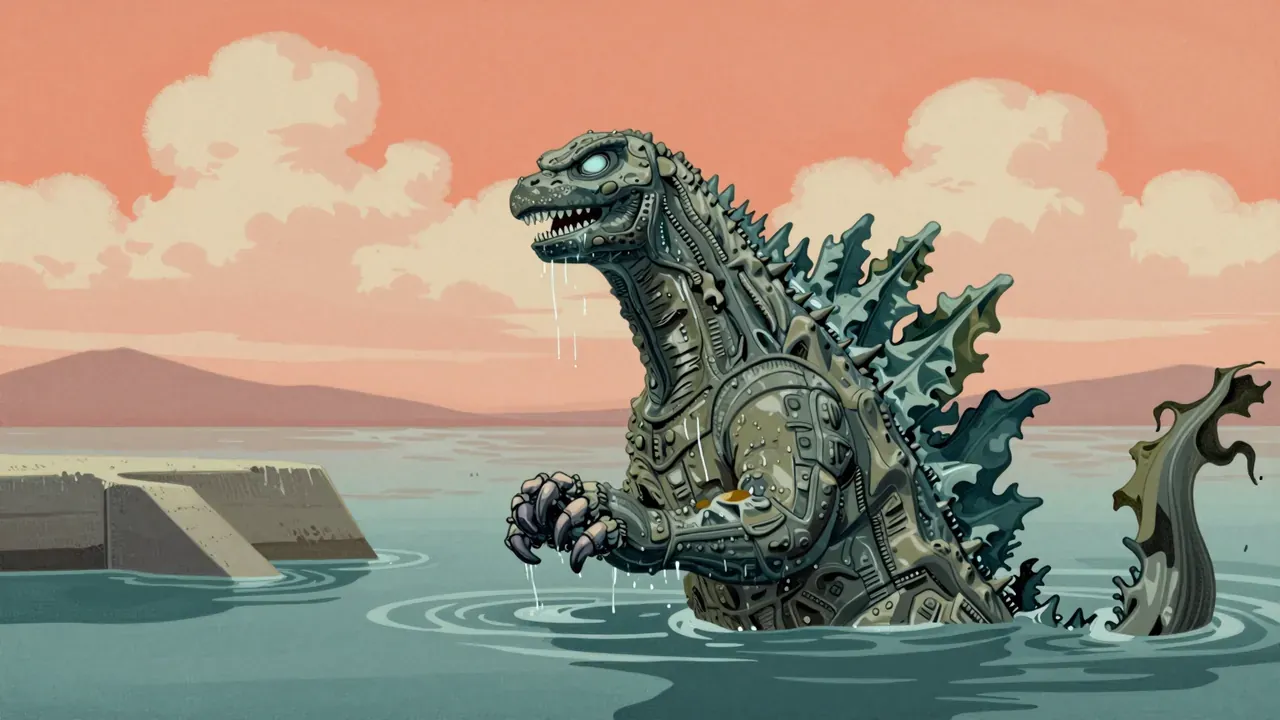
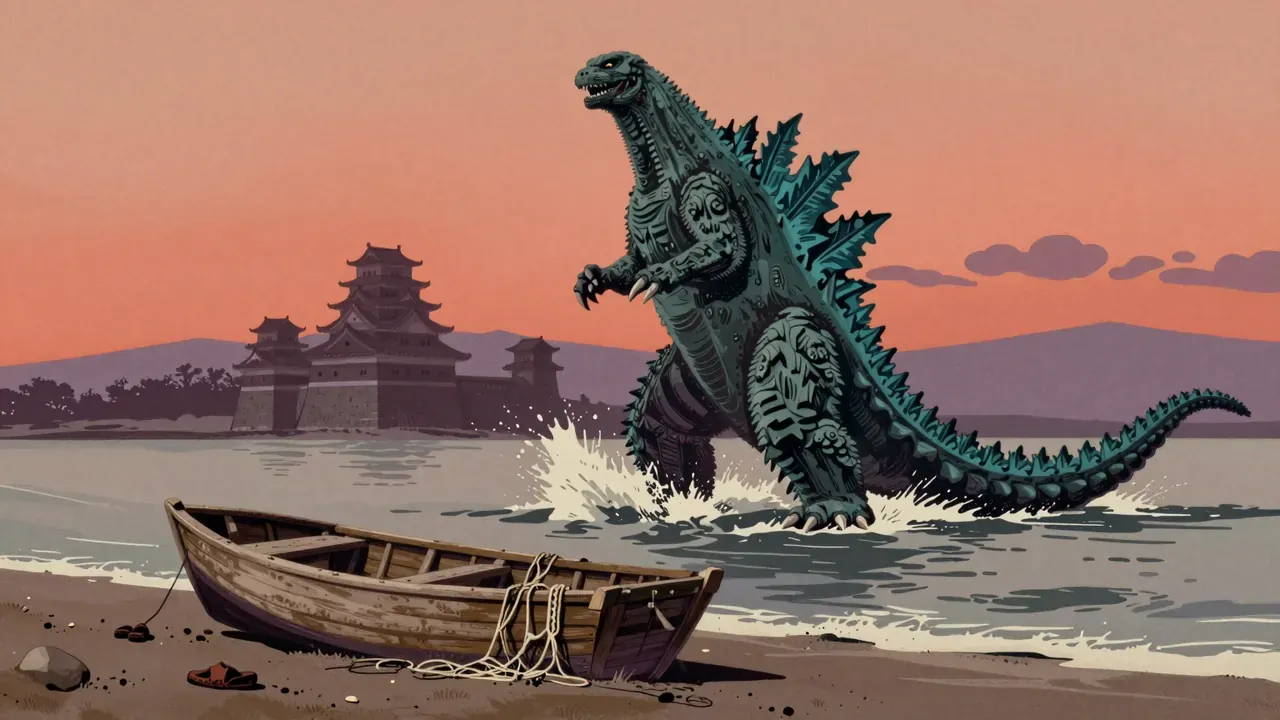
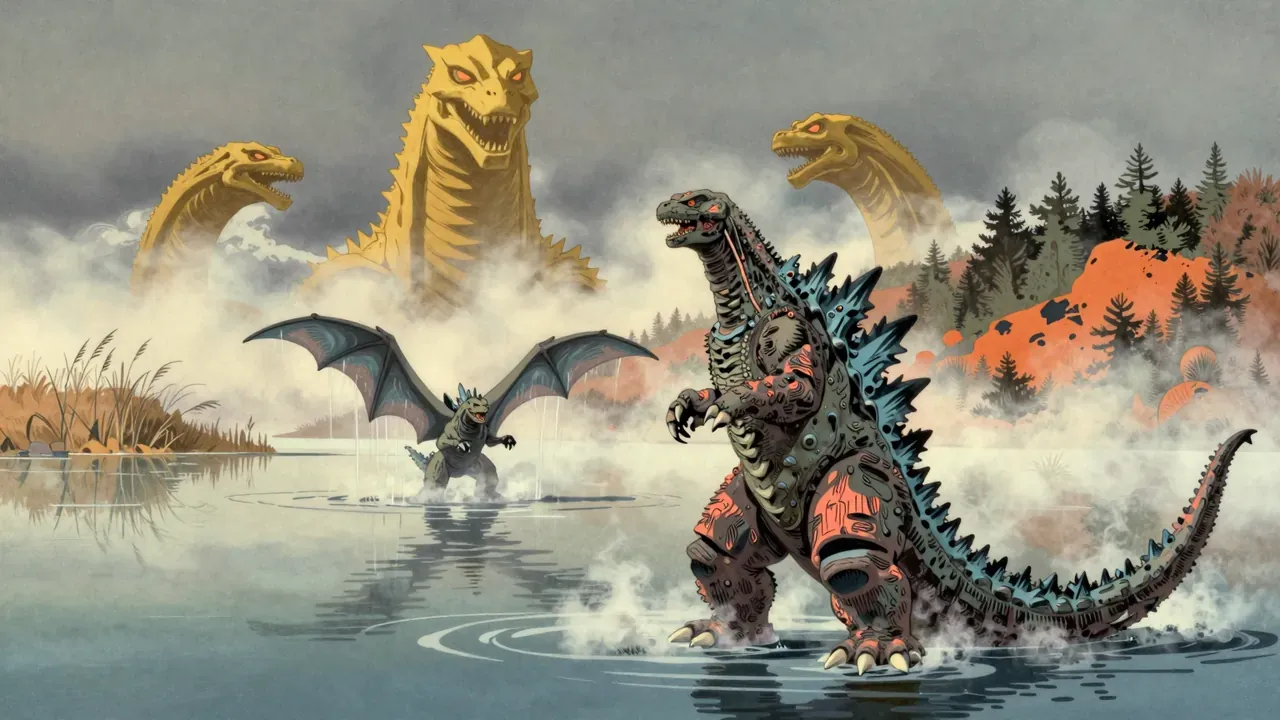
What lands is the sheer, unapologetic logic of its monster economy: three titans, each with distinct movement, sound and silhouette, sharing screen time without visual confusion. The Lake Myojin scenes — where Godzilla and Rodan first emerge from water under nitrogen-generated mist — retain tactile strangeness, their submerged entrances feeling less like spectacle and more like geological events. The P1 rocket’s low-angle launch, achieved by digging a hole in the soundstage floor, gives rare physical weight to the spacecraft. Nick Adams’ presence, though brief, stabilises the English-language scenes without condescension; his delivery avoids caricature, grounding the American subplot in procedural credibility. The Planet X sets — angular, monochromatic, lit with cool blues — contrast sharply with Earth’s warm, cluttered interiors, reinforcing the film’s binary between alien precision and human improvisation. Even the recycled effects hold up when recontextualised: Rodan’s wing-flap from Mothra gains new urgency when paired with Ghidorah’s triple-neck recoil. The film’s best moments do not ask for suspension of disbelief so much as acceptance of its own internal arithmetic — a logic of scale, symmetry and sonic punctuation that Ifukube’s brass and percussion enforce with unwavering consistency. (158 words)
The Dance
What does not land is the moral scaffolding. The Planet X aliens’ betrayal arrives without psychological preparation or ideological clarity: their motives remain opaque, their dialogue indecipherable even in translation, reducing them to plot devices rather than antagonists. The film’s attempt at satire — particularly the ‘victory dance’ — misfires because it lacks tonal control: the gesture feels tacked-on rather than earned, undermining both Godzilla’s menace and the stakes of the final battle. The American co-production compromises show in pacing disjunctions: Adams’ scenes were shot separately in five weeks, and their insertion creates slight temporal gaps in continuity, especially around the Lake Myojin sequence. Budget constraints also show in the Ghidorah suit’s repainted, rubber-settled faces — details visible in close-ups that flatten his otherworldly menace into craft limitations. The script’s reliance on exposition via radio transmission and lab briefing grows wearying by the second act, and Sekizawa’s dialogue rarely rises above functional utility. There is no character arc, no thematic pivot — only escalation, then reversal, then repetition. The film’s refusal to deepen its alien logic or human response leaves its Cold War parallels feeling schematic rather than resonant. (152 words)
The Terms of Engagement
The themes that matter are delegation, consequence and the illusion of control. Humanity does not defeat Ghidorah; it outsources the fight, then loses oversight. The film treats monster deployment like military procurement — a contract signed, assets deployed, accountability deferred — until the bill comes due in flattened Tokyo. Planet X functions less as a civilisation and more as a corporate entity: technologically advanced, bureaucratically detached, ethically indifferent. Its language is invented but unintelligible; its motives are financial or strategic, never spiritual or existential. This reframes the kaiju not as forces of nature but as leased infrastructure — dangerous, unreliable, and ultimately ungovernable. The film’s quietest theme is exhaustion: Honda’s later reflections on budget cycles and audience fatigue echo in the film’s texture — the reused models, the thinner smoke, the hurried edits. It is a film about diminishing returns, both industrial and imaginative. Its sci-fi is not speculative but diagnostic: a portrait of a franchise, and a culture, learning how much repetition an audience will tolerate before the spectacle stops signifying anything beyond itself. (147 words)
Who It Is For
This film is for viewers who value kaiju as formal elements — mass, motion, silhouette, sound — over psychological realism or narrative coherence. It rewards attention to suit design, miniature weathering, and Ifukube’s rhythmic scoring. It suits fans of mid-1960s Japanese genre cinema who accept compromise as part of the form: the dig in the soundstage floor, the thermos-bottle nitrogen trick, the hand-stitched dorsal fins. It is not for those seeking thematic depth, consistent tone or character development. Anyone expecting the moral gravity of Godzilla (1954) or the ecological unease of Mothra (1961) will find Invasion of Astro-Monster structurally hollow. Those who dislike anthropomorphic monster behaviour — particularly the victory dance — will find its inclusion unignorable and tonally corrosive. A viewer who values worldbuilding over world-wrecking may prefer Ebirah, Horror of the Deep, released the following year. The verdict shifts if the film were approached as a document of production pragmatism rather than a standalone narrative — but that is not how it is presented, nor how it plays. (143 words)
Is It Worth Your Evening?
It is worth your evening if you watch it as a case study in collaborative genre filmmaking under constraint — not as a self-contained story. Its pleasures are artisanal: the way Nakano’s lighting isolates Ghidorah’s central head during the Lake Myojin standoff, the precise timing of Godzilla’s roar cutting across a Planet X transmission, the physical heft of the 3-metre P1 model rising from the dug-out stage floor. It is not worth your evening if you require narrative momentum, emotional investment or thematic resolution. Critics who gave it 5/10 — or worse, dismissed it outright — are reacting to its structural thinness, not its craft failures. A viewer who dislikes recycled footage or finds the alien subplot emotionally inert will not be won over by the final battle’s scale. The film earns its place not through excellence but through persistence: it keeps the kaiju war going, even when the budget, the schedule and the creative energy are all running low. That persistence, however weary, is its quietest achievement. (149 words)