The shape of it
Guillermo del Toro’s Frankenstein is a deliberate, large-scale reworking of Mary Shelley’s 1818 novel—not as Gothic horror or science-fiction spectacle, but as a tragic, Catholic-inflected myth about creation, abandonment, and the moral weight of fatherhood. It seeks to restore the Creature’s interiority and linguistic capacity from the source text, while grounding Victor Frankenstein’s ambition in a distinctly Latin American emotional register: operatic, tactile, steeped in ritual and bodily consequence. Del Toro does not aim for fidelity to any prior screen version, nor does he treat Shelley’s prose as scripture; instead, he treats the story as a vessel for his long-held preoccupations—sacred monstrosity, the ethics of making, the loneliness of the made thing. The film’s scale, its reliance on physical production design over digital substitution, and its insistence on the Creature as thinker and speaker rather than symbol all serve that aim. It is less an adaptation than a consecration: a ritual performance of the myth in conditions del Toro spent nearly thirty years waiting to meet.
The voice of it
The story unfolds across three interlocking arcs: Victor’s obsessive, self-consuming pursuit of life beyond death; the Creature’s slow, painful emergence into language, memory, and grief; and the widening rupture between them, dramatised through encounters with secondary characters who each represent a different facet of human response—fear, curiosity, pity, exploitation. Oscar Isaac plays Victor not as mad scientist but as a man whose intellect is inseparable from his pride, his devotion, and his incapacity for humility. Jacob Elordi’s Creature is physically imposing and emotionally precise, moving from mute disorientation to articulate sorrow without melodrama. Dan Laustsen’s cinematography favours deep focus and chiaroscuro interiors, often holding on faces in candlelight or rain-smeared glass. Alexandre Desplat’s score avoids leitmotif in favour of sustained, vocal-led textures—choirs, prepared piano, low strings—that swell like liturgical incantation. Costume, makeup, and production design—each awarded at the Academy Awards—are not decorative but argumentative: every stitch, scar, and stone surface asserts the film’s thesis that matter carries memory.
The weight of it
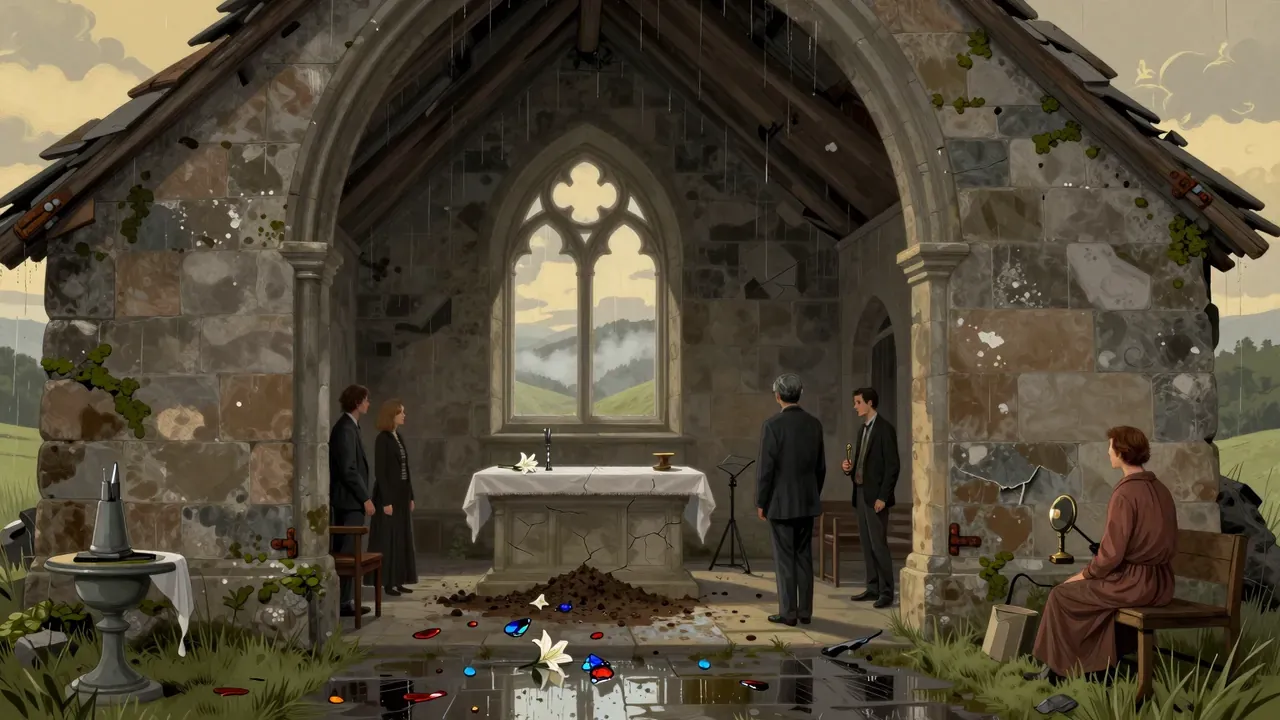
What lands most firmly is the film’s moral gravity—the sense that every choice has a body, every sin a silhouette. The Creature’s first full monologue, delivered in a ruined chapel at dawn, lands with the weight of confession, not exposition; it works because Elordi’s delivery is neither theatrical nor subdued, but grounded in breath and hesitation. The recurring motif of hands—Victor’s stitching, the Creature’s trembling grasp, Mia Goth’s character tracing sutures on a cadaver—functions as both image and idea, binding craft, violation, and care. Christoph Waltz’s role, though brief, anchors the film’s theological framing: his presence signals not villainy but institutional complicity, the way orthodoxy can calcify into cruelty. The production design, particularly Burghley House’s decaying grandeur and Hospitalfield House’s damp, book-lined corridors, never feels like backdrop—it feels like inherited guilt made architectural. Even minor performances, like David Bradley’s weary university provost or Ralph Ineson’s single-scene clergyman, land because they refuse caricature, offering quiet, specific resistance to Victor’s certainty.
The pace of it
What does not cohere is the film’s pacing in its second act, where narrative momentum gives way to atmospheric stasis for nearly thirty minutes. The extended sequence in the Swiss Alps—intended as a visual and philosophical pause—drags without sufficient internal tension or variation in tone, risking monotony despite Laustsen’s glacial compositions. Charles Dance’s return as Frankenstein’s father feels narratively redundant rather than resonant; his earlier appearance in the 2015 Victor Frankenstein makes this casting a referential echo rather than a thematic reinforcement. The decision to omit Shelley’s framing device—the Arctic expedition and Walton’s letters—flattens the novel’s recursive structure and weakens the film’s final act, which relies too heavily on visual metaphor rather than earned dramatic escalation. Some supporting roles, notably Felix Kammerer’s military officer and Lauren Collins’ governess, remain underwritten; their functions are clear—obstacle, witness, foil—but their inner lives are withheld, leaving gaps where empathy might have taken root. The film trusts its imagery too much in places, assuming mood will substitute for motive.
The heart of it
The themes that matter are not those of scientific hubris alone, but of ontological responsibility—the duty owed not just to what one makes, but to the world one reshapes in making it. Del Toro treats creation as sacrament and sin in equal measure: Victor’s laboratory is both altar and abattoir. The film interrogates inheritance—not of wealth or title, but of silence, shame, and unspoken violence passed from maker to made. It insists that monstrosity is relational: the Creature becomes monstrous only after being named, rejected, and denied language—not before. Catholic imagery recurs not as dogma but as grammar: stigmata, pilgrimage, purgatorial landscapes, the weight of vows. There is also a quiet, persistent theme of translation—between languages, between species, between intention and effect—and how failure there is where tragedy begins. This is not a film about good and evil, but about the unbearable proximity of love and neglect, and how easily one bleeds into the other when power goes unexamined.
The demand of it
This film is for viewers who value sustained atmosphere over plot propulsion, who find emotional resonance in texture and silence, and who approach myth not as entertainment but as ethical inquiry. It rewards patience, attention to composition, and familiarity with Gothic literary conventions—not as nostalgia, but as structural logic. It is not for those who require clear moral binaries, rapid narrative turnover, or exposition that spells out subtext. Fans of del Toro’s earlier work may be surprised by the relative absence of grotesque invention; this is his least baroque film, and those expecting the ornate world-building of Pan’s Labyrinth or the creature-design exuberance of Hellboy may feel under-served. Viewers who associate horror with jump scares or visceral threat will find little here—its dread is metaphysical, not mechanical. A viewer who values psychological realism over symbolic density, or who prefers irony to solemnity, will likely find the film’s tone unrelenting and its pace unremitting.
The end of it
Yes, it is worth your evening—if you are prepared to sit with its weight, not rush past its silences. At 149 minutes, it demands investment, but repays it with cumulative emotional force and formal rigour. Its virtues are not flashy but foundational: integrity of vision, consistency of tone, craftsmanship that serves meaning rather than spectacle. Those who dismiss it as ‘slow’ or ‘dour’ are not wrong about its tempo, but miss its purpose: this is not a film built for distraction, but for duration. A viewer who watches on a small screen, without subtitles, or while multitasking will likely misread its intentions entirely. Its verdict would shift for someone who values narrative efficiency above all else—or for a critic who measures adaptation by line-for-line fidelity rather than spiritual alignment. But for those willing to meet it on its own terms, it remains among the most serious, humane, and formally coherent treatments of Shelley’s novel ever committed to film.