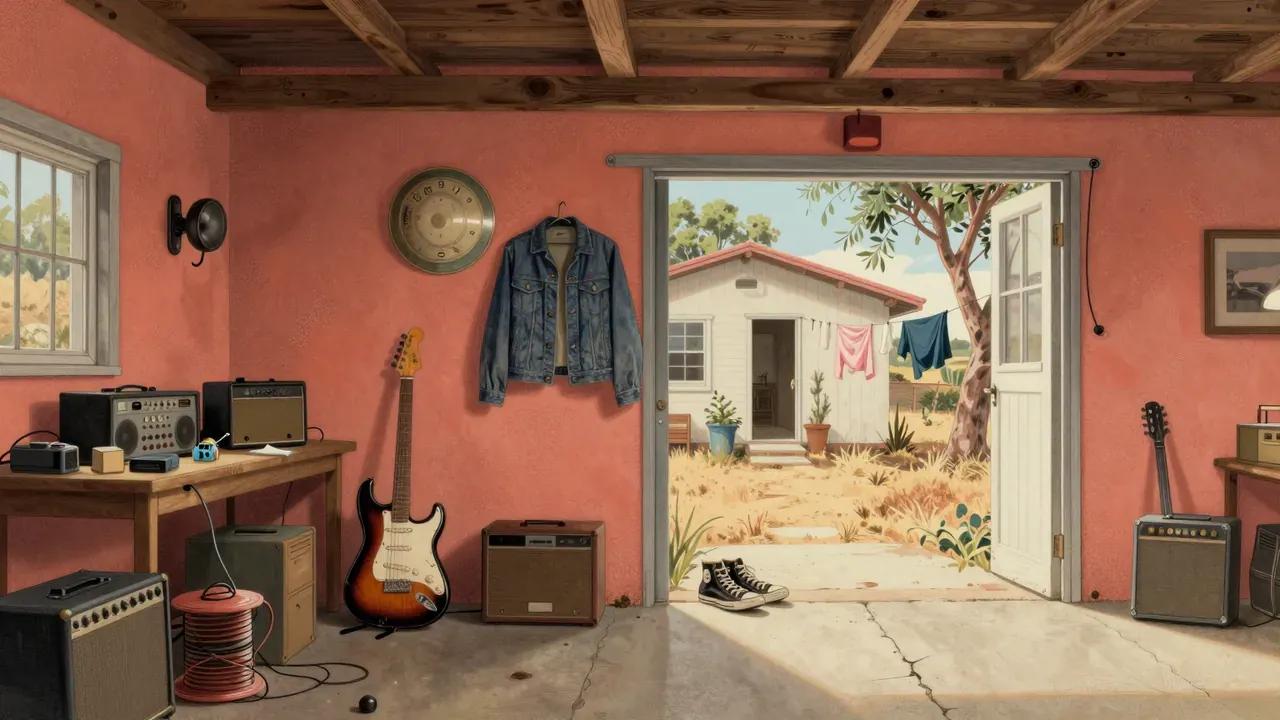
The boy in the frame
La Bamba is a biographical film about Ritchie Valens, the Mexican-American rock and roll singer who died aged seventeen in the 1959 plane crash that also killed Buddy Holly and J.P. Richardson. It aims to anchor his brief life in its domestic and cultural soil: a working-class Chicano family in late-1950s California, the friction between tradition and assimilation, and the sudden, destabilising force of fame. Luis Valdez writes and directs with clear intent to treat Valens not as myth but as boy — one shaped by his mother’s quiet resilience, his half-brother’s volatility, and his own fear of flying, which the script names and returns to like a motif. The film does not attempt forensic biography; it compresses time, simplifies relationships, and elevates certain emotional truths over chronological fidelity. Its ambition is modest but precise: to make Valens’ music feel earned, his loss felt, and his identity legible within American pop history without flattening its specificity. It is not a critique of the music industry, nor a dissection of mid-century racism, though both are present as background pressures. It is, first and foremost, a portrait held steady at eye level.
How it holds still
The story follows Richie Valens from farmhand to chart-topping teen, pivoting on key relationships — with his mother Connie, his half-brother Bob, and girlfriend Donna — rather than on studio sessions or tour logistics. Lou Diamond Phillips carries the film with physical ease and vocal conviction, singing all songs live on set, backed by Los Lobos’ arrangements. Esai Morales gives Bob a coiled, wounded presence that avoids caricature, while Rosanna DeSoto grounds the family scenes in unspoken fatigue and care. Adam Greenberg’s cinematography favours warm, shallow-focus interiors and sun-bleached exteriors, avoiding period pastiche in favour of lived-in texture. Carlos Santana’s score weaves Valens’ originals with subtle orchestral colouring, never overwhelming the diegetic performances. Don Brochu’s editing sustains momentum across episodic beats — the garage party, the Tijuana brothel, the Brooklyn Paramount — without forcing false urgency. The craft is consistent, unshowy, and calibrated to serve character over spectacle, with no single sequence straining for symbolic weight or stylistic flourish.
The weight of small things
What lands is the domestic gravity: the kitchen table where Connie mends clothes while listening to her son’s first record, the silence after Bob smashes the curandero’s talisman, the way Richie’s voice catches slightly when he sings ‘Donna’ on American Bandstand. These moments gain resonance because they are understated and anchored in behaviour rather than exposition. The film’s treatment of bilingualism feels natural — Spanish phrases enter without translation, untranslated, as part of the household air. The casting of real family members, including Ritchie’s mother as an extra, adds quiet authenticity without sentimentalising memory. Los Lobos’ cameo in the Tijuana ballroom works precisely because it refuses to wink: they are just another band in a dim room, playing the same folk song Valens would later reinvent. The film’s best scenes do not dramatise success but its aftermath — the awkwardness of returning home famous, the exhaustion behind the smile at Christmas, the way Bob’s resentment tightens his jaw before he throws the first punch. These register because they are observed, not announced.
Where the light doesn’t fall
What does not land is the structural thinness around Valens’ artistry. His songwriting process is reduced to a few lines of dialogue or a single take at the piano; the transformation of ‘La Bamba’ from regional folk tune to rock anthem is presented as instinct rather than labour. The music-business mechanics — Del-Fi’s operations, Keane’s strategy, radio promotion — remain vague, leaving Ritchie’s rise feeling fated rather than fought for. Some supporting characters flatten under narrative pressure: Donna remains defined almost entirely by her father’s disapproval and her love for Ritchie, while Rosie’s pregnancy and delivery happen off-screen, reducing her arc to plot function. The Winter Dance Party tour appears only in its final hours, stripping away the grind and camaraderie that might have complicated Ritchie’s isolation. The film’s restraint becomes a limitation in these places: where ambiguity serves character, omission erodes context. It assumes familiarity with the era’s racial codes without showing their daily operation — a missed opportunity, given how centrally identity shapes Ritchie’s journey.
What gets cut short
The themes that matter are inheritance and interruption. Inheritance operates in multiple registers: musical (the ‘La Bamba’ melody passed down, then remade), familial (Bob’s anger echoing his father’s absence, Richie’s ambition shadowed by his brother’s failure), and cultural (the tension between Connie’s Mexican roots and the Anglo-dominated world Ritchie enters). Interruption is the film’s quiet engine: the mid-air collision that kills Richie’s friend and seeds his aviophobia; the phone call cut short before the crash; the funeral procession that ends not with resolution but with Bob screaming into empty air. These are not metaphors but facts the film treats as structural — life halted mid-sentence, mid-song, mid-reconciliation. The film resists closure, refusing to frame Ritchie’s death as tragic irony or noble sacrifice. Instead, it lingers on the ordinary aftermath: the untouched guitar, the half-packed suitcase, the silence where a laugh used to be. This refusal to monumentalise makes the grief feel local, specific, and enduring — less about lost potential than about the sheer, unremarkable weight of what was taken.
Who it speaks to, and who it doesn’t
This film is for viewers who value character-driven biopics that foreground domestic texture over myth-making, and for those interested in Chicano cultural history as lived experience rather than political statement. It rewards attention to gesture, silence, and the rhythms of family speech. It is not for viewers seeking granular music-industry detail, formal experimentation, or psychological excavation beyond what the script provides. Those who expect biopics to interrogate systemic barriers — or to dramatise how race shaped Valens’ career beyond Donna’s father’s disapproval — may find its approach too contained. A viewer who values historical precision over emotional fidelity will likely leave dissatisfied. The film’s power rests in its narrow focus; widen the lens even slightly, and its carefully balanced tone begins to waver. Its appeal is cumulative, not immediate — built across small, repeated choices rather than singular set-pieces.
Why it stays with you
Yes, it is worth your evening — not as a definitive account of Ritchie Valens, but as a sustained, respectful act of remembrance rendered in plain, warm light. It earns its runtime by trusting the audience to sit with quiet moments: Richie tuning a guitar in the garage, Bob staring at a broken taillight, Connie folding laundry while the radio plays ‘Donna’ for the first time. Its virtues are modest but consistent: Phillips’ performance, Greenberg’s restrained camerawork, the authenticity of its Californian locations, and the way Los Lobos’ arrangements root Valens’ music in something older and deeper than teenage stardom. It does not demand admiration, only attention — and repays that attention with dignity, not dazzle. Those who dismiss it as ‘conventional’ mistake its discipline for conventionality. Its restraint is deliberate, its warmth earned, its ending neither redemptive nor despairing, but simply true.