A thriller that kept coming out funny
Dr. Strangelove is Stanley Kubrick’s 1964 black comedy about a paranoid American general who orders a nuclear strike on the Soviet Union, and the scramble by the President, his advisors and a visiting RAF officer to recall the bombers before the world ends. Kubrick began developing it as a straight thriller, adapting Peter George’s novel Red Alert after economist Thomas Schelling praised the book’s grasp of nuclear strategy; only partway through writing the script did Kubrick notice that every realistic scenario he worked out came out absurd, and rather than suppress that, he rewrote the project as what he called a nightmare comedy. Considered titles along the way included Dr. Doomsday and Wonderful Bomb before he settled on one that parodies Dale Carnegie’s self-help book How to Stop Worrying and Start Living.
Three roles for Sellers, one vast concrete room
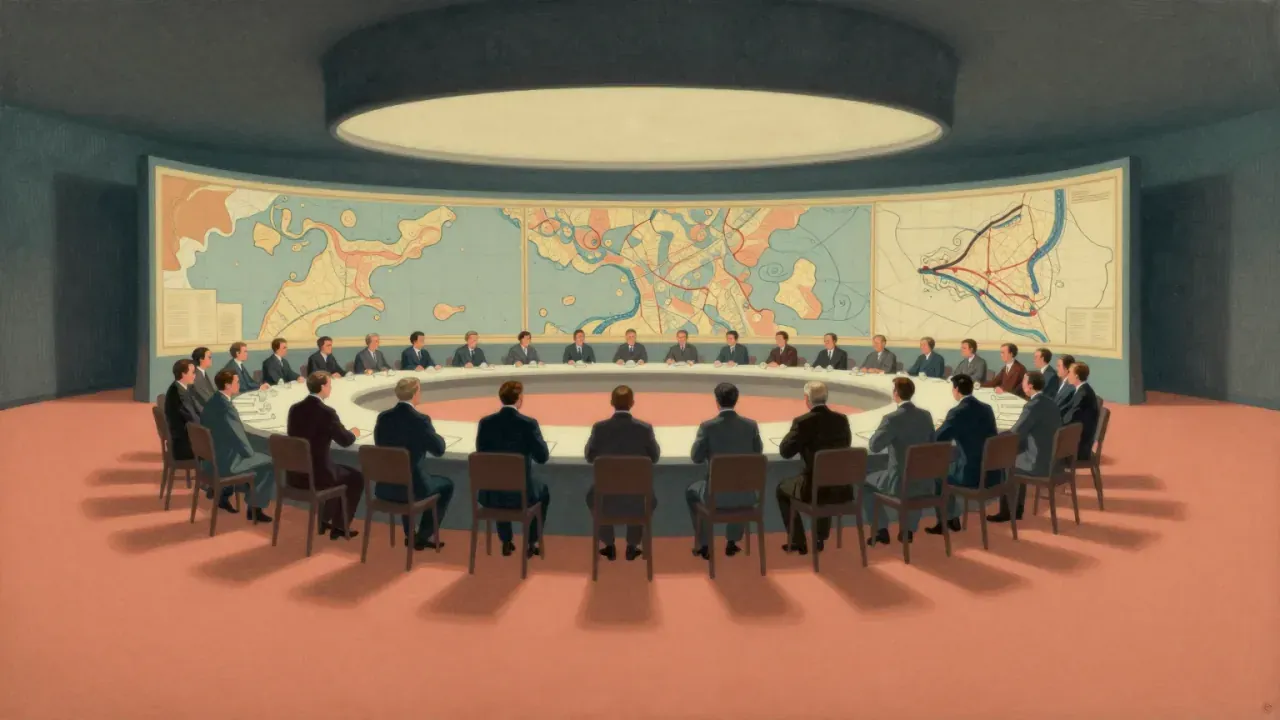
Peter Sellers plays three roles: the ineffectual President Muffley, the wheelchair-bound former Nazi scientist Dr. Strangelove, and the RAF officer Mandrake, trapped with the general who started the crisis. George C. Scott, as the blustering Joint Chiefs chairman General Turgidson, was reportedly persuaded by Kubrick to give looser, more exaggerated takes by being told they were only practice runs. Production designer Ken Adam, known for his James Bond sets, built the War Room as a vast triangular concrete chamber, 130 feet long with a 35-foot ceiling, lit only by a ring of overhead lamps around a table Kubrick insisted on covering in green baize so the actors would feel they were playing poker for the fate of the world, even though the black-and-white film could never show the colour.
A cockpit accurate enough to worry its own director
The War Room set is the film’s clearest achievement: its scale and its single circle of light give every scene inside it the look of a ritual rather than a meeting, and critics at the time compared its expressionist design to The Cabinet of Dr. Caligari and Metropolis. Sellers’s three performances rarely overlap on screen, yet each pulls the film’s tone in a different direction, from Mandrake’s stiff-upper-lip helplessness to Strangelove’s twitching, barely controlled reflexes, and the contrast between them is where much of the film’s comedy actually lives. The reconstructed B-52 cockpit, built without any Pentagon cooperation from a single photograph and a B-29 for comparison, was later judged accurate enough by Air Force personnel that Kubrick worried the production had broken the law simply by getting it right.
Comedy that occasionally waits on exposition
The film’s satire depends on keeping every character convinced of their own reasonableness, which means comic momentum occasionally slackens whenever a scene needs actual plot information delivered rather than absurdity performed; the exposition around the Doomsday Device in particular slows a film that otherwise moves briskly. Slim Pickens’s General Kong, the most straightforwardly comic performance, sits at a slight tonal distance from Sellers’s more controlled work, and the difference is noticeable on repeat viewings even if it never breaks the film’s momentum. A visible shadow of the camera plane across the Arctic ice in several exterior shots is a small production flaw that a modern viewer, unlike a 1964 audience, will likely spot.
Procedure as the real danger
Cold War paranoia is the film’s obvious subject, but its sharper target is the institutional machinery built to manage that paranoia: every character trusts a system of protocols, codes and second-strike doctrine that turns out to guarantee catastrophe rather than prevent it. Power in the film is inseparable from procedure, since neither the general who starts the crisis nor the officials trying to stop him ever step outside the rules long enough to simply end it, and that adherence to process is presented as the real danger rather than any single villain. Fear operates almost entirely through comedy here, converting the era’s genuine dread of mutual assured destruction into farce without ever pretending the underlying threat isn’t real.
Who the bureaucratic satire is built for
This suits viewers who want political satire built on procedure and character rather than incident, admirers of Sellers working at the extreme edge of his range, and anyone interested in how a serious Cold War thriller mutated into one of the more purely absurd comedies ever made. It is a weaker match for viewers wanting the fast plotting of a straight thriller, since much of the film’s pleasure comes from watching bureaucratic dialogue spiral rather than from incident. Some of the era-specific political and military references also require a little context that a contemporary viewer may not bring to it unprompted.
A joke that still lands sixty years later
Reviewers have converged almost entirely: 98 percent on the Tomatometer, a 97 Metascore and an average viewer rating above 9 out of 10, and the American Film Institute has ranked it among both the greatest and the funniest American films ever made. At 93 minutes it never wastes a scene, and its central joke, that the people responsible for preventing nuclear war are no more capable than anyone else, has not dated even as the specific Cold War politics around it have. It is worth an evening for anyone willing to take a subject this serious and watch it played entirely straight-faced as comedy, which is precisely the trick the film pulls off.