A stuntman who drives at night
Drive follows an unnamed stunt driver who takes freelance jobs as a getaway wheelman, a split identity Nicolas Winding Refn found more interesting than anything else in Hossein Amini’s script. Producers Marc Platt and Adam Siegel had optioned James Sallis’s 2005 novel years earlier, and after a string of attached directors and stars fell away, Ryan Gosling signed on and was given the unusual right, for an actor at his stage, to pick his own director. He chose Refn specifically. The Driver grows close to his neighbour Irene and her son while her husband Standard, freshly out of prison and in debt to men he can’t pay off, is drawn into a heist that the Driver agrees to help with — a decision that detonates the rest of the film.
Amini’s rewrite of a nonlinear novel
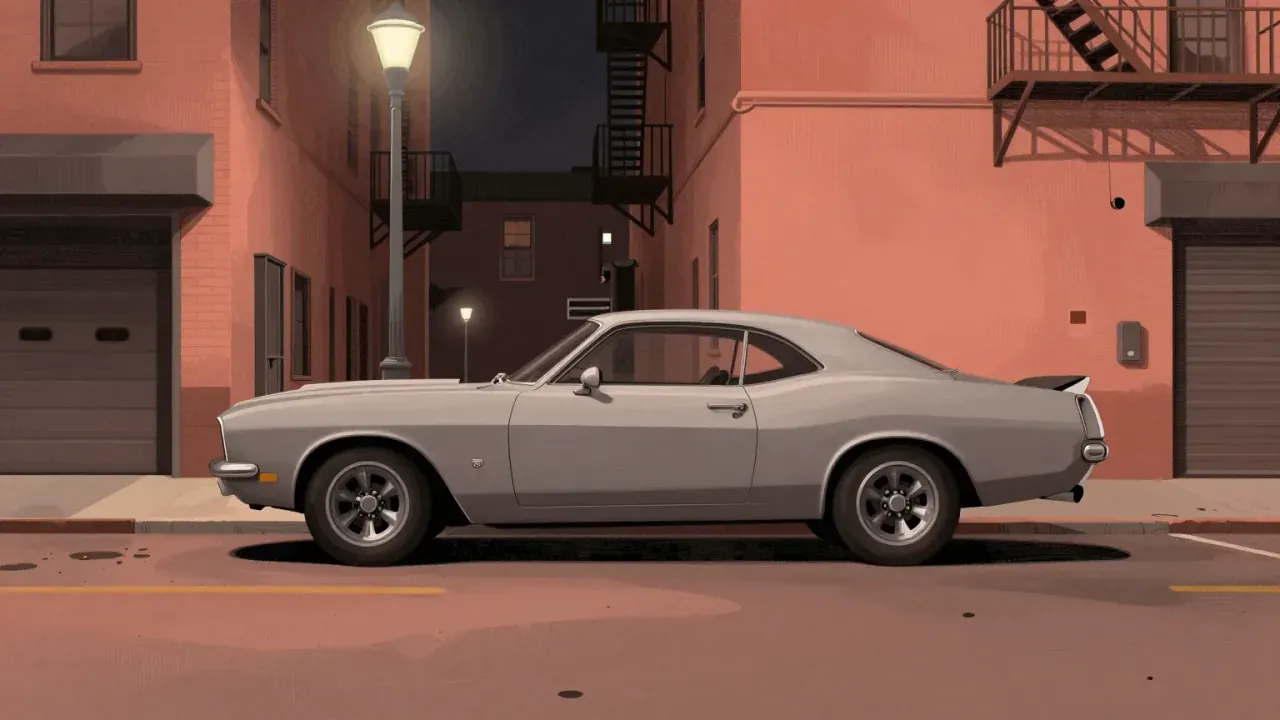
Sallis’s novel moves in fragments, doubling back on its own timeline, and Amini has said adapting it was difficult precisely because the source material wasn’t built to be read as a straight line. His script trades that structure for a more conventional forward momentum while keeping the novel’s spare, unsentimental tone intact. Filming ran from late September to mid-November 2010 in Los Angeles, with Newton Thomas Sigel shooting the city mostly at night, all sodium lighting and empty streets. Matthew Newman’s editing lets scenes run longer than a typical thriller would allow, particularly in the film’s first half, before compressing time sharply once the heist collapses — a structural choice that mirrors the source novel’s disorientation without copying its chronology.
Gosling saying almost nothing
Gosling plays the Driver almost entirely through posture and timing rather than line readings; long scenes pass with no dialogue, including much of his courtship of Irene, played by Carey Mulligan in her first role after an Academy Award nomination for An Education. Bryan Cranston, as the Driver’s garage boss and sole ally, gives the film its only consistently warm presence, while Albert Brooks, cast against his comic persona, plays a mob-connected producer whose calm delivery makes him the film’s most unsettling figure rather than its most obviously threatening one. Refn doesn’t ask any of them to explain their characters’ histories, and the performances are built around what’s withheld rather than what’s said.
Violence that arrives without warning
The film’s violence arrives in short, graphic bursts after long stretches of quiet, a contrast pointed enough that some critics who admired the direction, cinematography and performances were nonetheless appalled by specific scenes, including an elevator sequence that shifts from tenderness to brutality in seconds. That whiplash is clearly intentional — Refn is using the quiet not as padding but as a way of making the violence land harder when it comes — but it does mean the film’s second half reads as a different, harsher object than its first. Some early reviewers worried the graphic content would limit the film’s commercial prospects, though it went on to gross nearly five times its $16 million budget.
A man defined by what he does, not who he is
The Driver has no name, almost no backstory, and is defined entirely by competence at two related, dangerous jobs. That refusal to fill him in is the film’s real subject: masculinity here is presented as a set of skills and a code of loyalty rather than a personality, and the film is more interested in watching that code get tested than in explaining where it came from. Los Angeles itself functions less as setting than as a second character — an anonymous, sprawling city that suits a man who has deliberately made himself hard to place. The romance with Irene works because it’s underwritten in the same register: two people communicating mostly through what they don’t say to each other.
Who this is for
This is a film for viewers happy to sit with mood over incident — long silences, a persistent synth pulse from Cliff Martinez, and a plot that moves slowly until it suddenly doesn’t. Anyone drawn to Gosling’s more withholding performances, or to Refn’s visual control, will find both at full strength here. It’s a poor match for viewers expecting a conventionally plotted heist thriller with regular momentum, since large sections of the film are built around stillness rather than event, and the abrupt violence, when it comes, is graphic enough to be genuinely unpleasant rather than stylised in a way that softens it.
Is it worth the evening
Drive won the Best Director prize at Cannes for Refn and later picked up an Amanda Award and a National Board of Review nod for its list of the year’s best films; critics logged it at 93% on Rotten Tomatoes and 79 on Metacritic, figures that reflect a genuinely divided initial response rather than consensus. On rewatch, the film holds up less as a plot than as a mood piece, one that trusts silence and restraint over incident to a degree few genre films risk. That confidence is what has kept its cult following growing since 2011, and it’s reason enough to spend the evening with it, provided the pace and the sudden violence are the kind of trade-off a viewer wants to make.