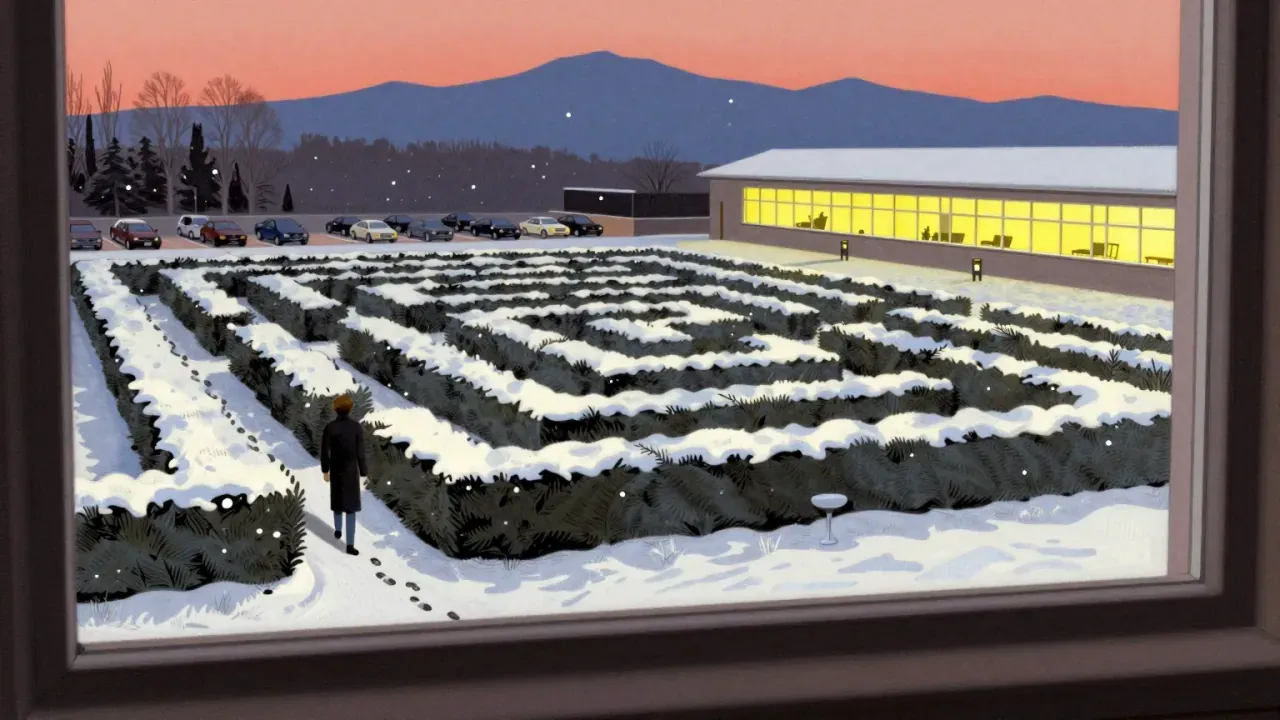
A caretaker’s job built on constructed sets
The Shining is Stanley Kubrick’s adaptation of Stephen King’s 1977 novel, following a recovering alcoholic and struggling writer, Jack Torrance, who takes a winter caretaker job at an isolated mountain hotel with his wife Wendy and clairvoyant son Danny. Kubrick wrote the script with novelist Diane Johnson after rejecting King’s own draft as too literal a transcription of the book, a choice that put the two men at odds from the start and that King never fully forgave. Produced through Kubrick’s Hawk Films and shot almost entirely at EMI Elstree Studios in England rather than on American locations, the film builds the hotel’s corridors and ballrooms as constructed sets rather than a real building, giving Kubrick total control over their geometry. On a $19 million budget it went on to gross $44 million, a modest return given the scale of its ambition.
Nicholson’s escalation and the Steadicam’s glide
Jack Nicholson, Kubrick’s first choice over actors including Robert De Niro and Robin Williams, plays Torrance’s descent from irritable to murderous in stages exaggerated enough that some contemporary critics found the character unstable from his very first scene. Shelley Duvall’s Wendy, written as more fragile than King’s original character, absorbs most of the film’s tension through visible physical strain, the product of a shoot on which Kubrick reportedly demanded dozens of takes from her to provoke the reaction he wanted. Cinematographer John Alcott used the then-new Steadicam rig to follow Danny’s tricycle through the hotel’s empty halls in single unbroken takes, a technique that gives the space a fluid, wrong-feeling continuity. Wendy Carlos’s electronic score and Ray Lovejoy’s editing, favouring long holds and abrupt cuts over conventional scares, replace jump-scare rhythm with slow, accumulating dread.
Where the camera and the cast pay off
The Steadicam corridors are the film’s clearest technical achievement, turning simple tracking shots of a child on a tricycle into a source of dread purely through the smoothness of the camera’s movement and the disorienting layout of a hotel whose windows and hallways do not obey any consistent floor plan. Nicholson’s delivery in the film’s most quoted scenes, where Torrance addresses his family through a broken door, works because Kubrick lets the performance run past the point of comfort rather than cutting away from it. The hotel’s design, built from real hotel and lodge references but arranged into a space that could not actually exist, gives the film a wrongness that survives repeat viewings. Danny Lloyd, protected by Kubrick from knowing he was making a horror film at all, gives a performance that reads as genuinely unnerved rather than acted.
Where the adaptation loses King’s sympathy
King’s objection to the film - that it discards the novel’s sympathy for Torrance as a man fighting his own addiction and instead presents someone unstable from the outset - is a fair description of a real problem: there is little sense of a good man being worn down, only a bad one being revealed by degrees. Wendy’s diminishment from the novel’s more capable character into someone largely defined by fear reduces one of the story’s two survivors to a function of Jack’s threat rather than a person actively managing it. At 144 minutes, several sequences, particularly Jack’s bar conversations with the ghostly bartender Lloyd, restate the hotel’s influence over him more than they develop it, and the film’s ambiguity about what is supernatural and what is Jack’s own collapse is sometimes simply left unresolved rather than productively so.
A family under strain before the ghosts arrive
The hotel functions less as a haunted building than as a magnifier of a family already under strain - Jack’s drinking, his resentment of his own failed writing career, and Wendy and Danny’s fear of him all predate anything supernatural on screen, and the Overlook mostly seems to encourage tendencies that were already there before the season began. Danny’s visions give the film its title and its clearest instance of psychology made literal: a child’s fear of his father rendered as premonition rather than metaphor. Kubrick’s stated interest was in the human personality’s capacity for cruelty rather than in ghosts as such, and the film keeps its violence domestic even when it dresses that violence in supernatural imagery - a locked bathroom door and an axe do most of the actual frightening, not spectres.
Who this rewards, and who wants clearer rules
This suits viewers who want horror built from unease and architecture rather than jump scares, and anyone interested in Kubrick’s or Nicholson’s careers, since both are working at a register neither had attempted before. Fans of King’s novel should come prepared for a film that keeps the setting and some of the incidents but drops the book’s sympathy for Torrance almost entirely, which is why King disliked it enough to later commission his own miniseries adaptation. It is not for viewers wanting a faithful adaptation, nor for those wanting fast pacing - the film moves slowly by design, and its scares depend on patience with long, quiet stretches between them. Younger or more literal-minded horror audiences expecting a monster or a ghost with clear rules may find its ambiguity frustrating rather than unsettling.
A reputation built well after release
Reappraised well beyond its mixed 1980 reception - a Metascore in the high sixties from contemporary critics against a Tomatometer in the mid-eighties from a wider retrospective sample - the film has earned its reputation as one of horror’s most closely studied works, down to individual carpet patterns and camera moves. Its Golden Raspberry nominations for Worst Director and Worst Actress, one of them rescinded decades later once the treatment behind Duvall’s performance became better known, look now like the clearest sign of how badly its first audience misjudged what they were watching. The pacing demands a full, undistracted evening rather than background viewing, but the Steadicam sequences and Nicholson’s performance alone justify the time spent. It holds up as craft even where its faithfulness to the source material clearly falls short.