Scaring children as a power utility
Monsters, Inc. imagines child-scaring as an actual industry: Sulley and Mike work the door-shift floor of a factory that converts children’s screams into a city’s electricity supply, competing against colleagues for scream quotas while believing, as their entire culture does, that children are toxic to the touch. When a small girl named Boo slips through a door and into the factory, the film’s premise flips — the monsters afraid of children turn out to be right to fear exposure, just not for the reason they think — and Sulley and Mike have to smuggle her back home before anyone notices. Pete Docter directs, working from a story idea that dates back to a 1994 brainstorming lunch that also produced the seeds of several other Pixar films.
Five years and several scrapped premises
The production took roughly five years and went through several full concept changes — Docter’s earliest version involved an adult man’s childhood fears returning to haunt him, before the story settled into a buddy comedy between an up-and-coming scarer and a small child. Technical work on Sulley’s fur, which had to move convincingly across a character built at eight feet tall, pushed Pixar’s simulation software further than any previous production, and animators had to solve how cloth and fur would interact in the same shots without either looking artificial. Randy Newman, scoring his fourth consecutive Pixar film, keeps the music buoyant even during the factory’s tenser sequences, which helps sell the film’s insistence that this dangerous-seeming world runs on ordinary office politics.
A workplace comedy that never breaks character
The factory setting itself is the film’s best joke, sustained rather than thrown away after the opening: safety inspections, a rival scarer’s showboating, and a corporate cover-up all play out with the texture of a real workplace comedy, which makes Boo’s arrival feel like an actual disruption to a functioning system rather than a plot device dropped into empty space. Mike Wazowski’s public-facing bravado versus his private panic gives Billy Crystal’s performance somewhere to go beyond comic relief. The late realization that a child’s laughter generates more power than a scream reframes the entire economy the film has spent an hour establishing, and it does so through a sight gag rather than a speech.
Where Randall and the vault chase thin out
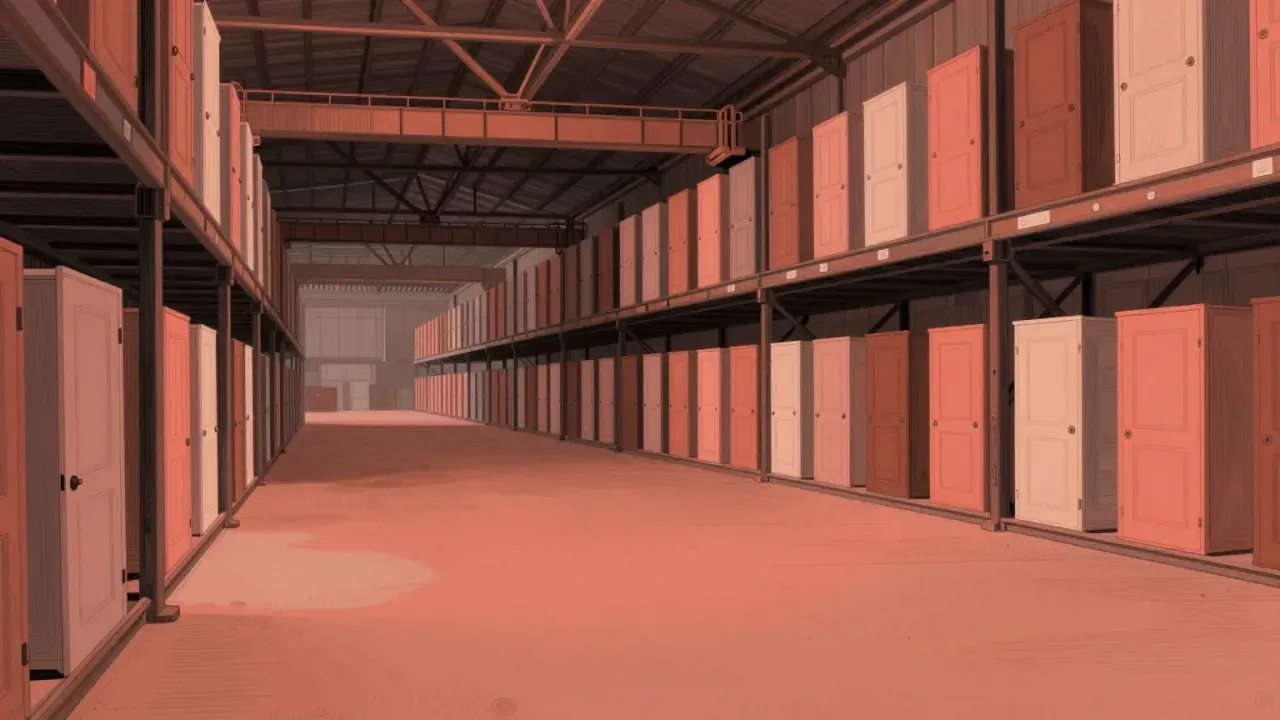
Randall Boggs, the film’s antagonist, is functionally underwritten next to Sulley and Mike — his motivation amounts to professional jealousy escalated into corporate sabotage, and he disappears from the story’s emotional core well before the climax. Some of the factory-floor world-building, elaborate as it is, doesn’t fully pay off once the plot shifts into a chase across the door vault in the final act, which trades the earlier workplace specificity for more generic action-movie mechanics. A handful of scenes meant to establish monster-world customs run longer than the plot strictly needs.
A culture organized around a lie
The film’s real subject is how an entire culture can organize itself around a fear that turns out to be a lie: monsters believe children are toxic because that belief keeps the scare economy running, not because it’s true, and the factory’s leadership has every incentive to keep the lie in place once a cheaper energy alternative appears. Boo’s total lack of fear toward the monsters, treating them as playmates rather than threats, exposes the arbitrariness of the whole system faster than any argument could. Sulley’s arc, from a scarer optimizing his numbers to someone risking his career and safety for a child he isn’t supposed to even acknowledge, gives the corporate satire an emotional stake beyond the workplace joke.
Who the corporate satire suits
This suits viewers who enjoy a workplace comedy dressed up as a monster movie, and parents wanting a story that treats a small child’s fearlessness as a genuine narrative engine rather than cute set dressing. It also rewards anyone interested in animation’s technical history, given how much of Pixar’s later fur and cloth work traces back to problems solved here. It’s a weaker choice for anyone wanting a straightforward scare-comedy without the corporate-satire layer, since a fair amount of the humor depends on recognizing office and factory tropes rather than monster tropes.
Why the twist still lands on rewatch
At 92 minutes, Monsters, Inc. gets through set-up, reversal and resolution without padding, and a $632 million worldwide gross against a $115 million budget — the studio’s most expensive production up to that point — suggests the five-year development process paid for itself. The Best Original Song win for If I Didn’t Have You is a smaller honor than the film’s overall craft deserves, but it’s evidence the music mattered as much to voters as the visuals. Worth the evening for the door-vault chase and the scream-to-laugh reveal alone, both of which still land regardless of how many times the ending’s twist has been spoiled.