A stanza in a longer poem
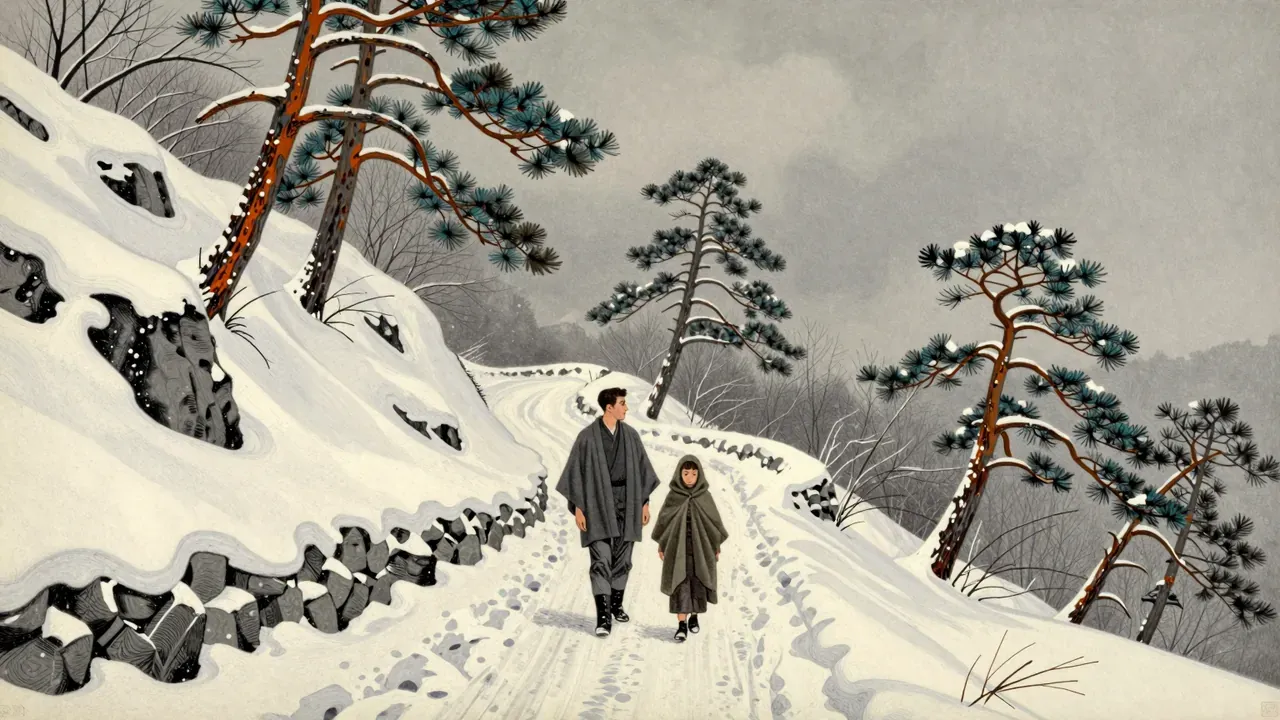
Zatoichi’s Vengeance is the thirteenth entry in Daiei Film’s Zatoichi series, a mid-1960s Japanese chambara built around Shintarō Katsu’s blind itinerant masseur. It does not attempt reinvention: it sustains the series’ established rhythm—travel, encounter, moral pressure, calibrated violence—within tight formal constraints. The film works within the conventions of studio-era genre filmmaking: episodic structure, economical exposition, recurring motifs (the biwa, the rain-slicked road, the bridge), and a protagonist whose agency derives from perception rather than sight. Its aim is continuity—not expansion of the character’s psychology or critique of the genre, but fidelity to the figure’s quiet authority and the world’s unspoken codes. It assumes familiarity with Zatoichi’s habits: his restraint, his refusal of status, his tolerance for minor corruption until it hardens into cruelty. This is not a standalone story but a stanza in a longer poem, written for viewers who already know the metre. (158 words)
The look of it
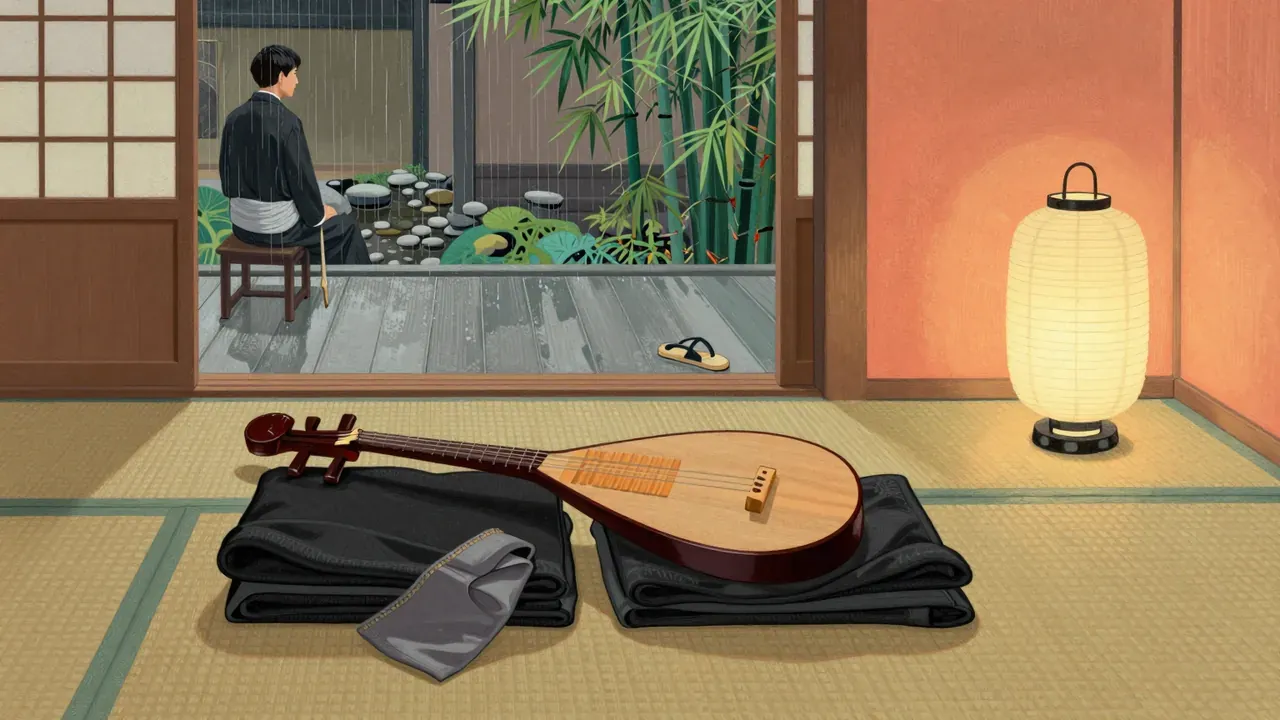
The story moves briskly: Zatoichi accepts a dying man’s burden, then shares the road with a blind priest before arriving at a town dominated by Boss Gonzo. Hajime Takaiwa’s script gives little backstory to the yakuza or the townsfolk, trusting gesture and posture to convey hierarchy and fear. Katsu’s performance remains grounded—no flourishes, no self-conscious ‘blindness’, just stillness punctuated by precise, unhurried movement. Jun Hamamura’s priest offers subtle counterpoint: less stoic, more sardonic, his biwa playing a narrative device as much as a musical one. Kazuo Miyagawa’s cinematography avoids grandeur; he frames interiors with shallow depth, lets shadows pool in corners, and keeps daylight flat and unsentimental. Akira Ifukube’s score is restrained—percussion-led, sparing in melody—supporting action without swelling it. Yoshinobu Nishioka’s sets are functional, not ornate: the thunder drum festival feels lived-in, not staged. There is no attempt at realism, but neither is there stylisation for its own sake: every choice serves duration, clarity, and tone. (159 words)
What lands
What lands most securely is the film’s sense of proportion. The bridge fight—its climax—is not choreographed for spectacle but for consequence: Zatoichi’s movements are economical, his opponents’ reactions delayed just long enough to register threat before collapse. The rain, the narrow planks, the drumming crowd below—all function as environmental pressure, not backdrop. Miyagawa’s camera stays low, close, never cutting away to reaction shots, preserving Zatoichi’s point of view even in motion. The relationship between Zatoichi and the priest lands because it avoids exposition: their mutual recognition is conveyed through shared silences, parallel gestures, and the way they hold space in the same frame without needing to face each other. Mayumi Ogawa’s Ocho carries quiet weight—not as a plot device but as someone whose choices are legible without explanation. The film trusts its audience to infer motive from behaviour, and that trust is repaid in moments where tension builds not from music or editing but from a pause before a hand reaches for a cane. These are small victories, but they are consistent and cumulative. (157 words)
Where the frame thins
What does not land is the yakuza boss, Kei Satō’s Gonzo. He is drawn too broadly: his menace relies on volume and posture rather than presence, and his motivations remain opaque beyond generic greed. The town’s subjugation feels schematic—there are no individual faces among the oppressed, no detail that makes their fear specific or earned. The dying man’s opening gift of money and the name ‘Taichi’ introduces a thread that frays without resolution; it functions as plot glue, not thematic anchor. The thunder drum festival, though visually distinct, lacks narrative integration—it is atmosphere without consequence, a set piece that could be swapped for any seasonal gathering without altering the stakes. The film’s brevity works against it here: at eighty-three minutes, there is no room to deepen secondary characters or clarify moral gradations. Everyone outside Zatoichi and the priest operates at a remove, speaking in proverbs or threats without texture. This is not incompetence but compression—yet compression that sacrifices coherence for pace leaves gaps no amount of craft can fully conceal. Some viewers will find this austerity admirable; others will feel the world is sketched, not inhabited. (159 words)
What it holds without saying
The themes that matter are obligation and perception. Zatoichi accepts the dying man’s burden not out of duty but because refusal would violate an unspoken contract between travellers—between those who move and those who cannot. His blindness is never framed as limitation but as recalibration: he hears the tremor in a voice before seeing a clenched jaw, senses the shift in weight before a blade draws. The blind priest mirrors this—not as rival or foil, but as counterpart whose biwa both records and interprets the world. The film treats sound as evidence, silence as intent. Power, meanwhile, is shown not in declarations but in extraction: Gonzo’s control is measured in rice quotas and withheld festivals, not speeches. Justice is procedural, not rhetorical: Zatoichi does not judge, only intervenes when balance tips past endurance. There is no redemption arc, no moral lecture—only the quiet insistence that some lines, once crossed, cannot be uncrossed without consequence. These ideas are not argued but embedded in pacing, in shot duration, in the way a door closes slowly after violence ends. They do not require articulation because the film’s form enacts them. (156 words)
Who walks this road
This film is for viewers who value economy over exposition, who recognise that a character’s weight can reside in how they hold a walking stick rather than what they say about it. It suits those already familiar with the Zatoichi series—or with mid-century Japanese studio genre work—because it presumes fluency in its visual grammar and moral shorthand. It is not for viewers who require psychological motivation for antagonists, or who expect world-building beyond what a single town square and a bridge can hold. Those who rely on dialogue to establish stakes may find the film withholding; those who expect thematic elaboration may find it taciturn. A viewer new to chambara might mistake its restraint for emptiness. But the verdict rests on intention: this is not a film that failed to develop its ideas—it chose not to. Change the runtime to two hours, add three scenes of Gonzo’s backstory, and it becomes a different film—one less certain of its own terms. (159 words)
Is it worth your evening
Yes, it is worth your evening—if your evening includes patience for understatement and respect for craft that serves character over concept. It rewards attention to composition, to timing, to the way light falls across a tatami mat. It is not a landmark film, nor a culmination: it is a well-made instalment, confident in its place in a sequence. Those who want revelation will leave unsatisfied; those who appreciate consistency, precision, and the dignity of repetition will find it quietly satisfying. It does not ask to be loved, only to be met on its own terms—and it meets those terms without strain. To dismiss it as ‘just another Zatoichi’ is to miss how precisely it fulfils the series’ contract: no excess, no apology, no deviation. A viewer who dislikes it likely values narrative propulsion over atmospheric cohesion—or expects a 1966 film to behave like a 2024 one. That is not a flaw in the film, but a mismatch of expectation. (158 words)