The grave at Itakura
Zatoichi and the Chest of Gold is the sixth entry in Daiei’s 26-film Zatoichi series, released in March 1964. It attempts to deepen the character’s moral weight while expanding the formal language of the jidaigeki genre beyond its established rhythms. Unlike earlier instalments, it introduces a more self-conscious visual syntax — notably in montage sequences and credit design — and shifts focus from episodic duels to systemic corruption: tax extortion, bureaucratic complicity, and the vulnerability of rural communities under feudal administration. The film treats Zatoichi not as a wandering avenger but as a reluctant witness who becomes an instrument of restitution. Its ambition lies in threading political consequence through personal memory — the grave visit at the start anchors Ichi’s actions in accountability, not just reflex. It does not seek novelty for its own sake, but uses structural departures — like the vertical swish-pan noted by Video Watchdog — to mirror the destabilisation of social order. This is a mid-series recalibration: less about proving Zatoichi’s skill, more about testing what his presence can unsettle. (158 words)
The chest and the ambush
The story moves with deliberate economy: a stolen chest of gold binds villagers, bandits, constables, and officials into a chain of betrayal that Zatoichi unpicks step by step. Shintarō Katsu’s performance remains grounded — no grand speeches, few raised voices — his stillness making each intervention precise. Tomisaburō Wakayama’s Jushiro carries menace without caricature; his whip is both weapon and symbol of arbitrary authority. Kazuo Miyagawa’s cinematography avoids high contrast in favour of textured mid-tones, letting smoke, steam and dusk soften edges without obscuring action. Ichirō Saitō’s score uses shamisen sparsely, reserving strings for moments of civic tension rather than swordplay. The script by Asai and Ōta tightens exposition into implication: when Chiyo overhears Ichi speaking at the grave, no flashback explains the past fight — we infer it from her silence and his posture. Fight choreography stays functional, not flamboyant; even the final duel at Bodai Temple prioritises spatial logic over flourish. The film trusts its audience to follow cause and consequence without emphasis. (159 words)
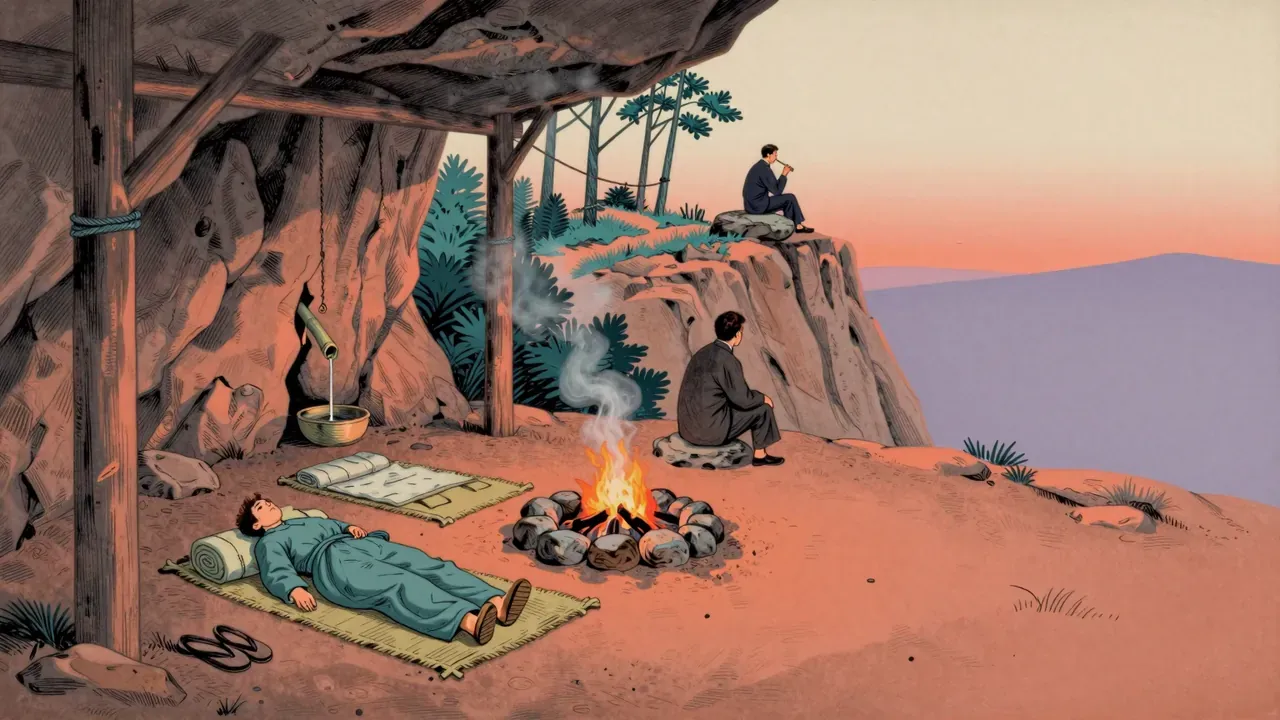
The bandit’s mountain
What lands is the quiet accumulation of moral pressure. The villagers’ three-year drought, their collective effort to raise 1,000 ryo, their panic when ambushed — these register because the film refuses to sentimentalise them. Ichi’s pipe-smoking vigil atop the chest is neither heroic nor ironic; it is simply the only thing he can do in that place, at that time. The scene at the onsen, where he squirts peeping men without turning his head, lands not as comedy but as calibrated reassertion of agency — blindness is not helplessness, but a different kind of attention. Chuji’s decision to walk away from banditry feels earned because it follows not redemption but exhaustion: he hears his men confess, then looks at Ichi and sees no judgment, only fatigue. The receipt Gundayu is forced to sign matters precisely because it is bureaucratic — a piece of paper, not a speech — restoring dignity through procedure. Even the vertical swish-pan works: it disorients not to dazzle, but to convey how quickly communal resolve fractures when muskets appear. These moments land because they are anchored in material consequence, not thematic assertion. (157 words)
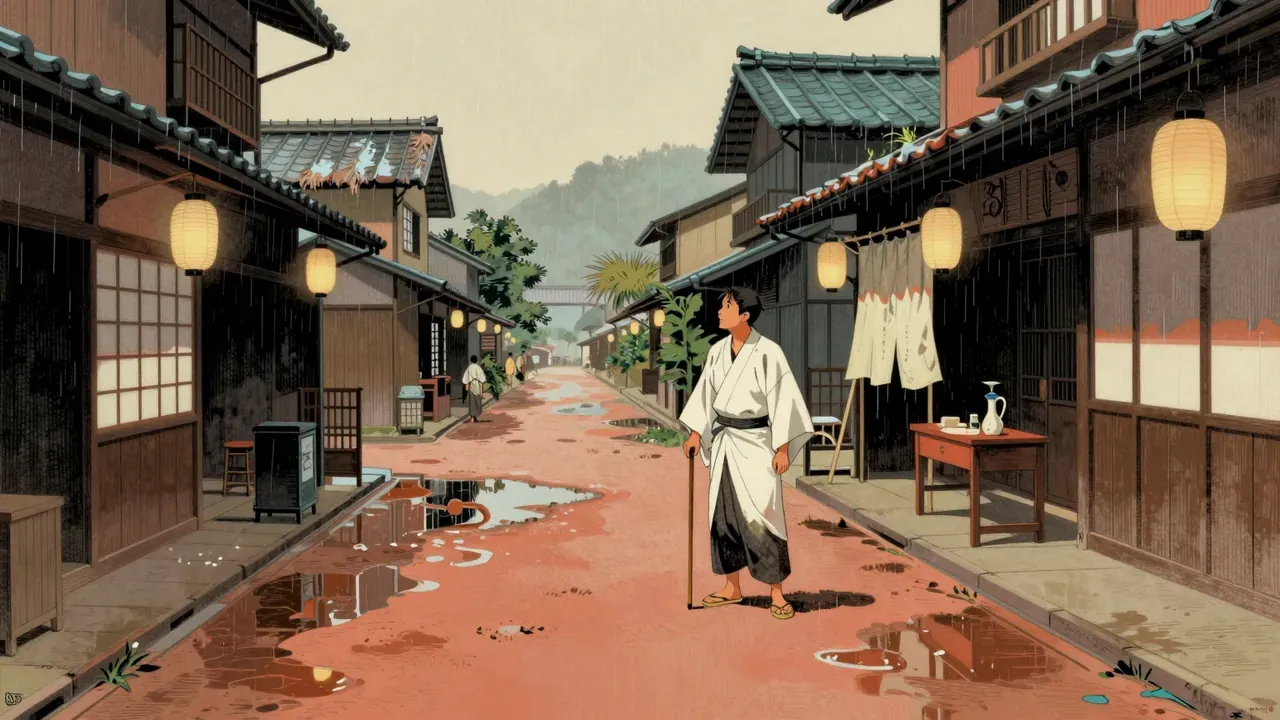
The constable’s promotion
What does not land is the late-stage pivot into outright farce during the dice-hall sequence. The half-coin bet, while visually sharp, interrupts the film’s prevailing gravity without sufficient tonal preparation. It reads less as character revelation and more as a concession to series expectations — a reminder that Zatoichi must also be ‘the gambler’. Similarly, Monji’s sudden promotion and jitte-handover arrive without prior establishment of his ambition or insecurity, making his turn toward vengeance feel schematic rather than inevitable. The ambush on Mt Akagi suffers from compressed geography: the alarm system’s activation and the police’s swift encirclement happen too fast to register spatial stakes, flattening what should be a tense escalation. Ogin’s role recedes after the onsen scene, her connection to Monji left unexplored beyond functional exposition. These are not failures of craft — Hasegawa’s presence is assured, the editing crisp — but of narrative patience. The film rushes where it had previously lingered, mistaking pace for momentum. A tighter edit of the middle act would have preserved the moral through-line without sacrificing urgency. (159 words)
The half-coin bet
The themes that matter are restitution without vengeance, authority without legitimacy, and sight without vision. The chest of gold is never wealth but evidence — of labour, of trust, of violation. Ichi does not return it to restore balance, but to reinstate a contract between rulers and ruled. Gundayu’s panic when destroying documents is not fear of punishment but of exposure: his power rests on paper, not person. Jushiro’s whip, unlike Ichi’s cane-sword, cannot kill at range — it controls space, not life — making his defeat a dismantling of coercive theatre. The film treats blindness not as metaphor but as condition: Ichi navigates by sound, scent, temperature, and hesitation; his certainty comes from listening, not seeing. Even Chiyo’s plea for him to stay is not romantic closure but a quiet acknowledgement that justice, once delivered, leaves a void no celebration can fill. There is no triumphalism in the final walk back toward Itakura — only the weight of having acted, and the uncertainty of what comes next. These themes cohere because they are embedded in action, not announced. (158 words)
The burning of evidence
This film is for viewers who value procedural integrity in period drama — those who watch jidaigeki for the weight of a rice tax ledger, not just the flash of a blade. It rewards attention to gesture, silence, and bureaucratic detail. It is not for those who require clear moral binaries or sustained action set-pieces: the duels are brief, the villains rarely monologuise, and the ending offers no cathartic feast, only a promise deferred. Someone who found Zatoichi on the Road too placid may find this one restless; someone who praised Zatoichi’s Flashing Sword for its kinetic clarity may find this one overly diffuse. A viewer expecting the series’ later, more stylised entries will be jarred by its restraint. What would change the verdict? A stronger integration of the dice-hall sequence into the central corruption arc — perhaps by linking the samurai’s grievance directly to Gundayu’s embezzlement — would tighten the film’s logic and make its tonal shifts feel necessary, not expedient. (159 words)
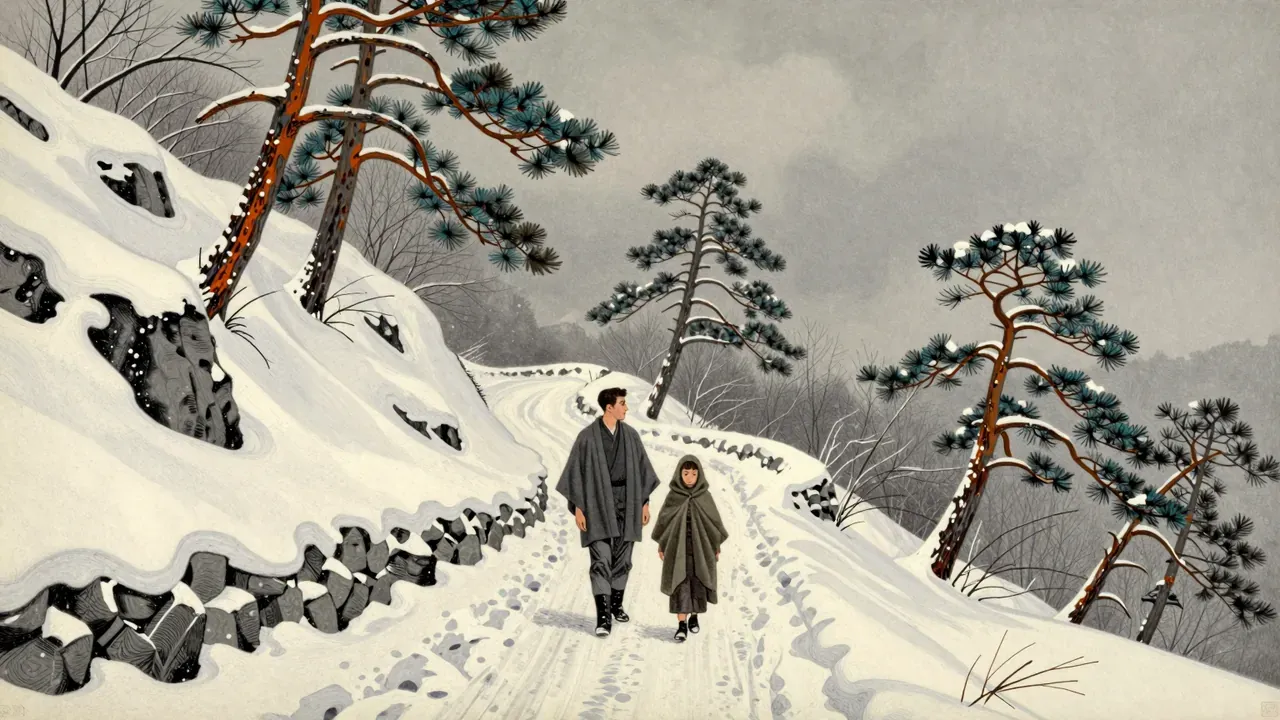
The walk back to Itakura
Yes, it is worth your evening — provided you accept it as a pivot point, not a peak. At 83 minutes, it moves with purpose, and its best scenes linger not because they are beautiful, but because they are exact: the steam rising off the onsen water, the rustle of straw sandals on gravel, the pause before Ichi drops his pipe to draw. It assumes familiarity with the series’ grammar but does not depend on it — the moral architecture is legible without prior knowledge. Those who dislike slow-burn political texture or find bureaucratic stakes inert will not warm to it, and fans of pure chambara spectacle may feel underserved. But if you respond to films where a receipt carries more emotional charge than a killing, where silence is calibrated like a sword-stroke, and where justice is measured in returned coin rather than spilled blood, then this is among the most quietly consequential entries. Its worth lies in its refusal to shout what others merely imply. (159 words)