The borderless van
Take Aim at the Police Van is a Nikkatsu studio action film from 1960, conceived as part of the company’s ‘borderless’ subgenre — an attempt to package Japanese genre cinema for imagined international markets through generic settings, minimal local specificity, and interchangeable criminal plots. It is not a realist crime procedural nor a moral parable, but a tightly wound, studio-bound thriller built around a single heist: the ambush of a police van transporting a prisoner. Seijun Suzuki, then under contract and still early in his stylistic development, treats the assignment as a formal exercise — less concerned with character psychology than with spatial tension, rhythmic editing, and the physical logistics of movement through confined urban spaces. The script by Shinichi Sekizawa provides lean scaffolding: escape, pursuit, betrayal, and a final confrontation on railway sidings. There is no attempt at sociological depth or historical anchoring; the film operates inside the logic of its own mechanics, like a clockwork toy wound to run for seventy-nine minutes. Its ambition is functional, not expressive — to deliver momentum, clarity, and a clean visual signature within tight budget and schedule constraints. (158 words)
The rhythm of the ambush
The story follows Daijirô Tamon, a recently released convict who joins a gang planning to intercept a police van carrying a key witness. The plot unfolds across Tokyo’s industrial periphery — freight yards, concrete overpasses, rain-slicked streets — all shot in high-contrast monochrome. Gordon Willis did not photograph this film; it was Kazuo Miyagawa, whose lighting carves deep shadows across faces and architecture alike, keeping interiors dim and exteriors stark. Suzuki’s direction favours long takes punctuated by sharp cuts, especially during the van’s approach and the ambush sequence, where camera placement stresses geometry over emotion. Performances are stylised but restrained: Michitaro Mizushima carries weight without gravitas, Misako Watanabe’s Yûko is watchful rather than vulnerable, Shinsuke Ashida’s father figure is terse, not tender. The editing by Akira Ito maintains pace without flash — no montage, no voiceover, no musical score that swells or recedes. Sound design is sparse: footsteps, train whistles, distant sirens, the clank of metal doors. Every element serves propulsion, not embellishment. (157 words)
The geometry of pursuit
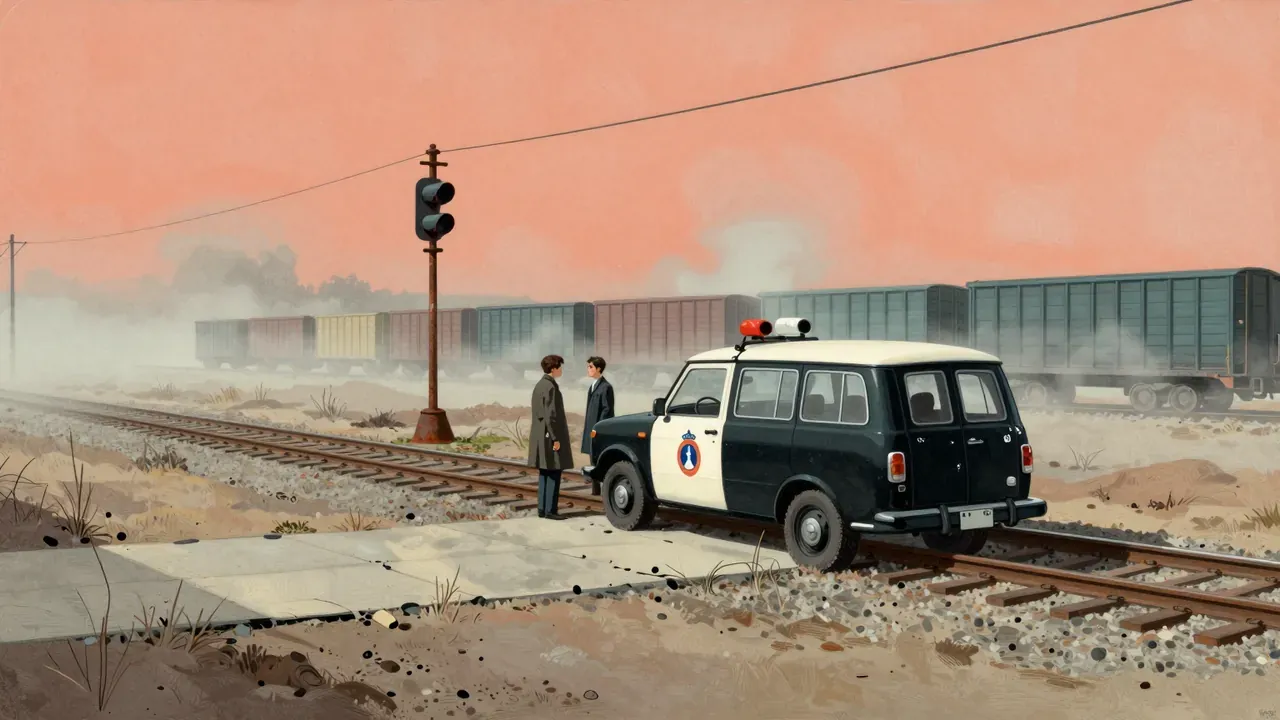
What lands is the film’s unbroken sense of forward motion. From the first frame — a slow push into a railway siding — the film establishes a rhythm of approach, delay, and release that never falters. The ambush sequence remains effective not because of surprise but because of its precision: the van’s headlights cutting through fog, the gang’s silent coordination, the sudden violence rendered in tight close-ups and abrupt cuts. Suzuki’s use of architectural space — low bridges, parallel rails, converging lines — gives the action a graphic inevitability. The performances land in their economy: Mizushima’s stillness reads as calculation, not vacancy; Watanabe’s glances carry implication without exposition. The film’s black-and-white photography avoids romanticism — there is no chiaroscuro poetry, only functional contrast that clarifies who is where and when. Even the minor characters register through posture and timing: Toru Abe’s nervous lookout, Shoichi Ozawa’s laconic driver. Nothing feels improvised, yet nothing feels rehearsed beyond necessity. The film sustains its own internal grammar so thoroughly that its modest scale becomes a virtue, not a limitation. (159 words)
The silence between lines
What does not land is any sustained investment in motive or consequence. The characters’ backstories exist only as brief, unelaborated references — a debt, a grudge, a promise — and none accrue emotional weight. The film makes no claim to realism, but neither does it offer stylisation strong enough to compensate: it sits between genres, too grounded for surrealism, too abstract for noir, too lean for melodrama. The borderless premise collapses under scrutiny: the setting is unmistakably Tokyo, the dialogue distinctly Japanese, the social texture specific to post-war Nikkatsu contract work — yet the script refuses to name any of it. The ending resolves the immediate plot but leaves relationships unresolved and stakes unexamined. There is no irony, no satire, no self-awareness about the genre machinery it employs. When the van stops and the dust settles, the film has no further comment. It does not fail because it is shallow, but because it declines to choose between shallowness and depth — remaining suspended, technically proficient but emotionally inert. A viewer expecting either pulp energy or thematic resonance will find neither fully delivered. (158 words)
Who holds the door
The themes that matter are confinement, transit, and the illusion of control. The film’s world is one of thresholds: railway sidings, police vans, prison gates, apartment doorways — all liminal zones where movement is permitted only under surveillance or threat. Characters are defined by what they carry — weapons, documents, secrets — and how they move them across restricted space. The police van itself is both vehicle and cage, a mobile cell that promises safety but delivers vulnerability. There is no ideology here, no critique of authority or celebration of rebellion; instead, a quiet insistence on the physical facts of power: who holds the keys, who controls the route, who decides when to stop. Age surfaces obliquely — Mizushima was forty-eight, unusually old for a Nikkatsu lead — and his presence introduces a subtle friction: his weariness contrasts with the genre’s expectation of youthful vigour, suggesting exhaustion as a structural condition, not a personal failing. The film’s social candour lies not in dialogue but in mise-en-scène: the worn uniforms, the peeling posters, the damp concrete — evidence of a society rebuilding, not reflecting. (156 words)
The audience in the sidings
This film is for viewers who value compositional discipline over narrative richness, and who find pleasure in the mechanics of genre execution — particularly those familiar with Nikkatsu’s 1950s output or mid-century Japanese studio craft. It rewards attention to framing, sound placement, and the choreography of group movement. It is not for viewers seeking psychological complexity, moral ambiguity, or cultural specificity — those elements are absent by design, not oversight. Anyone expecting the flamboyant abstraction of Suzuki’s later films, or the brooding introspection of contemporaneous Kurosawa or Ozu, will be disappointed. Nor is it for casual viewers unfamiliar with monochrome Japanese action cinema: its pacing assumes familiarity with studio-era conventions, and its lack of exposition offers no hand-holding. A change in context would alter the verdict — if viewed as a case study in studio workflow or as part of the Eclipse box set alongside Rusty Knife and A Colt Is My Passport, its formal rigour gains new significance. Alone, it feels like a blueprint, not a building. (159 words)
The van stops. The film ends.
Yes, it is worth your evening — provided you watch it as a precise, seventy-nine-minute demonstration of how a skilled director works within strict commercial constraints without surrendering control of image, rhythm, or space. It is not ‘entertaining’ in the conventional sense, nor is it ‘challenging’ in the arthouse mode; it occupies a third category: professionally resolved. Its value lies in its consistency — every shot advances the spatial logic, every cut serves the tempo, every performance obeys the tone. Those who dismiss it as ‘just a B-movie’ miss how deliberately it avoids the excesses of that label: no filler, no digression, no star turns. It is worth your time if you accept that craft can be its own subject. It is not worth your time if you require emotional payoff, thematic argument, or stylistic rupture. A viewer who values the integrity of form over the urgency of content will find it quietly impressive; one who demands either catharsis or provocation will find it dutiful but distant. (159 words)