What the film is
Samaritan Zatoichi is the twelfth entry in Daiei’s Zatoichi film series, released in late 1968 and directed by Kenji Misumi. It follows the blind itinerant masseur and swordsman Zatoichi as he intervenes in a provincial town where a yakuza gang exploits local farmers through debt bondage and intimidation. The film attempts to consolidate the series’ recurring moral architecture: Zatoichi does not seek justice as retribution but as quiet restoration — returning balance where power has calcified into cruelty. Unlike earlier entries that foreground gambling or duels as narrative engines, this one anchors itself in agrarian vulnerability and communal silence. It leans on the figure of the blind man not for spectacle but for perceptual contrast: his heightened awareness of sound, hesitation, and unspoken tension becomes the film’s ethical compass. The title’s ‘Samaritan’ signals intent rather than irony; the film treats compassion as procedural, not rhetorical. It is less about proving Zatoichi’s skill than about measuring how long a community tolerates its own subjugation before someone steps in — and whether that step must be taken by an outsider who sees nothing but understands everything. (158 words)
How it works
The story proceeds with deliberate, almost ritual pacing: Zatoichi arrives, observes, withdraws, returns. His interventions are sparse — a whispered warning, a redirected blow, a refusal to leave when asked. Shintarō Katsu’s performance avoids bravado; his Zatoichi moves with the economy of someone conserving energy, his voice low and uninflected, his stillness more unnerving than any flourish. Yoshiko Mita’s Oshin provides emotional counterweight — not as love interest but as witness whose quiet dignity underscores the stakes. Misumi’s direction favours medium shots and shallow focus, keeping faces legible even in shadow; Gordon Willis is not involved — this is cinematographer Kazuo Miyagawa, who uses diffused natural light to flatten hierarchy between interior and exterior space. Editing avoids cross-cutting suspense; scenes resolve before new ones begin. The swordplay is brief, functional, filmed in full figure without slow motion or close-ups on blades. Music is sparse — shamisen appears only at transitions, never underscoring emotion. Every craft choice serves restraint: no score swells, no frame lingers unnecessarily, no line is delivered for effect. The film trusts the weight of implication over exposition. (159 words)
What lands
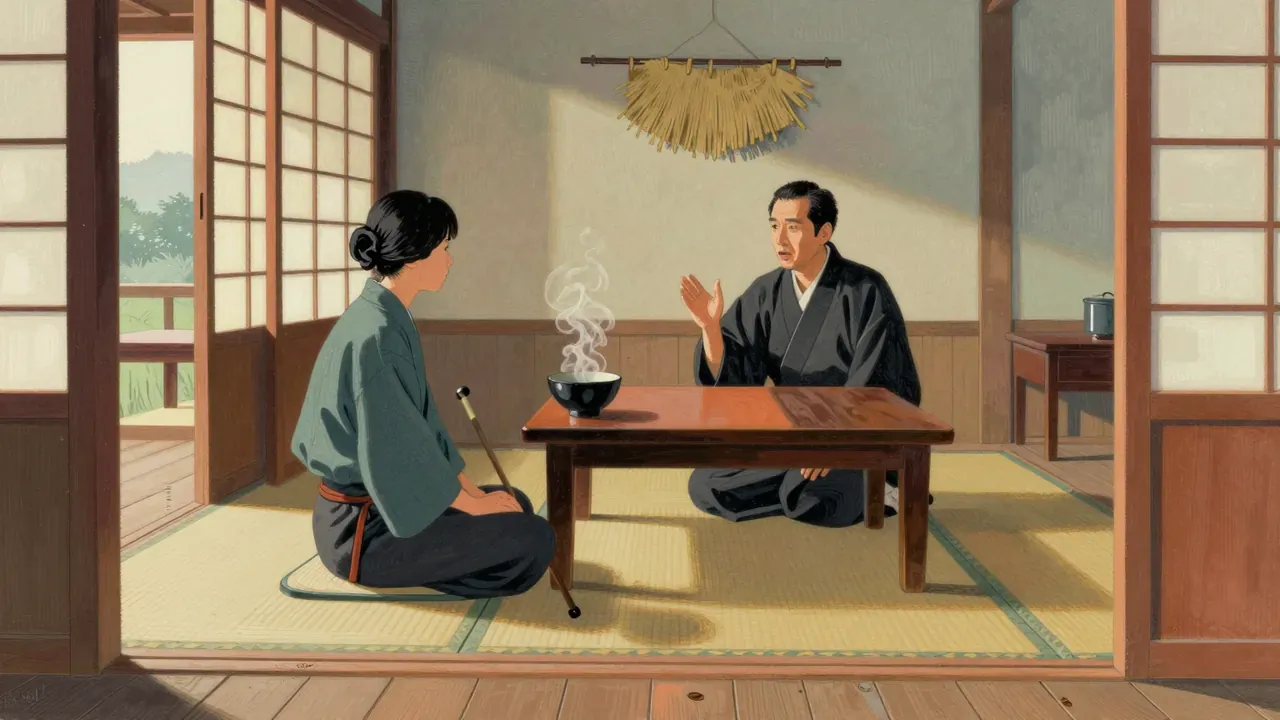
What lands is the cumulative pressure of moral exhaustion. The film’s central sequence — Zatoichi sitting silently at a dinner table while the gang boss monologues about ‘order’ — works because the silence is shared, not imposed. The audience feels the weight of withheld speech, the fatigue of listening to justification dressed as pragmatism. Katsu’s physicality lands too: the way he adjusts his cane mid-step, the slight tilt of his head when hearing footsteps recede, the pause before answering a question — these are not mannerisms but calibrated units of perception. The farmers’ collective hesitation also registers: they do not cheer Zatoichi’s arrival, nor do they flee when violence begins. Their stillness is neither passivity nor consent, but the posture of people who have learned that movement invites consequence. The film’s most effective image is not a duel but a rice field at dawn, flooded and mirror-still, reflecting sky and bent stalks — a visual metaphor for clarity achieved only through suspension, not action. These moments accrue without fanfare, building a register of quiet conviction that feels earned, not imposed. (157 words)
What does not
What does not land is the structural reliance on narrative ellipsis. Several key relationships — particularly between gang enforcer Takuya Fujioka’s character and Chōchō Miyako’s widow — are implied but never dramatised, leaving emotional payoffs undernourished. The script assigns motives without grounding them in behaviour: Fujioka’s turn from enforcer to reluctant ally lacks a pivot scene, making his final gesture feel like plot necessity rather than psychological logic. Makoto Satō’s farmer-leader speaks of resistance but never organises it; his speeches remain abstract, disconnected from tangible action. The film’s refusal to show preparation — no planning, no rehearsal, no failed attempts — risks flattening agency into inevitability. Some viewers may find the pacing inert rather than contemplative, especially those expecting the tighter rhythm of Misumi’s 1964 Zatoichi films. The yakuza boss, played by Kō Nishimura, remains archetypal rather than dimensional — his menace is textual, not embodied. And while the film avoids romanticising violence, it also avoids examining its aftermath: wounds heal off-screen, consequences dissipate, and the town’s recovery is assumed, not shown. This omission narrows the film’s social scope, turning systemic exploitation into a problem solved by one man’s presence. (159 words)
The themes that matter
The themes that matter are endurance, reciprocity, and the ethics of non-intervention. Endurance appears not as stoicism but as sustained attention — Zatoichi’s blindness demands constant recalibration of space and intent, mirroring the farmers’ daily negotiation of threat. Reciprocity is treated as structural, not transactional: when Zatoichi mends a broken fence, it is not repayment for shelter but alignment with a principle — that care must circulate, not accumulate. The film questions non-intervention not as cowardice but as complicity disguised as neutrality; every character who looks away enables the boss’s control, and their silence is framed as active participation. Ageing surfaces obliquely — in the worn hands of the farmers, in the stiffness of Zatoichi’s shoulders after a fight, in the way older characters speak of past uprisings as cautionary tales rather than blueprints. There is no nostalgia for lost honour, only scrutiny of how power reproduces itself across generations. Buddhism informs the tone but not the dialogue: impermanence is visible in weathered wood and fading ink, not in sermons. The film’s moral gravity comes from its refusal to separate ethics from labour — justice here is not declared but dug, carried, and repaired. (156 words)
Who should watch it
This film is for viewers who value moral texture over narrative velocity — those accustomed to the pacing of late Ozu or early Imamura, or who appreciate Kurosawa’s quieter chamber pieces like Ikiru. It rewards patience with layered stillness, not revelation. It is not for viewers who require clear cause-and-effect chains, defined antagonists, or cathartic confrontation — the resolution here is diffuse, almost administrative. Those expecting the kinetic choreography of later Zatoichi films or the mythic sweep of Katsu’s 1970s television run will find this thin in incident. A viewer who values thematic density over plot momentum may disagree with this assessment, arguing that the film’s austerity is its strength. What would change the verdict is a tighter integration of secondary characters’ arcs — if Fujioka’s shift had been anchored in a single, unbroken scene of witnessed cruelty, or if the farmers’ collective decision had been shown as process rather than pronouncement. Without that, the film remains compelling but narrowly focused. (158 words)
Is it worth your evening
Yes, it is worth your evening — provided you watch it without expectation of escalation or closure. Its ninety-minute duration unfolds like a slow tide: no single wave rises high, but the cumulative pull reshapes how you hold silence, hesitation, and restraint. It is not entertainment in the conventional sense, but it is deeply absorbing in its commitment to understatement. Viewers who mistake slowness for emptiness will leave unsatisfied; those who treat stillness as information will find it rich. It repays attention not with surprise but with calibration — adjusting your threshold for what counts as action, what qualifies as courage, what constitutes resolution. The film does not ask for investment in outcome but in observation. Its value lies in how it recalibrates time: minutes stretch not with boredom but with accumulated weight. To dismiss it as ‘minor Zatoichi’ is to miss how precisely it fulfils its own terms — not as spectacle, but as ethics made visible through absence. Anyone willing to sit with that proposition will find it quietly consequential. (159 words)