The story it tells
The Wandering Princess is a 1960 Japanese historical romance, adapted from Hiro Saga’s 1959 memoir, and directed by Kinuyo Tanaka for Daiei Film. It attempts to render the emotional arc of a Japanese aristocrat who marries into the deposed Qing imperial family in Manchukuo — not as political allegory or national reckoning, but as a restrained portrait of displacement, duty, and quiet endurance. Its ambition lies in fidelity to personal testimony rather than spectacle: it treats Ryuko’s marriage to Pujie as an intimate passage through shifting sovereignties, where love is circumscribed by protocol, language barriers, and the slow erosion of status. The film avoids dramatising Puyi’s collaboration or the broader collapse of Manchukuo; instead, it holds focus on domestic spaces, formal gestures, and unspoken tensions between generations and nations. As Tanaka’s first colour and CinemaScope film, it also tests whether the scale and saturation of the new format can serve interiority rather than grandeur. That tension — between technological expansion and psychological containment — is built into its premise.
The shape of its silence
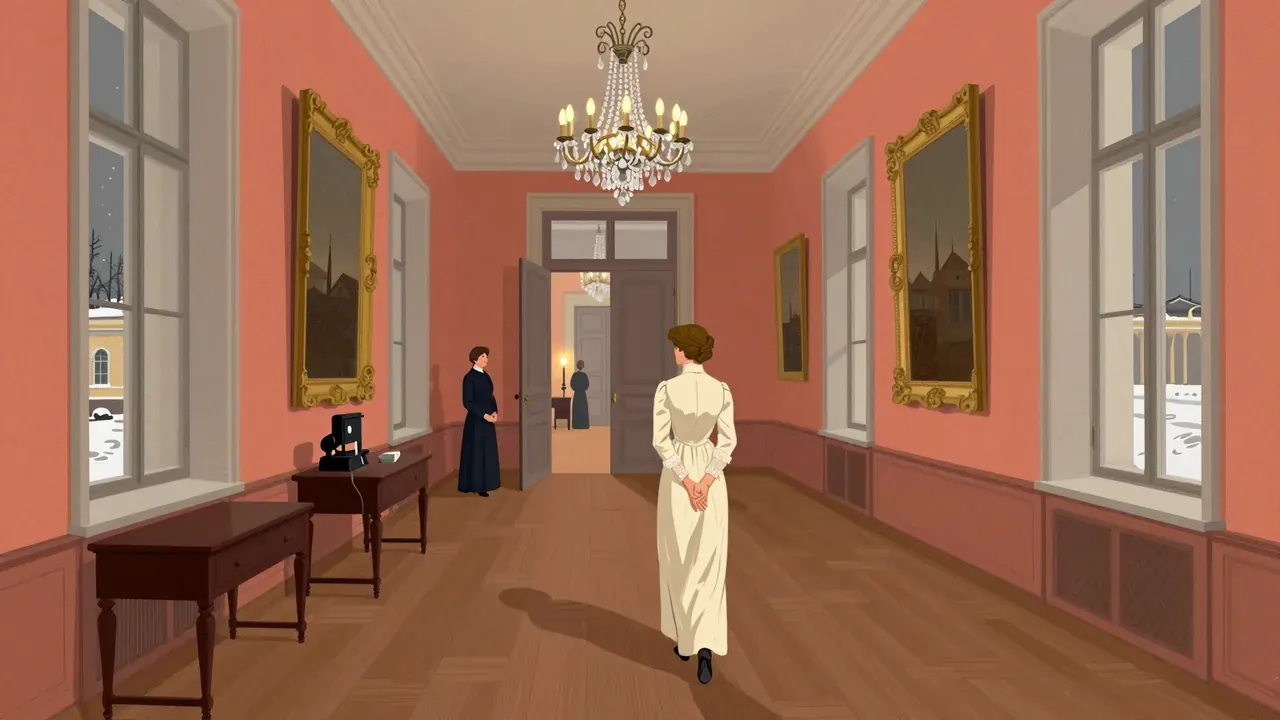
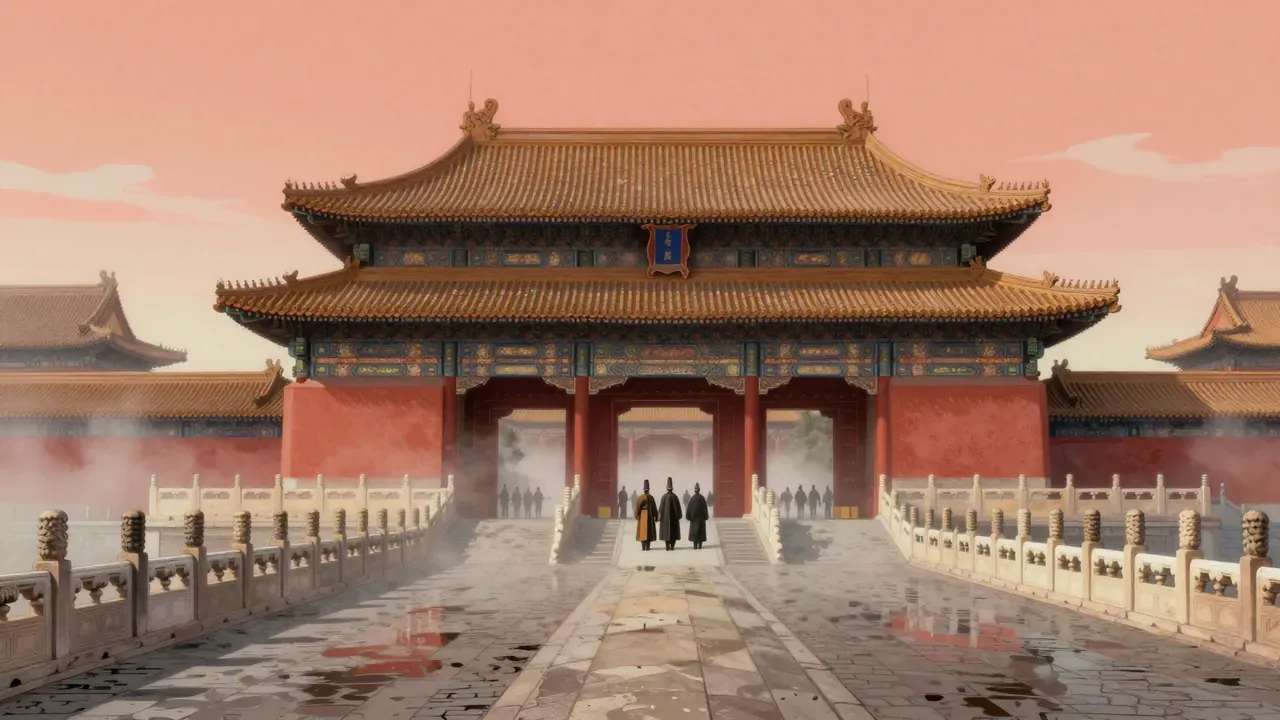
The story follows Ryuko from her arranged marriage in Tokyo to life in Changchun under Japanese occupation, then through repatriation and post-war uncertainty. Natto Wada’s script moves with deliberate pacing, trusting implication over exposition: dialogue is sparse, often mediated by interpreters or withheld by silence. Machiko Kyō carries the film with stillness — her Ryuko registers change through posture, glance, and the gradual loosening of formal hairpins. Eiji Funakoshi’s Pujie is less defined, his passivity read as resignation rather than weakness. Kimio Watanabe’s CinemaScope framing favours symmetrical interiors and long takes, keeping characters small within ornate rooms or vast courtyards. Chūji Kinoshita’s score uses koto and shakuhachi sparingly, avoiding melodrama. Chishū Ryū appears briefly as a pragmatic elder, grounding the film in Tanaka’s recurring interest in generational continuity. The colour palette is muted — ochres, greys, washed silks — resisting the vibrancy CinemaScope might invite. Performances are calibrated to restraint; even Sadako Sawamura’s Kazuko, the pragmatic mother-in-law, speaks with measured cadence, never rising above conversational volume.
What it lets settle
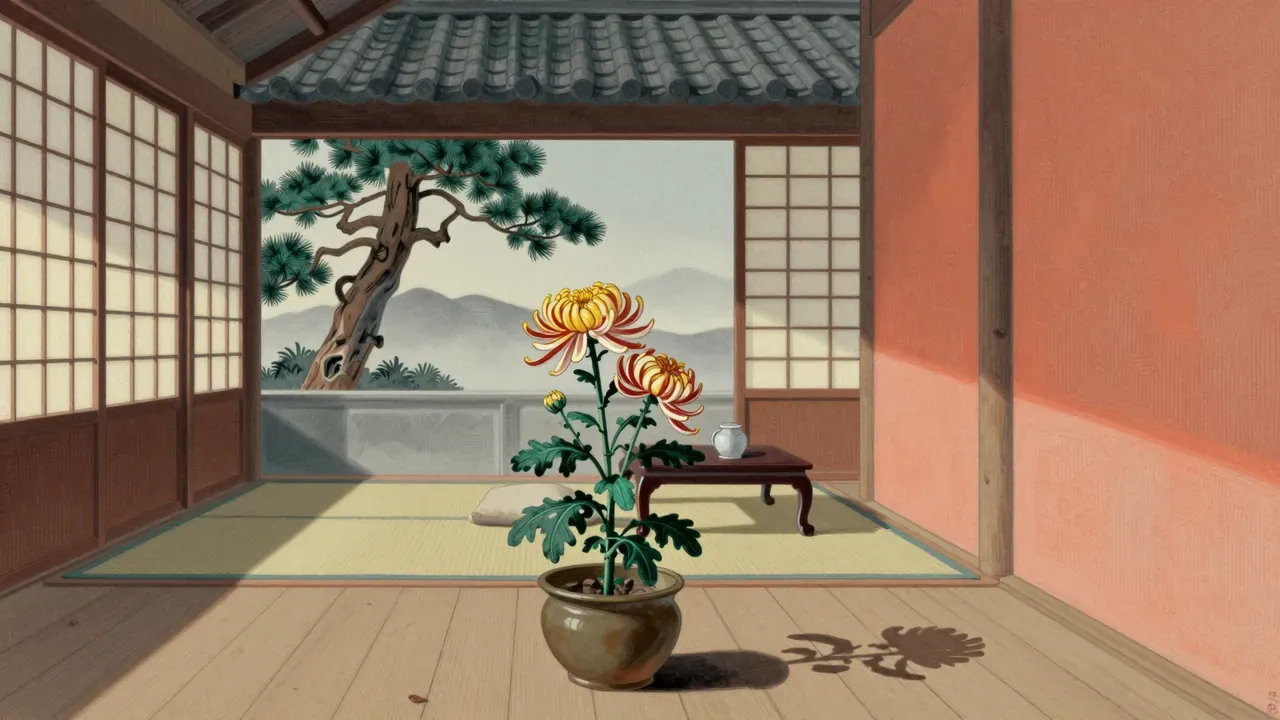
What lands is the cumulative weight of small, unemphatic choices: Ryuko learning Manchu tea ceremony without comment; Pujie folding a letter twice before handing it to her; the repeated shot of a single potted chrysanthemum in different rooms, its blooms fading across seasons. These details accrue meaning without explanation. The film’s refusal to moralise — neither condemning nor excusing the Japanese presence in Manchuria, neither romanticising nor vilifying the Qing remnants — gives it a rare ethical neutrality. Tanaka’s direction sustains this by refusing to privilege any one perspective: we see Ryuko’s isolation, but also Pujie’s powerlessness, Kazuko’s pragmatism, and Nao Sugawara’s quiet grief. The colour cinematography works precisely because it does not dazzle — Watanabe keeps saturation low, letting texture dominate: the grain of tatami, the weave of brocade, the dust motes in slanted light. The result is a film that feels lived-in, not staged; its emotional impact arrives not through climax but through accumulation — a slow settling, like silt in still water.
Where it holds back
What does not land is the structural thinness of Pujie’s characterisation. Though Funakoshi performs with dignity, the script gives him little interior access beyond stoicism, making his relationship with Ryuko feel more like a vessel for her development than a mutual bond. The historical scaffolding remains deliberately vague: names like ‘Manchukuo’ and ‘Puyi’ appear without context, assuming audience familiarity with mid-century East Asian history. This is not ignorance, but omission — and while it serves the film’s focus on personal scale, it risks alienating viewers unfamiliar with the period’s geopolitical contours. The CinemaScope frame occasionally works against intimacy: wide shots of empty corridors or distant figures in gardens can read as detachment rather than contemplation. Some supporting roles — particularly Ken Mitsuda’s Asabuki and Mitsuko Mito’s Izumi — feel underwritten, their functions purely expository. And though the film avoids overt sentimentality, its restraint borders on austerity in the final third, where narrative momentum softens into repetition rather than resolution.
The weight of small things
The themes that matter are not sovereignty or empire in the abstract, but sovereignty over one’s own affect: how Ryuko learns to modulate grief, defer desire, and perform composure without surrendering self. The film treats marriage as a site of translation — linguistic, cultural, emotional — where fidelity is measured not in passion but in sustained attention. Class operates as both barrier and bridge: Ryuko’s aristocratic upbringing grants her access to Pujie’s world, yet denies her agency within it. Time is another theme: the film unfolds across years, but rarely marks them with explicit dates or events; instead, time is registered through costume shifts, architectural decay, and the ageing of faces. Colonialism appears not as ideology but as atmosphere — in the presence of Japanese officers who speak over others, in the way servants move with lowered eyes, in the unspoken hierarchy between ‘Japanese wife’ and ‘Manchu household’. What endures is not nation or dynasty, but the persistence of ritual — tea, bowing, letter-writing — as a grammar of belonging when all else is unstable.
Who it waits for
This film is for viewers who value compositional discipline over narrative propulsion, who find resonance in silence and precision in gesture. It suits those familiar with Japanese post-war cinema — particularly Tanaka’s earlier work or Mizoguchi’s historical dramas — and those comfortable reading history through domestic detail rather than headline events. It is not for viewers seeking exposition, psychological exposition, or clear moral coordinates. Those expecting a conventional romance will find its emotional economy withholding; those looking for political critique may find its ambiguity frustrating. A viewer who values strong character arcs or tight plotting would likely leave unsatisfied. The film assumes patience with ellipsis and rewards attention to texture over plot. Its appeal narrows further for anyone unfamiliar with early 20th-century East Asian history — not because it demands expertise, but because its omissions rely on a baseline of contextual awareness. Without that, some scenes risk feeling inert rather than intentional.
The length of its breath
Yes, it is worth your evening — but only if you approach it as a study in tonal control, not as entertainment. Its 102 minutes unfold with the pace of a measured breath: no scene rushes, no performance overreaches, no camera movement distracts. That consistency is its strength and its limitation. You will not leave energised, but you may leave recalibrated — attuned to the weight of a held glance or the significance of an unopened letter. It rewards rewatching, not for plot clarification, but for noticing how Watanabe’s lighting shifts across a single room between acts, or how Kyō’s hands change position when speaking to different characters. Those who dislike films that ask for sustained attention without offering catharsis or clarity will find it unrewarding. But for viewers who trust that restraint can be expressive, and that colour need not shout to be felt, it offers a rare kind of cinematic gravity — modest in scale, exact in execution, and quietly insistent in its humanity.