The geography of it
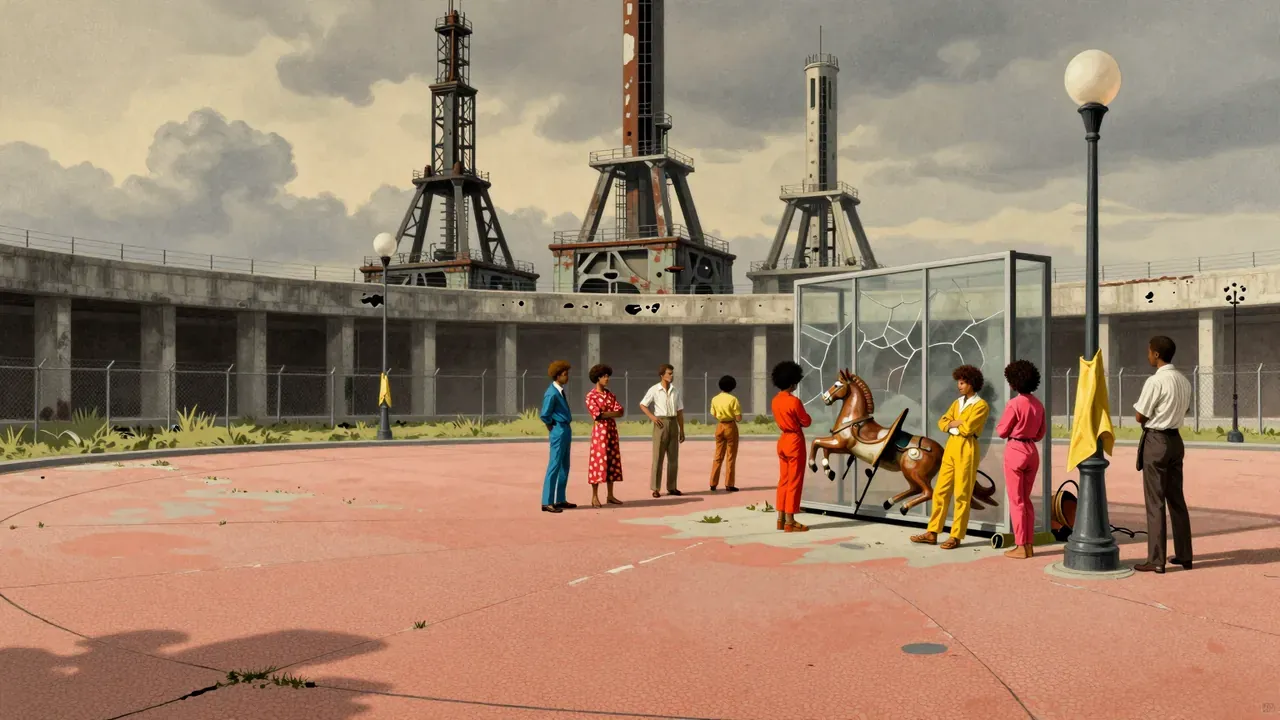
The Wiz is a 1978 musical film adaptation of the 1974 Broadway show, itself a reimagining of L. Frank Baum’s The Wonderful Wizard of Oz with an African-American cast and urban-fantasy setting rooted in New York City. It relocates Dorothy Gale from Kansas to Harlem, casts her as a 24-year-old schoolteacher, and transposes Oz into a decaying, stylised metropolis — the World Trade Center as the Emerald City, the New York State Pavilion as Munchkinland, Coney Island as the Tin Man’s domain. Directed by Sidney Lumet, known for naturalistic drama rather than musical spectacle, the film attempts a dual project: to affirm Black cultural self-determination through mythic storytelling, and to translate stage-bound theatricality into cinematic scale without relying on the visual grammar of the 1939 MGM film. Its ambition is structural as much as symbolic — to build a new Oz from scratch, not as homage or parody, but as autonomous worldbuilding grounded in Black American vernacular, music, and spatial imagination. It is not a children’s film in tone or pacing, nor does it seek crossover innocence; it leans into its own specificity, even when that specificity strains against its format. (158 words)
The journey of it
The story follows Dorothy’s journey after a cyclone transports her from Harlem to Oz, where she seeks the Wiz’s help returning home, gathering companions along the way: a Scarecrow who doubts his mind, a Tin Man who believes he lacks heart, and a Lion who fears his courage. Joel Schumacher’s script departs entirely from the Broadway libretto, embedding themes drawn from Werner Erhard’s est seminars — self-actualisation, personal responsibility, communal affirmation — most overtly in Glinda’s closing monologue and the song ‘Believe in Yourself’. Oswald Morris’s cinematography favours saturated colour and deep-focus compositions, often framing characters against monumental, weathered backdrops. Dede Allen’s editing sustains rhythm across long musical numbers but struggles with narrative continuity between set pieces. Louis Johnson’s choreography blends street dance, jazz, and Broadway precision, while Quincy Jones’s score expands Charlie Smalls’s original songs with new material co-written with Ashford & Simpson. Diana Ross sings with control and warmth, Michael Jackson moves with uncanny physical intelligence, and Richard Pryor grounds the Wiz in sardonic humanity — though the film’s tonal register wobbles between earnest allegory and camp-inflected satire. (159 words)
The movement of it
What lands is the film’s visual audacity and its performers’ commitment. The production design — Tony Walton’s costumes, Albert Whitlock’s matte paintings, Stan Winston’s prosthetics — constructs a cohesive, tactile Oz that feels lived-in and politically charged, not cartoonish. The Emerald City sequence, with its 650 dancers and custom garments from Oscar de la Renta and Norma Kamali, remains singular: a riot of texture, movement, and Afrofuturist aspiration. Michael Jackson’s Scarecrow is physically articulate and emotionally porous, his performance unburdened by star persona — he listens, reacts, and evolves in real time. Lena Horne’s Glinda radiates regal calm, her voice anchoring the film’s spiritual pivot. Nipsey Russell’s Tin Man balances wit and pathos, and Ted Ross’s Lion channels vulnerability without undercutting dignity. The gospel-inflected arrangements of ‘Ease on Down the Road’ and ‘Home’ carry emotional weight beyond their function as plot devices. These elements cohere not because they are polished, but because they are inhabited — sung, danced, and believed in by people who treat the material as both inheritance and intervention. (156 words)
The rhythm of it
What does not land is the script’s philosophical scaffolding and Lumet’s directorial approach to musical form. Schumacher’s est-derived dialogue — about ‘knowing who you are’ and ‘sharing your light’ — reads as didactic rather than earned, especially when delivered by characters whose inner lives remain underdeveloped. The film never convincingly dramatises Dorothy’s growth; her arc is announced, not enacted. Lumet’s dramatic instincts work against the genre’s requirements: he lingers on reaction shots during solos, cuts away from choreographic climaxes, and treats musical numbers as interludes rather than structural pillars. The pacing sags between set pieces, and the narrative logic of Oz — why the Wiz is powerless, how Dorothy’s slippers function — is left vague or inconsistent. Diana Ross, though vocally assured, is miscast as Dorothy: her presence reads as authoritative, not aspirational, and her age and bearing sit uneasily beside the character’s stated youth and naivety. The film’s refusal to engage with the 1939 version leaves it without a counterpoint — it gestures toward reinvention but rarely achieves transformation. (157 words)
The voice of it
The themes that matter are self-definition in the face of systemic erasure, the reclamation of myth as collective resource, and the tension between individual aspiration and communal responsibility. Oz is not escapism but infrastructure — a parallel society built from repurposed ruins: the World’s Fair pavilion, the Cyclone rollercoaster, the Twin Towers. This is urban alchemy, turning post-industrial decay into symbolic abundance. The film treats Black interiority as inherently fantastical — Dorothy’s classroom, her aunt’s apartment, the subway platform before the cyclone — all contain latent magic. The est influence, however awkwardly rendered, points to a real historical moment: Black professionals and artists engaging with self-help frameworks not as substitutes for structural change, but as tools for psychological sovereignty. The Wiz’s powerlessness mirrors institutional failure; Glinda’s final speech reframes liberation not as rescue but as recognition — ‘you always had the power’. That idea resonates beyond the film’s execution: it names a politics of capacity, one that refuses to outsource agency to external saviours, whether wizards or studios. (155 words)
The audience of it
This film is for viewers who value bold aesthetic risk over narrative polish, who find meaning in the gap between intention and execution, and who approach musicals as cultural documents rather than entertainment commodities. It rewards attention to costume, choreography, and sonic layering — the way Quincy Jones weaves funk basslines beneath gospel harmonies, or how Louis Johnson stages group movement as both celebration and resistance. It is not for those who require tight plotting, psychological realism, or genre consistency. Anyone expecting a streamlined family musical or a faithful Oz adaptation will be alienated by its pacing, tonal shifts, and philosophical detours. Critics who dismissed it in 1978 — like Pauline Kael, who called Ross’s casting a triumph of will over sense — would still find its flaws glaring. But its worth has grown with time, not because it improved, but because audiences now better recognise its formal ambition and historical placement: a Black-led studio musical made at the height of post-civil rights disillusionment, insisting on wonder as method, not metaphor. (158 words)
The weight of it
Yes, it is worth your evening — not as flawless cinema, but as a singular, unrepeatable artefact of Black creative ambition in mainstream Hollywood. Its 136 minutes unfold with uneven energy, but the cumulative effect is immersive: a world built from conviction, not compromise. You will notice the seams — the stilted dialogue, the Lumet-esque pauses mid-number, the budgetary limits visible in rear-projection shots — yet these do not cancel the achievement. What endures is the sheer density of invention: the costumes, the choreography, the vocal performances, the architectural imagination. To watch it is to witness a collision of forces — Motown’s commercial clout, Broadway’s theatrical grammar, New York’s physical reality, and 1970s Black intellectual currents — all funnelled into one defiant, flawed, luminous object. It asks for patience, not passive consumption. Those who meet it on its own terms leave with images and sounds that linger: Jackson’s lean, Ross’s gaze, Horne’s glow, the yellow brick road laid across Queens asphalt. (159 words)