Two decades told through the boy who got out
City of God is Fernando Meirelles and Kátia Lund’s 2002 crime epic, adapted from Paulo Lins’s novel about the real Cidade de Deus housing project in Rio de Janeiro, tracing the rise of organized crime there from the late 1960s into the early 1980s. It is narrated by Rocket, a boy who wants to be a photographer and mostly stays on the margins of the violence around him, which gives the film a vantage point that is invested but not complicit. The film received four Academy Award nominations, for direction, cinematography, editing and adapted screenplay, and was Brazil’s submission for the Academy’s Best Foreign Language Film category the year before, though it wasn’t selected as a finalist that time.
A cast built from an acting workshop in the favelas
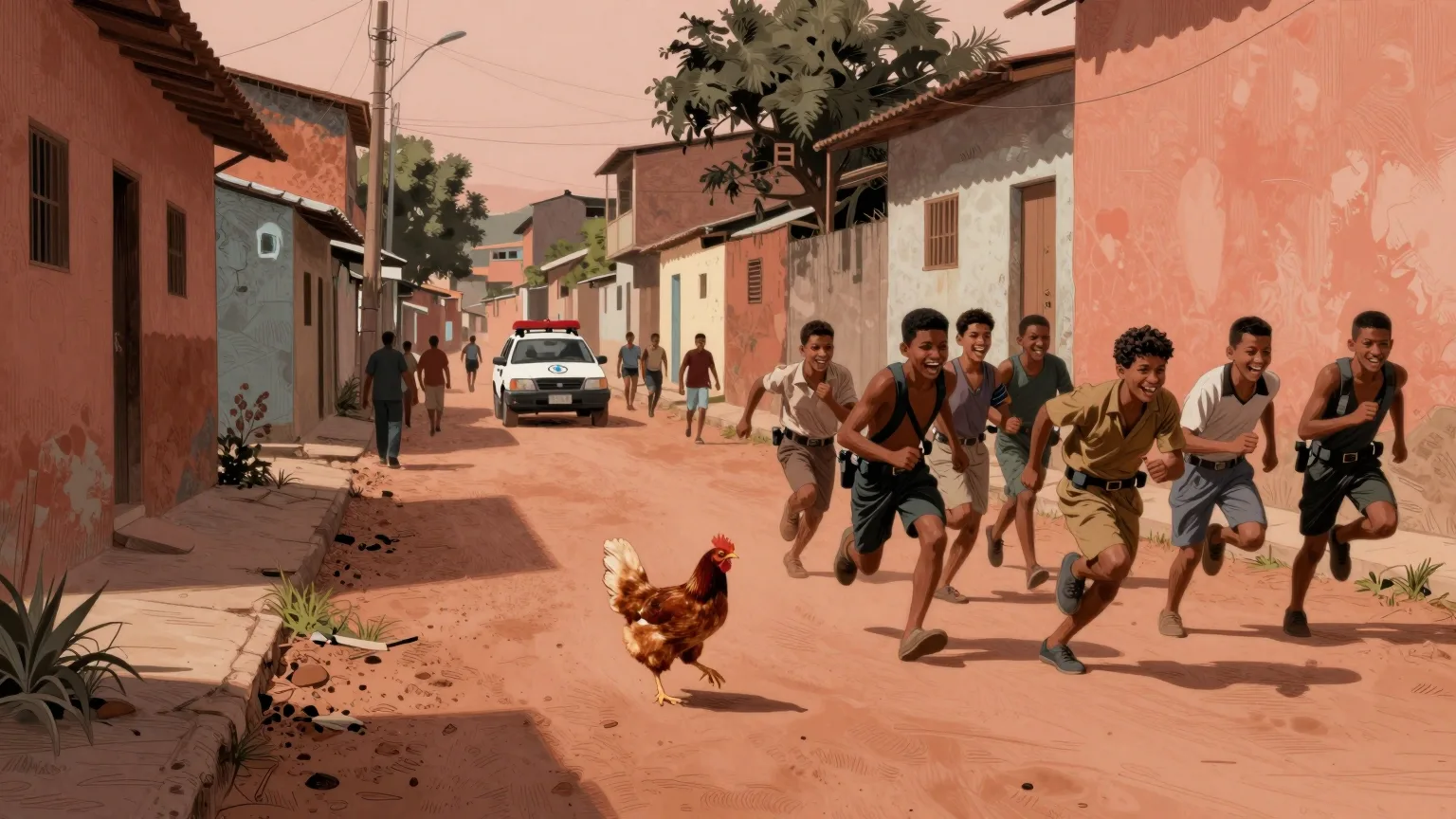
The plot follows the escalation from small-time robbery by the amateur Tender Trio to the drug empire built by Li’l Zé, formerly the child lookout Li’l Dice, whose unprovoked massacre during a motel robbery both destroys the Trio and sets his own rise in motion. Meirelles and Lund cast the film almost entirely with non-professionals, many recruited directly from favelas including Cidade de Deus itself, and ran them through months of improvisation-based training rather than conventional rehearsal; only Matheus Nachtergaele, playing Carrot, had prior acting experience. Cinematographer César Charlone shot on 16mm, and editor Daniel Rezende cuts between decades and storylines at a pace that mirrors the accelerating violence.
Li’l Zé’s massacre at the motel
What lands most forcefully is the authenticity the casting method produces: the film’s violence never reads as choreography because so many of the performers had lived adjacent to versions of it, and Meirelles’s decision to keep many killings indistinct or out of frame, rather than staged for impact, gives the film a matter-of-fact brutality that is more disturbing than a more graphic approach would be. Rocket’s narration and his late storyline involving a newspaper photograph of Li’l Zé’s gang tie the film’s themes of visibility and exposure together without slowing its momentum.
Photographs as currency and as exposure
The scale of the story, covering two decades and dozens of named characters, occasionally outpaces what a single viewing can track, and some side plots, particularly around the Runts gang who inherit the film’s violence in its final stretch, register more as thematic reinforcement than fully developed narrative. The sheer amount of violence inflicted by and on children throughout is unrelenting by design, and some viewers will find that unbearable regardless of the film’s evident craft and restraint in how it’s shot. Knockout Ned’s transformation from a peaceful ex-soldier into a combatant is compressed enough that his final loss of principle can feel more like a plot requirement than an earned turn.
Violence treated as routine, not spectacle
The film is concerned with how a closed economy of poverty and impunity manufactures violence as an ordinary career path, using its parallel tracks of Rocket’s marginal survival and Li’l Zé’s total immersion to show two possible responses to the same conditions. Its treatment of media and image, through Rocket’s photographs, is a secondary but pointed theme, showing how outside attention to violence can as easily inflame the people being photographed as expose them. The film’s structure, tracing violence back to a specific, almost accidental act by a child, also argues implicitly that the war which follows was never inevitable, only allowed to compound once it started.
Who should watch it
It suits viewers who want kinetic, structurally ambitious crime cinema, anyone interested in what non-professional casting can achieve for realism, and those seeking a serious account of how organized crime takes root rather than a glamorised gangster narrative. It is a poor match for viewers sensitive to sustained depictions of violence against and by children, and it demands more tracking effort than a single-thread crime drama, since its span of decades and shifting nicknames can make the connections between early and late scenes hard to hold onto without close attention.
128 minutes of accumulating consequence
At 128 minutes covering two decades, the film never feels bloated, thanks to editing that keeps its many threads under constant pressure. It is an intense rather than relaxing evening, but its combination of craft, authenticity and moral seriousness make it one of the more essential crime films of the 2000s. Its four Academy Award nominations for a film shot largely on 16mm with an amateur cast are themselves a measure of how completely its technical ambition and its social subject reinforce each other, rather than competing for the viewer’s attention.