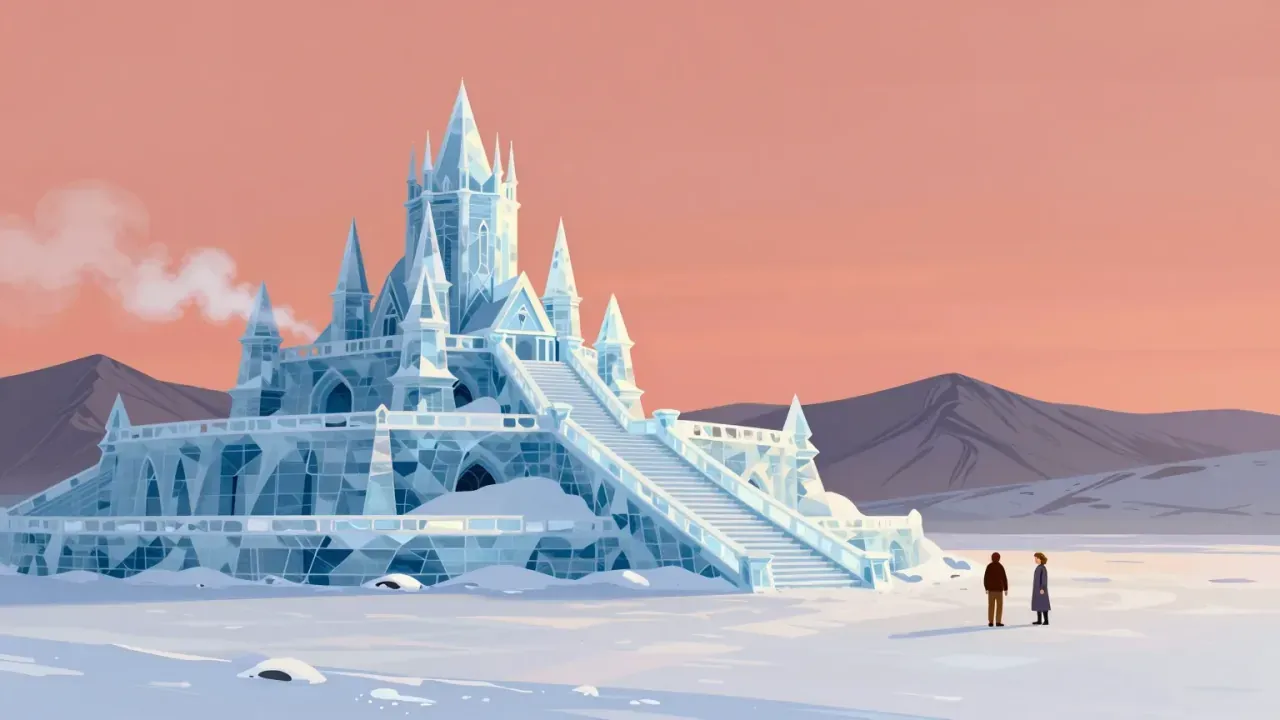
A power hidden until it cannot be anymore
Frozen, directed by Chris Buck and Jennifer Lee and released in 2013, loosely adapts Hans Christian Andersen’s The Snow Queen into the story of two royal sisters, Elsa and Anna, separated after Elsa’s uncontrollable ice powers nearly kill Anna as a small child during a moment of play. Their parents’ subsequent response, isolating Elsa within the palace and hiding the entire incident from Anna, is what actually drives the sisters apart over the following years, rather than the powers themselves ever being the real obstacle between them. The film reworks Andersen’s Snow Queen considerably, since the original tale has no sisters at all and centres instead on a girl named Gerda rescuing a boy from the queen’s influence.
A song that rewrote the whole villain
The film had spent well over a decade in various stalled forms at Disney going back to the late 1990s, with the Snow Queen character repeatedly resisting every attempt to make her work dramatically as either a hero or a villain; animator Glen Keane, an early champion of the project, eventually left it entirely for what became Tangled instead. Jennifer Lee was brought on as screenwriter in a compressed seventeen-month window before release and rebuilt the script largely from scratch, working closely alongside songwriters Kristen Anderson-Lopez and Robert Lopez from the very start of that process.
A rescue plot that isn’t about a prince
The turning point in that rewrite was the song Let It Go, which reimagined Elsa not as a straightforward villain but as a frightened young woman struggling to accept a part of herself she has never been able to control; director Chris Buck has said this single song forced the entire production to reconsider Elsa’s arc mid-development, essentially rebuilding the film around her rather than around Anna alone. The decision replaced an earlier draft in which Elsa was simply evil from the outset, kidnapping Anna from her own wedding and descending on the town with an army of animated snowmen.
A decade of scripts that could not solve the villain problem
Anna’s journey to find her estranged sister runs alongside a romantic subplot with the iceman Kristoff, and the film includes several of the genre’s expected trappings, a charming rogue in Prince Hans, a talking snowman named Olaf, but it deliberately withholds the traditional romantic resolution at its climax in favour of an act of sacrifice between the two sisters instead. Disney’s own production team has described this choice, prioritising sibling love over romantic love as the story’s actual saving act, as a genuinely deliberate departure from the studio’s long-standing narrative conventions.
Fear of your own nature as the actual subject
The film’s actual subject is the damage caused by hiding a part of yourself out of fear of what it might do to the people around you, and the way that isolation, however protectively intended by loving parents, can end up causing more harm than the very thing it was meant to prevent in the first place. Anna’s insistence on finding Elsa rather than simply accepting her exile is the film’s clearest statement that separation is not, in fact, the safe option it had always appeared to be to everyone involved.
Who should watch it
This is squarely aimed at families and children, and it succeeds very well within that aim; the songs, character designs and overall pacing are all built for a young audience first and foremost. Adults viewing without children present will still find a well-executed, tightly constructed musical here, but they should not expect the underlying story mechanics themselves to match the sheer scale of the film’s later cultural impact and merchandising reach. The film’s popularity eventually produced two feature-length sequels, a stage musical adaptation and a short film, Frozen Fever, extending the story further still.
A hundred and one minutes that became inescapable for a reason
At 101 minutes, Frozen won the Academy Awards for both Best Animated Feature and Best Original Song for Let It Go, grossed $1.27 billion worldwide against a $150 million production budget, and became, for a time, the highest-grossing animated film ever made anywhere. That scale of reception reflects genuine craft in the songwriting and character work throughout, even in the places where the underlying plot itself stays comparatively simple by design. It also won two Grammy Awards for its songs, an unusual recognition for a film aimed primarily at children.