Twelve men, one impostor
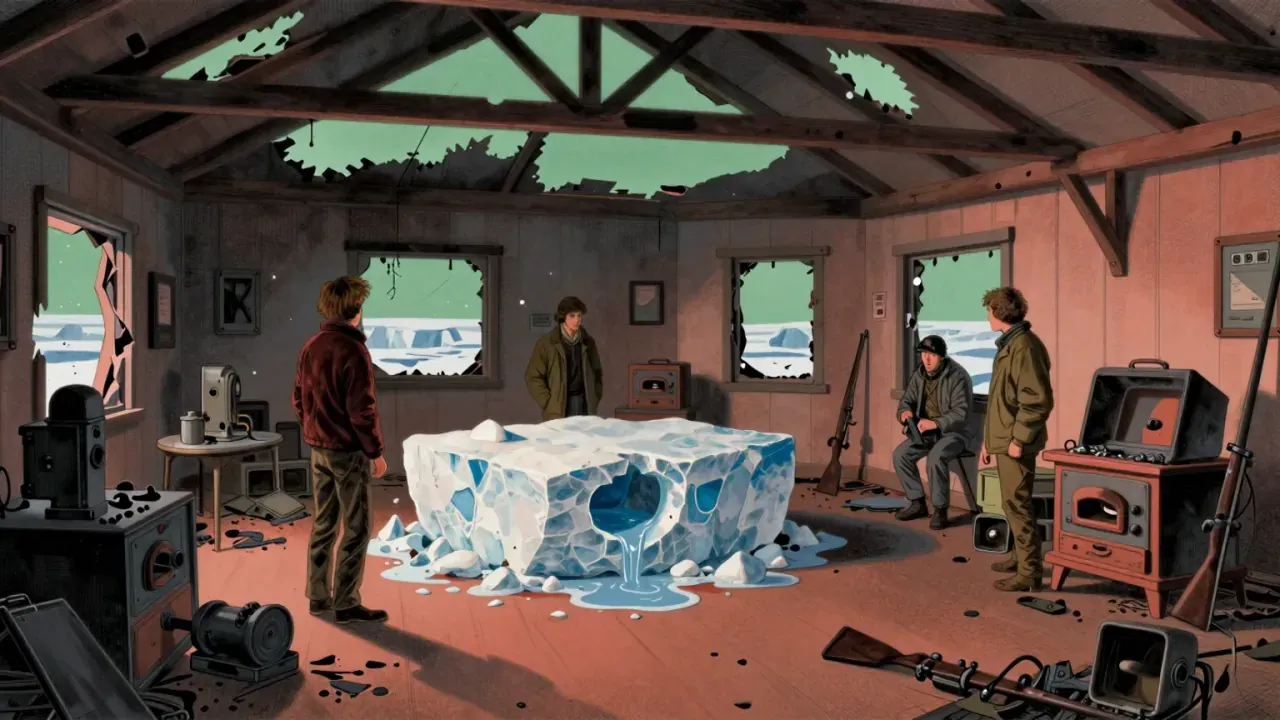
The Thing is John Carpenter’s 1982 adaptation of John W. Campbell’s 1938 novella Who Goes There?, following a precedent adaptation in the 1951 film The Thing from Another World that Carpenter had watched repeatedly for inspiration while remaining unconvinced by its monster. Kurt Russell plays R.J. MacReady, a helicopter pilot at an American Antarctic research station whose isolated team takes in a dog fleeing a nearby Norwegian camp, unaware it is host to a shape-shifting organism capable of perfectly imitating any living thing it consumes. Bill Lancaster wrote the script after several earlier drafts, from other writers, were rejected for straying too far from Campbell’s premise. Carpenter’s aim was fidelity to the novella’s central anxiety: not what the creature looks like, but that nobody can prove who still is who.
How the not-knowing is staged
The crew, played by Wilford Brimley, Keith David, Donald Moffat, T.K. Carter, David Clennon, Richard Masur, Richard Dysart and others, spend the film’s back half testing each other’s blood and reading each other’s behaviour for signs of infection, since the creature’s imitations are otherwise undetectable. Rob Bottin led the creature effects team, spending roughly a tenth of the film’s budget on transformations built from mechanical rigs, chemicals and food products rather than any digital trick, since none existed at the scale required. Dean Cundey’s cinematography keeps the station lit mostly by practical sources against Antarctic dark, and Ennio Morricone’s score, largely a low synthesizer pulse rather than an orchestral one, was composed to match Carpenter’s own sparse musical instincts from his earlier films. Todd Ramsay’s editing holds on reaction shots as long as on the transformations themselves, treating suspicion as the real special effect.
What still unsettles
What still unsettles is the uncertainty itself: the film never lets the audience know more than MacReady does, so every character remains a plausible threat until proven otherwise, including in the blood-test scene that has become the film’s most cited sequence for how mundane its staging is against how much tension it carries. Bottin’s transformation effects, when they arrive, remain genuinely upsetting rather than merely gory, built from a physical, tactile logic that has not aged the way early computer-generated monsters have. Russell plays MacReady with a wariness that never curdles into simple heroism; he is guessing as much as anyone else, and the film lets that show throughout.
What audiences rejected in 1982
Reviews on release were largely negative, and the film lost money against its 15 million dollar budget, taking only 19.6 million. Several explanations for that rejection have held up: it opened weeks after E.T. the Extra-Terrestrial offered audiences a friendlier alien, into a summer already crowded with science-fiction and fantasy releases, and its bleak, nihilistic ending arrived for an audience living through a recession who, by most accounts, wanted comfort rather than dread. Critics at the time praised Bottin’s effects but found them repulsive rather than impressive, and some considered the characters underwritten compared to the horror of what happens to them across the film’s second half.
Paranoia and the limits of trust
Set at an isolated station where nobody can leave and nobody can be trusted, the film uses the Thing less as a monster than as a mechanism for dismantling group trust entirely, each character’s fate turning on how well the others read them rather than on courage or firepower. That makes it a study in enforced loneliness: a crew that must isolate anyone showing symptoms ends up isolating everyone, since none of the tests are conclusive until it’s too late to matter. The ending, which the crew loses regardless of who wins the immediate fight, refuses the genre’s usual reassurance that identifying the threat solves it.
Who this is for
This suits viewers who want practical creature effects at their most extreme, and anyone who prefers a horror film that ends in doubt rather than resolution. It rewards close attention to performance, since the tension depends on watching each character’s behaviour for the small tell that might give them away. Fans of Carpenter’s other genre work, and of Kurt Russell’s collaborations with him, will recognise the same sparse, functional dialogue. It is not for anyone wanting a clear villain defeated by the final act, or viewers sensitive to body-horror transformation effects, which remain among the most graphic the genre has produced. Anyone wanting narrative closure should be warned the ending stays deliberately unresolved.
Worth the evening, decades late
The Thing lost money in 1982 and was reviewed harshly at the time, a commercial and critical failure by any contemporary measure, yet it found a second life on home video and has since been added to the National Film Registry as a work of lasting significance. That reversal is worth knowing going in: the film that disappointed its first audience is now regarded by many working directors as one of the best examples of the genre. Watched today, away from the summer it had to compete against, its bleakness reads as clarity rather than a miscalculation. An evening well spent, particularly for anyone who has only seen it referenced rather than seen it in full.