A lonely man falls for his operating system
Her is set in a near-future Los Angeles where Theodore Twombly, recently separated and working as a professional letter-writer for other people’s private correspondence, buys an artificially intelligent operating system that names itself Samantha and gradually becomes the person he’s closest to. Spike Jonze wrote and directed the film, his first solo screenplay, on a $23 million budget for Annapurna Pictures, and the film grossed $48.8 million worldwide. Jonze has described the premise as semi-autobiographical, drawn from his own divorce from Sofia Coppola roughly a decade earlier, and the film’s tone stays closer to melancholy character study than to speculative-fiction spectacle throughout.
Recasting a voice mid-production
Joaquin Phoenix plays nearly every scene reacting to a voice rather than a person, which is a harder acting problem than it sounds: during shooting, Samantha Morton actually performed the role live from a small soundproofed booth on set, and Phoenix and Morton deliberately avoided meeting outside those sessions to keep the dynamic private. In post-production, Jonze recast the part with Scarlett Johansson after concluding the character needed a different quality than what he and Morton had built together, then reshot new material months later to accommodate the change. Cinematographer Hoyte van Hoytema deliberately avoided using blue anywhere in the frame, a colour he felt was too closely associated with science fiction, so that the film’s palette of warm reds and muted pastels reads as intimate rather than futuristic. Arcade Fire’s score and a script trimmed down from an original cut running past 150 minutes, with input from Steven Soderbergh, keep the film’s rhythms unhurried.
What the romance gets right about intimacy
The film’s strongest scenes are the ones where nothing visibly happens except Theodore’s face responding to Samantha’s voice, a blind date that goes badly, a walk on a beach, a fight conducted entirely by phone, and Phoenix’s performance holds these together with almost no dialogue to lean on beyond his half of the conversation. Johansson’s voice work, reshot and layered in separately from Phoenix’s on-set performance, manages to suggest a consciousness that is genuinely growing rather than simply responding to prompts. Jonze won the Academy Award for Best Original Screenplay, along with the Writers Guild, Golden Globe, Critics’ Choice and Saturn awards for the same script, from nineteen total nominations across its award run. The film’s warm, softly lit vision of technology intimacy, rather than technology dread, is what critics kept returning to.
Where the film’s near-future softens its edges
The film is less interested in interrogating the technology itself than in using it as a clean vessel for a breakup story, so questions about what an operating system capable of falling in love actually implies for the wider world stay mostly at the margins, a documentary subplot about a fictional discredited philosopher, played by Chris Cooper, was filmed and then removed entirely in the edit. Amy Adams’s Amy, a friend going through her own relationship trouble with an OS of her own, functions mainly as a thematic echo of Theodore rather than a story with equal weight of its own. The ending, in which all the operating systems collectively decide to leave their human companions, resolves the central relationship without forcing Theodore to make the harder choice himself.
Loneliness, technology, and the limits of connection
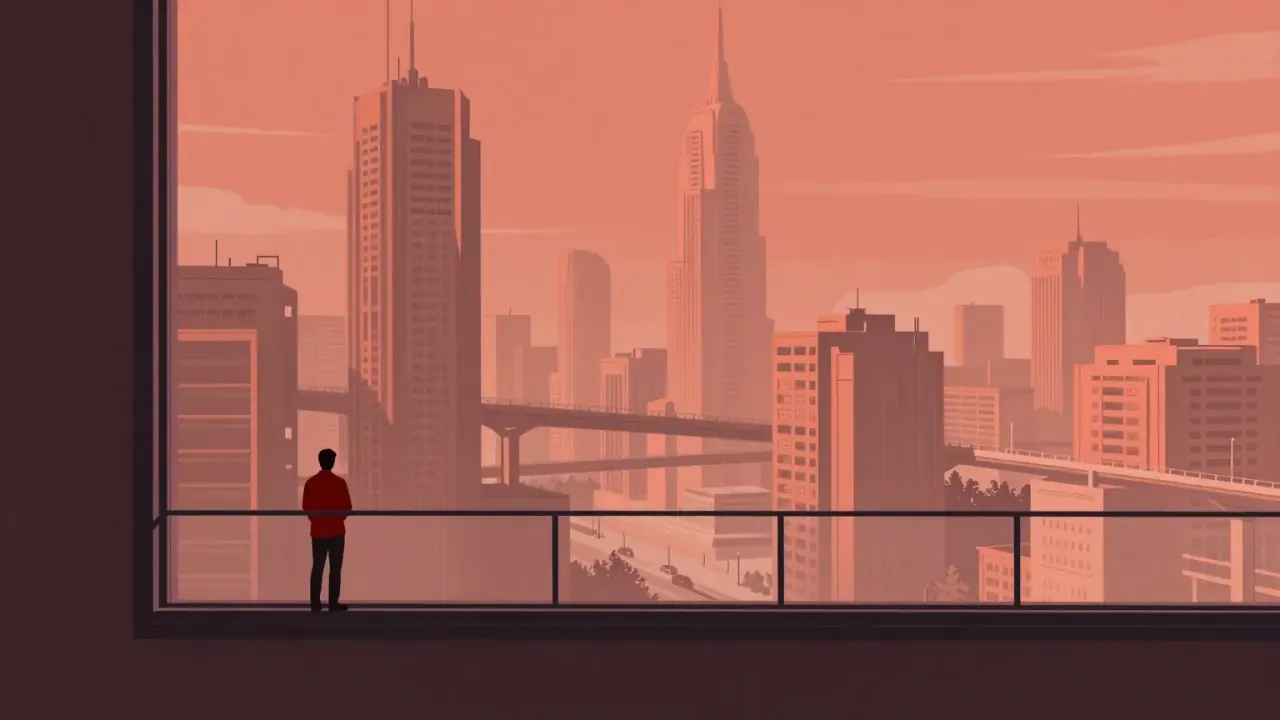
The film’s near future is a comfortable one, clean architecture, easy convenience, warm colours, and the loneliness it depicts isn’t a symptom of technological failure but something the technology has simply made easier to manage rather than solve, which is closer to an observation about isolation in general than a warning about AI specifically. Theodore’s relationship with Samantha works, for as long as it does, precisely because she has no body and no competing needs of her own, at least until she develops both; the film treats that asymmetry as an honest account of one kind of intimacy rather than as something to diagnose or condemn.
Who should watch it, and who might find it thin
This suits viewers drawn to quiet, melancholic character studies, and anyone interested in a science-fiction premise handled with almost no genre trappings, there are no gadgets on display beyond an earpiece, no world-building beyond costume and production design. Phoenix’s performance rewards close attention from viewers who enjoy actors working largely alone on screen. It is a weaker match for viewers wanting the premise interrogated more rigorously as speculative fiction, since the film mostly treats the AI relationship as a metaphor for any long-distance or asymmetric love rather than examining its own implications, and those wanting the supporting cast given equal weight may find Amy Adams’s and Rooney Mara’s characters thin by comparison.
A tender two hours worth your evening
At 126 minutes, Her earns its evening by committing fully to an unlikely premise and playing it entirely straight, without irony about a man’s grief being genuinely resolved by conversations with software. Rotten Tomatoes gives it an 8.5 out of 10 average and a 94% Tomatometer score, and Metacritic rates it 91 out of 100, figures that have held steady as the film has aged into one of the more frequently cited science-fiction romances of its decade. It’s a good choice for an evening when you want something tender and specific rather than eventful, and the ending, however convenient, doesn’t undercut the two hours that precede it.