A boot-camp film split into two half-films
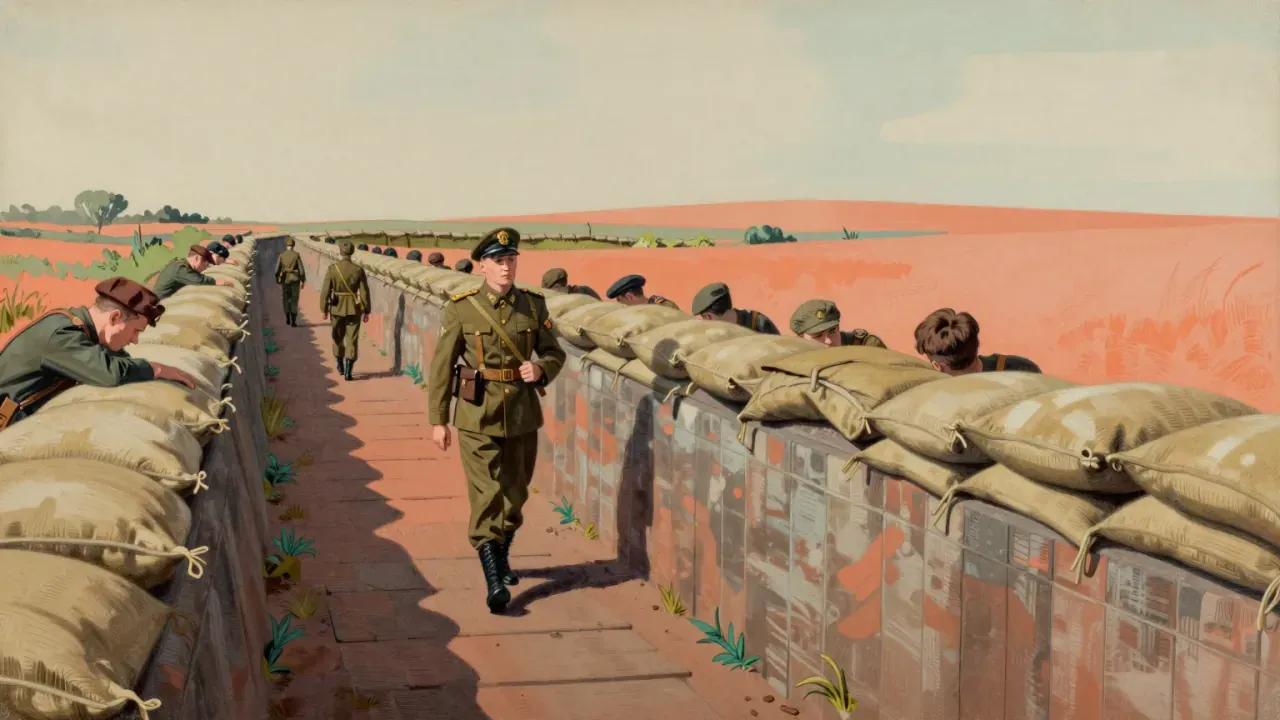
Full Metal Jacket is Stanley Kubrick’s 1987 war film, adapted with Michael Herr and Gustav Hasford from Hasford’s novel The Short-Timers and shot entirely in and around London rather than anywhere near Vietnam. It splits cleanly in two: a first half at Parris Island boot camp, where Gunnery Sergeant Hartman breaks down a platoon of Marine recruits including the slow, overweight Private Pyle, and a second half following the recruit nicknamed Joker into the Tet Offensive fighting in Hue. Kubrick spent years persuading Herr back into Vietnam material after his memoir Dispatches, and then split screenwriting duties three ways by phone and mail, none of the three fully aware how much the others had contributed. The film is less interested in the politics of the war than in showing, mechanically, how a training system converts a person into a weapon and what is left over once it has.
A drill instructor writing his own dialogue
The first half belongs almost entirely to R. Lee Ermey, a real former drill instructor hired initially as a technical consultant, who auditioned by improvising insults at a group of extras and ended up writing, by Kubrick’s own estimate, roughly half of Hartman’s dialogue. Vincent D’Onofrio’s Pyle absorbs that abuse and slowly hardens from bewildered target into something else entirely, a transformation the film tracks in his posture and blank stare rather than in dialogue. Matthew Modine’s Joker functions as the audience’s eyes rather than its hero, a wisecracking correspondent whose peace-sign button and Born to Kill helmet slogan are the film’s own joke about the gap between what a soldier says and what he is trained to do. Douglas Milsome’s cinematography, working from Kubrick’s own compositions, keeps the boot camp scenes flat and symmetrical, then lets the Hue sequences fall into rubble and haze once the film crosses into combat.
A demolished gasworks standing in for Hue
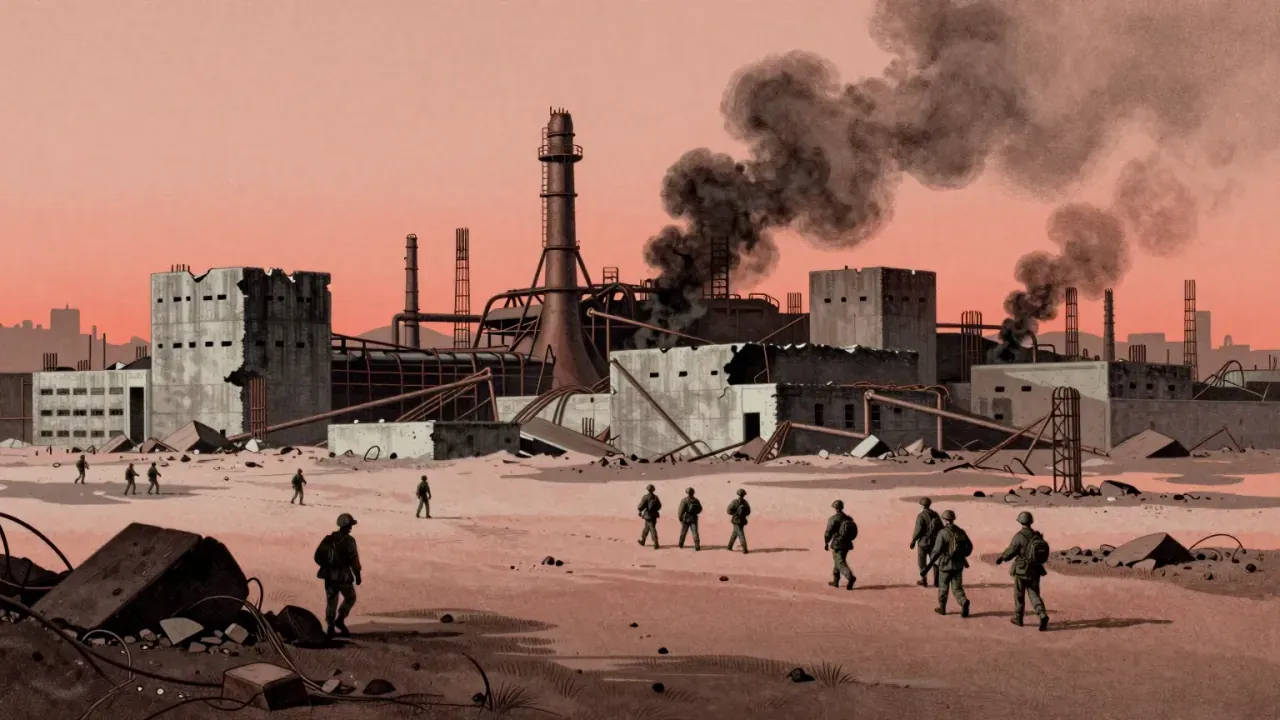
The production’s most convincing illusion is architectural rather than dramatic: Kubrick found a condemned gasworks in east London, had it partially demolished with a wrecking ball, and dressed it with imported palm trees to stand in for a bombed-out Hue, and the effect holds up as some of the more convincing urban-combat staging shot outside an actual warzone. Ermey’s performance is the film’s clear centre of gravity, sustained through takes that reportedly required twenty error-free runs with tennis balls and oranges thrown at him mid-line, and the rhythm of his insults never slackens on rewatch. The hard cut between the two halves, with no softening, is the film’s boldest structural choice, refusing the audience the relief of treating Parris Island as closed off before the real violence starts. The closing march, the platoon singing the Mickey Mouse Club theme through a burning city, is an unsettling piece of editing that earns its discomfort rather than reaching for it.
A second half that never matches the first
The Vietnam half never finds a structure as tight as the boot-camp section it follows, moving between a magazine-interview framing device, a firefight around a burned village, and a sniper stand-off that feel more like connected episodes than a single dramatic line. Adam Baldwin’s Animal Mother is meant to represent a hardened, amoral version of what Hartman’s training produces, but the character is given little beyond swagger to work with, and the film’s argument about him stays mostly implicit. Joker’s own arc, from ironic commentator to a man who has to make the film’s final, ugly decision, is underwritten compared to Pyle’s, so the ending’s weight falls on a character the film has spent less time building. Some of the dialogue, particularly Joker’s interview answers, reads as written rather than spoken, a rare lapse for a Kubrick script.
Training as a manufacturing process
The film’s real subject is dehumanisation as a manufacturing process rather than as an accident of war: Hartman strips recruits of their names, their bodies and their individuality before the platoon ever ships out, and Pyle’s arc suggests that the training does not fail so much as succeed too completely, producing a man capable of exactly the violence it was designed to instil. Masculinity here is presented as something built under duress rather than natural, performed through insult and repetition until it calcifies into fact. The war itself becomes almost secondary to the machine that produces its soldiers, which is why the Parris Island half, though it contains no combat, is the section most often remembered as the film’s true subject.
Who should sit through the first forty minutes
This suits viewers interested in performance and structure over battlefield spectacle, and anyone who wants to see a Vietnam film that treats training rather than combat as its centre of gravity. Ermey’s sequences alone justify a watch for anyone studying screen acting built from improvisation and repetition rather than a written part. It is a difficult recommendation for anyone sensitive to sustained verbal and physical abuse played at length without relief, since the first forty minutes offer almost no tonal breathing room. Viewers expecting a conventional combat narrative with a clear protagonist arc through the second half may find that section thinner and more episodic than the opening promises.
A film remembered for a third of itself
Made for thirty million dollars against a returned 46.3 million, the film was a modest commercial result for a director whose reputation rested on cultural rather than box-office weight, and it remains more admired for its opening third than as a complete piece. Critics’ aggregates in the high seventies and eighties out of a hundred reflect that split judgment fairly, rewarding Ermey’s performance and Kubrick’s construction of Parris Island more than the film’s back half. It was the last Kubrick film released while he was alive, and its influence on how drill-instructor scenes are staged in later films is disproportionate to its actual screen time. An evening with it earns its reputation in the first hour and coasts somewhat on that reputation through the second.