The idea behind it
Frankenweenie is a black-and-white stop-motion animated feature, directed by Tim Burton and released by Walt Disney Pictures in 2012. It is a full-length expansion of Burton’s 1984 live-action short, retaining its core premise: a boy named Victor Frankenstein reanimates his dead bull terrier Sparky using electricity, then faces escalating chaos when classmates imitate him with disastrous results. The film sets out to work as both homage and parody — invoking Universal horror iconography, Mary Shelley’s novel, and Burton’s own visual lexicon — while grounding its fantasy in childhood grief, scientific curiosity, and social alienation. Its formal choices are deliberate: monochrome photography, hand-crafted puppets, deliberately shallow depth of field, and a score by Danny Elfman that quotes and reframes his earlier gothic themes. It does not aim for realism or psychological naturalism, but for tonal consistency across image, movement, and sound — a self-contained aesthetic world where emotional logic governs narrative cause and effect. The ambition is modest in scope but precise in execution: to sustain a mood of tender melancholy beneath comic grotesquerie, without slipping into sentimentality or farce. (159 words)
The voice and the hand
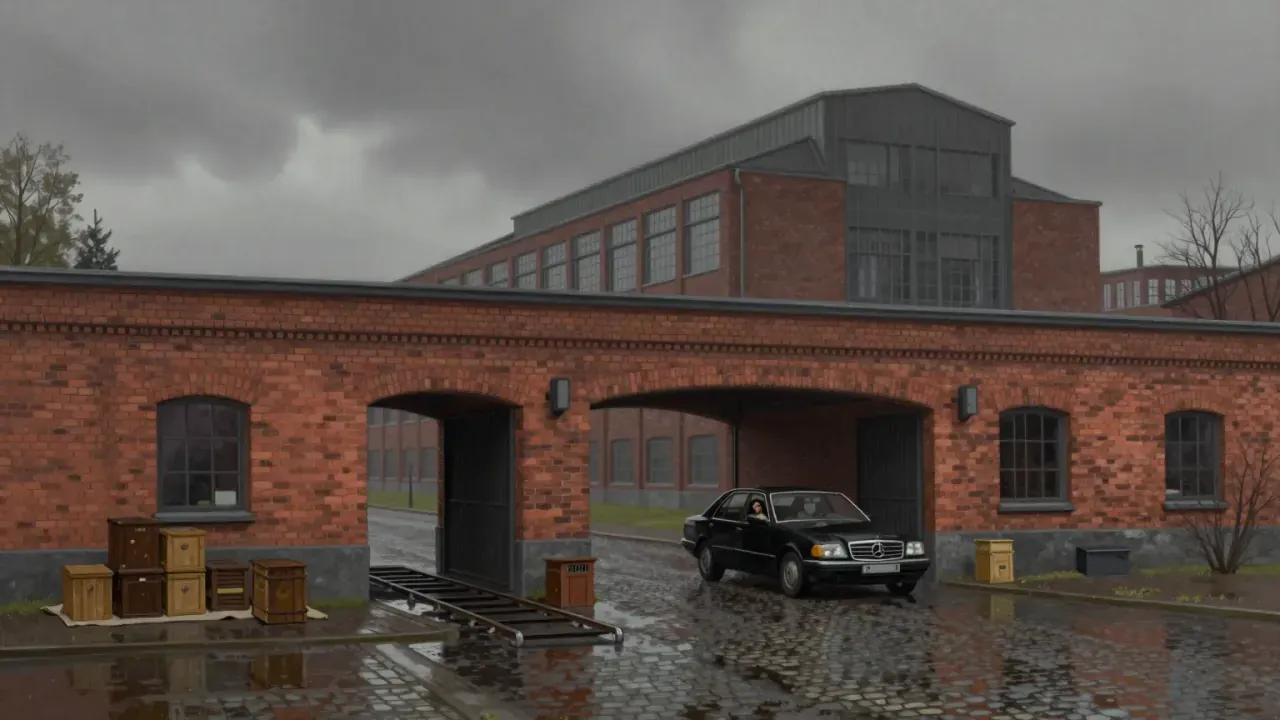
The story follows Victor’s isolation, loss, and quiet determination, then pivots into ensemble mayhem once Sparky escapes the attic and classmates begin their own reanimation experiments. Voice performances are stylised rather than naturalistic: Winona Ryder’s Elsa carries a muted gravity; Catherine O’Hara and Martin Short shape-shift between parental concern and caricatured suburbia; Martin Landau’s Mr. Rzykruski delivers exposition with theatrical menace. The craft is anchored in stop-motion rigour — 200 puppets, each with human hair and dozens of joints, built on mechanical armatures requiring Swiss watchmakers’ precision. Chris Lebenzon’s editing sustains rhythm through repetition and contrast: tight close-ups on blinking eyes or twitching ears, then wide shots of New Holland’s miniature streets under low-contrast lighting. Gordon Willis is not involved; the cinematography credit belongs to Peter Sorg, who keeps shadows dense but legible, and textures — fur, brick, rain-slicked pavement — palpable. Danny Elfman’s score mirrors the action’s shifts: a waltz for Sparky’s first walk, dissonant brass for the windmill fire, leitmotifs that recur with slight decay. There is no improvisation in performance or timing — every frame was pre-planned, rehearsed, and shot in sequence. (158 words)
What holds its weight
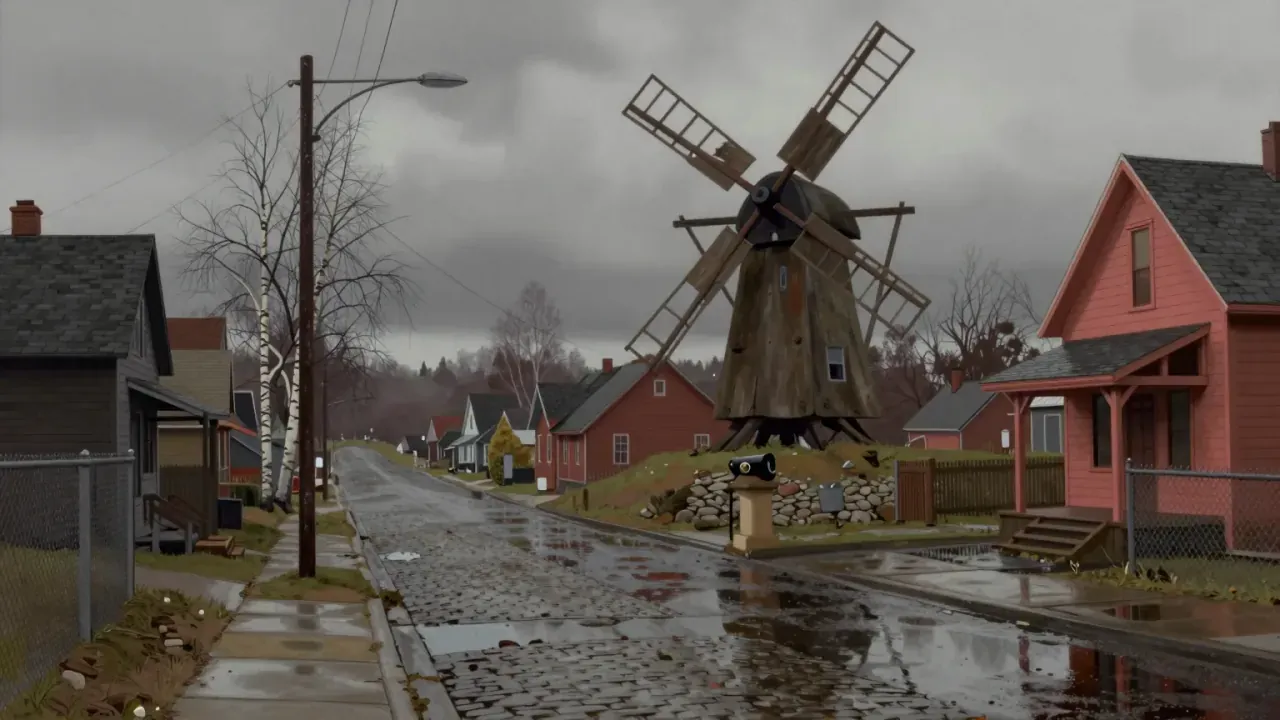
What lands is the film’s tactile sincerity. Sparky’s physical presence — his loping gait, the way his ears flatten when scolded, the weight he carries when dragging a leash — feels earned, not cutesy. The black-and-white palette avoids the saccharine glow of mainstream animation and instead gives the town a weathered, lived-in texture: peeling paint, crooked fences, fogged windows. Victor’s grief is never verbalised in cliché; it registers in how he holds Sparky’s collar, how he rewinds film footage of him, how he flinches at sudden noise. The classroom scenes land because they treat adolescent insecurity as structural, not anecdotal — Edgar’s blackmail reads as social calculus, not villainy. Even the monsters have internal logic: the wererat’s twitchiness matches its origin in garbage, Shelley the turtle’s kaiju form swells from Miracle-Gro’s absurd promise of growth. The windmill climax works not because of spectacle but because it resolves Victor’s arc physically — he climbs, falls, is saved, saves — and emotionally — Sparky chooses him, not the other way around. The film trusts its audience to read feeling in posture, silence, and composition, not exposition. (157 words)
Where the wires show
What does not land is the secondary ensemble’s moral arc. Toshiaki, Bob, Nassor and Edgar remain types rather than characters: their reanimations feel like plot devices, not extensions of personality. Their motivations — winning the science fair, impressing peers, one-upping rivals — are thin scaffolding for transformation, and their comeuppance arrives without consequence or reflection. The satire of suburban conformity is broad and unexamined: Edward Frankenstein’s baseball pep talk, Susan’s floral aprons, the town’s collective panic — all function as backdrop, not critique. Mr. Rzykruski’s dismissal hinges on a single ill-timed speech, which flattens what could have been a sharper point about pedagogy and fear of the unfamiliar. The Weird Girl’s clairvoyance is deployed for punchlines, not thematic resonance. Some visual gags misfire: the invisible goldfish vanishes without spatial logic; the Sea-Monkeys’ amphibious rampage lacks choreographic clarity. The film’s restraint elsewhere makes these lapses more visible — moments where tone slips from wry to arbitrary, or where the stop-motion’s slowness exposes a script beat that hasn’t earned its duration. A viewer expecting narrative density will find stretches where pacing serves craft over character. (156 words)
What it thinks about
The themes that matter are grief as labour, not catharsis; knowledge as embodied, not abstract; and care as continuity, not rescue. Victor does not ‘get over’ Sparky’s death — he digs him up, wires him, watches him sleep, teaches him tricks again. His science is not theoretical but procedural: measuring voltage, adjusting electrodes, timing lightning strikes. The film treats resurrection not as miracle but as repair — flawed, reversible, demanding attention. The monsters are literalisations of unchecked intention: Nassor’s mummified hamster returns rigid and silent, Shelley the turtle grows uncontrollably because growth was the only instruction given. This is not anti-science but pro-responsibility — a distinction the film holds without sermonising. Family appears not as ideal but as friction: Susan and Edward are baffled, then frightened, then pragmatic. Their final decision — to help Victor search, then accept Sparky’s return without condition — is quiet, uncelebrated, and deeply adult. The film’s gothic surface masks a persistent humanism: that love persists not in spite of imperfection, but through it — in frayed leashes, burnt windmills, and dogs who still chase cats even after death. (154 words)
Who it’s for, and who it isn’t
This film is for viewers who value material craft over narrative velocity, and who respond to melancholy as a tonal register rather than a flaw. It suits adolescents who recognise Victor’s isolation, adults who remember the weight of childhood responsibility, and animation enthusiasts attuned to puppet articulation and set construction. It is not for those who require psychological realism, rapid plotting, or moral clarity — the film refuses to condemn its villains or reward its heroes with tidy closure. Parents expecting a light family comedy may find its monochrome gloom and slow pacing alienating; fans of Burton’s broader work may miss the satirical bite of Beetlejuice or the emotional scale of Edward Scissorhands. A viewer who values thematic coherence over incident will stay engaged; one who needs constant escalation or clear stakes may drift. The film’s patience is its virtue and its barrier — it asks for attention, not just consumption. Those unwilling to sit with stillness, shadow, and unresolved tension should look elsewhere. (158 words)
Whether it’s worth your time
Yes, it is worth your evening — provided you approach it as a crafted object, not a story engine. Its 87 minutes pass without hurry, anchored by texture, rhythm, and emotional fidelity. You will not leave with a new insight about life, but you may notice how light falls on wet pavement, how a dog’s tail thumps before he looks up, how silence can hold more weight than dialogue. It rewards attention to detail: the stitching on Victor’s lab coat, the grain of the attic floorboards, the way Sparky’s breath fogs glass. It is not a film to stream while multitasking, nor one that benefits from skipping ahead. Its modest budget shows in the limited number of sets, but also in the focus those constraints impose — every frame has purpose. Those who dislike stop-motion, distrust monochrome, or expect narrative payoff proportional to runtime will find it thin. But for anyone willing to meet it on its own terms — as a handmade elegy dressed as a monster movie — it remains quietly resonant, technically assured, and emotionally precise. (159 words)