The end of an era
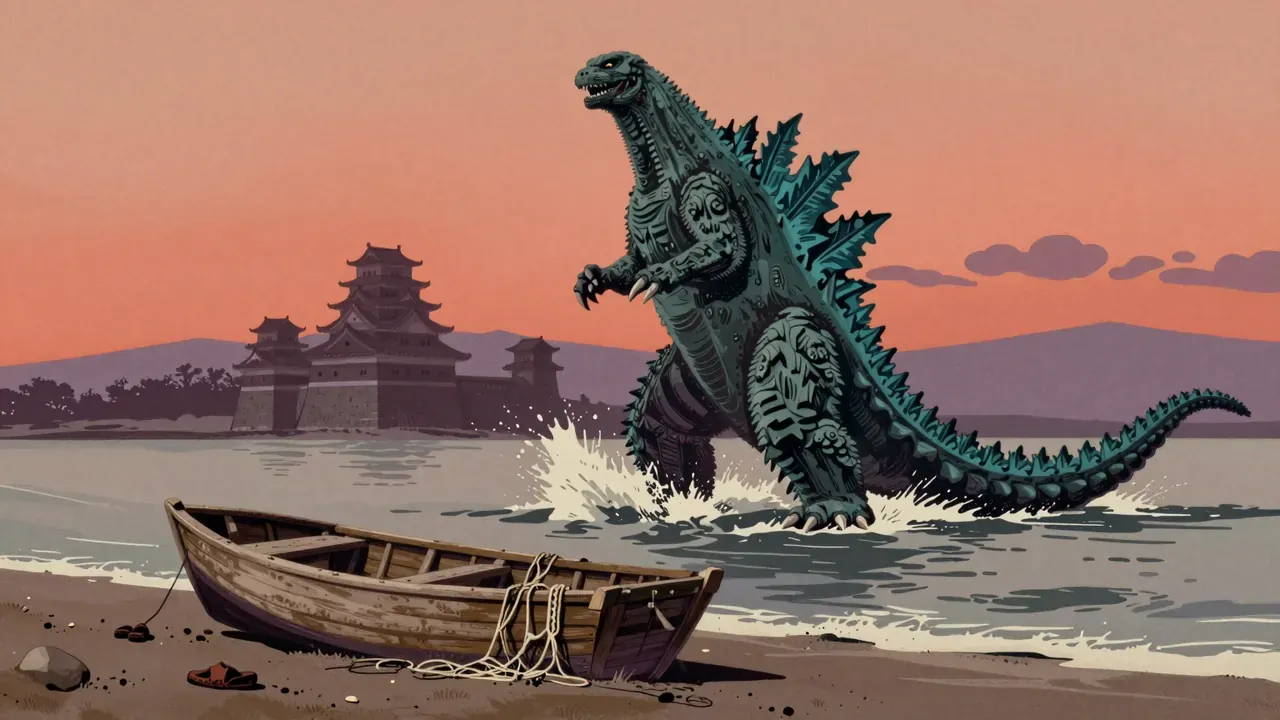
Terror of Mechagodzilla is the fifteenth entry in the Godzilla franchise and the final Shōwa-era film, conceived as a direct sequel to Godzilla vs. Mechagodzilla and intended to close Ishirō Honda’s involvement with the series. It attempts a tighter, more personal narrative than earlier entries: the story centres on Katsura, a cyborg woman implanted with a control device for Mechagodzilla 2, and her fraught relationship with marine biologist Akira Ichinose. The film seeks to fuse kaiju spectacle with psychological stakes — grief, coercion, paternal obsession — while maintaining the genre’s structural obligations: three monsters, interplanetary antagonists (the Simeons), and a Tokyo showdown. Its ambition lies not in scale but in condensation: fewer locations, fewer human subplots, and a sharper focus on bodily violation and technological possession. It does not aim to reinvent the formula but to refine it under constraint — budgetary, temporal, and tonal — within the diminishing margins of mid-1970s Toho kaiju production. The script, by Yukiko Takayama, was revised four times before approval, suggesting deliberate calibration rather than improvisation. (158 words)
The body as battleground
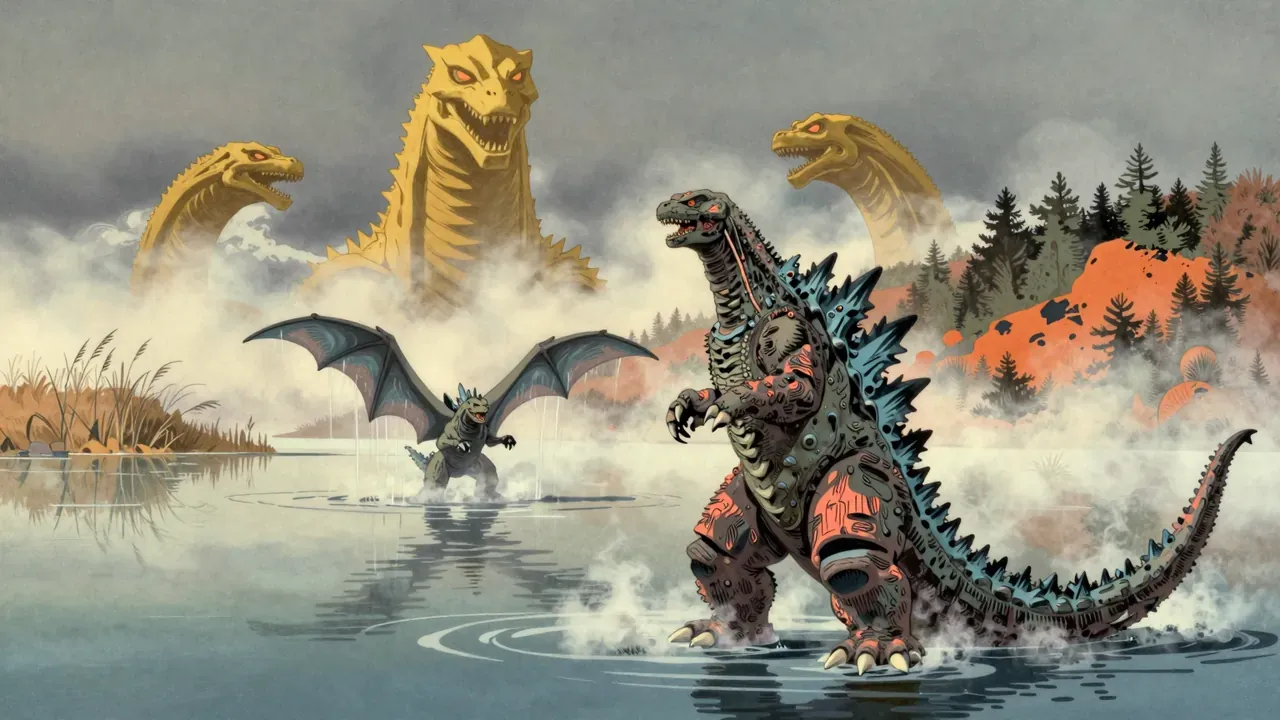
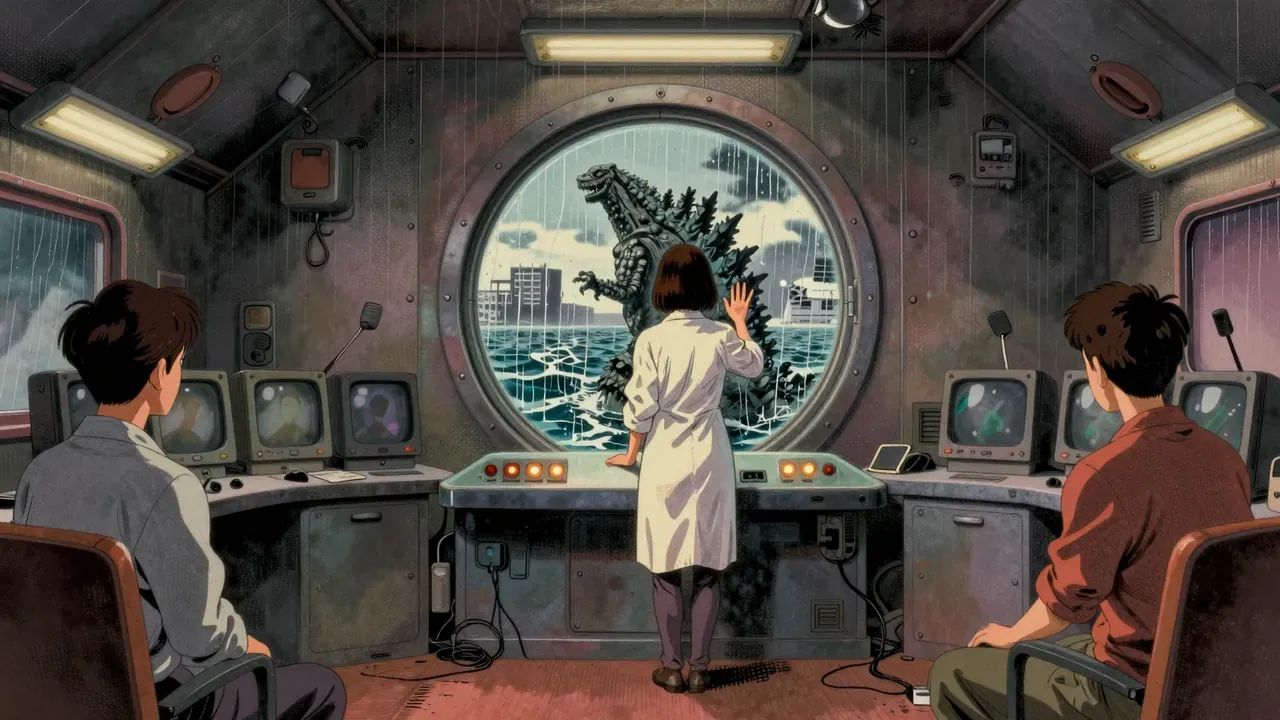
The story moves briskly across its 83 minutes, pivoting on Katsura’s dual role as victim and vector: her surgery, her deception of Ichinose, and her final self-sacrifice anchor the plot more firmly than most Shōwa entries. Performances are functional rather than expressive — Katsuhiko Sasaki conveys earnest concern without flourish; Tomoko Ai’s Katsura carries quiet gravity, especially in stillness. Akihiko Hirata, as the unhinged Dr Mafune, avoids caricature through restraint. Akira Ifukube’s score remains characteristically thunderous but less leitmotif-driven than in earlier films, favouring rhythmic urgency over thematic recurrence. Yoshitami Kuroiwa’s editing sustains momentum, cutting tightly between submarine interiors, Mafune’s cliffside laboratory, and the final Tokyo battle. Teruyoshi Nakano’s special effects retain the tactile weight of suitmation and miniatures — Mechagodzilla 2’s articulation feels heavier, more deliberate than its predecessor; Titanosaurus moves with lurching, amphibious menace. The underwater sequences lack depth but gain coherence from consistent lighting and framing. There is no attempt at realism, only legibility: each monster’s behaviour, each human decision, serves the next beat without digression. (159 words)
The weight of choice
What lands is the film’s moral clarity amid mechanical chaos. Katsura’s arc — from passive subject to active agent of her own erasure — gives the finale emotional weight rare in the series. Her suicide is neither melodramatic nor gratuitous; it follows logically from her earlier helplessness and the film’s consistent emphasis on bodily autonomy as contested ground. The supersonic wave oscillator functions as both plot device and metaphor: a fragile, human-made counterpoint to overwhelming force, repaired not by genius but by persistence. The Tokyo battle avoids the city-wide obliteration proposed in early drafts, focusing instead on tactical coordination between Interpol, the military, and Godzilla — a shift that makes cooperation feel earned, not incidental. Akira Ifukube’s use of brass stings during Mechagodzilla 2’s activation underscores dread without overstatement. Even the brief nudity — clinically framed, shot on mannequin — lands as clinical violation, not titillation, reinforcing the film’s preoccupation with instrumentalised bodies. The ending, with Godzilla returning to sea after a hard-won victory, closes the Shōwa era not with fanfare but with weary resolution — a tone Honda sustains without sentimentality. (156 words)
Where the logic frays
What does not land is the Simeons’ presence: their motives remain vague, their design unmemorable, and their dialogue perfunctory. Their alien hierarchy — Mugal, Tsuda, unnamed underlings — adds bureaucracy without intrigue. The subplot involving Interpol’s submarine attack dissolves after one scene, leaving Titanosaurus’ origin under-explained despite its centrality. The film’s attempt to merge two dinosaurs into one creature, as noted in development notes, results in a monster whose biology feels arbitrary rather than coherent — less evolutionary anomaly, more narrative convenience. Toru Kawai’s Godzilla, while physically imposing, lacks the brooding presence he brought to earlier films; his interventions feel reactive rather than volitional. The romantic thread between Ichinose and Katsura has little breathing room — their bond is asserted, not built — making the final embrace emotionally thin. The English-language prologue added for US television, though absent from the Japanese version, exemplifies a broader issue: exposition is often delivered via title cards or rushed voiceover, sacrificing immersion for expediency. The film’s tight runtime becomes a liability in places, compressing consequence into gesture. (158 words)
The sound of resistance
The themes that matter are bodily integrity, technological complicity, and the limits of paternal control. Katsura’s body is repeatedly appropriated — by her father’s experiments, by Simeon surgery, by Interpol’s surveillance — making her physical vulnerability the film’s ethical axis. Mechagodzilla 2 is not just a weapon but an extension of Mafune’s will, literalising the danger of unchecked scientific authority cloaked as care. The Simeons, though poorly drawn, function as externalisers of that same logic: they do not conquer, but co-opt — offering ‘services’ to amplify existing human pathologies. Titanosaurus, emerging from the deep and responding to sonic frequency, embodies nature as both threat and diagnostic tool: its weakness reveals what human systems cannot perceive without collaboration. The film treats science not as neutral method but as relational practice — flawed when isolated, potent when accountable. There is no triumph of reason over superstition, but a quiet insistence that survival depends on listening: to waves, to wounds, to silence between lines of dialogue. This is not ecological allegory but embodied epistemology — knowledge held in tissue, transmitted through vibration, disrupted by violence. (157 words)
Who it is for
This film is for viewers who value narrative economy in genre cinema, those familiar with the Shōwa series’ rhythms and willing to sit with its limitations, and students of practical effects who appreciate how miniature scale and suitmation shape emotional register. It rewards attention to composition — the way Honda frames Katsura against laboratory glass, or how Nakano lights Titanosaurus’ dorsal ridge from below — rather than spectacle alone. It is not for viewers seeking mythic grandeur, psychological complexity beyond its narrow scope, or tonal consistency: the shifts between clinical horror and pulpy action remain unresolved. Fans of later eras may find its pacing abrupt, its politics underdeveloped. Those put off by dated effects or dubbed dialogue should note the Japanese audio track preserves Ifukube’s score and Takayama’s dialogue rhythms better than any English version. A viewer who dislikes the premise of human-monster symbiosis — or finds the cyborg trope exhausted — will not be won over. The verdict hinges on tolerance for constraint: this is a film that achieves precision within strict boundaries, not transcendence beyond them. (159 words)
Is it worth your evening?
Yes, it is worth your evening — if you approach it as a late-career distillation rather than a climax. Its 83 minutes move without waste, and its central dilemma — how to resist when your body is the battlefield — remains materially urgent. It works best viewed back-to-back with Godzilla vs. Mechagodzilla to see how Takayama and Honda tighten the screws: fewer villains, fewer detours, more focus on consequence. Those who expect the operatic sweep of Mothra or the existential dread of Godzilla 1954 will be disappointed; this is leaner, colder, more procedural. It is not essential viewing for casual fans, but indispensable for anyone mapping the franchise’s evolution — or studying how genre constraints can sharpen thematic intent. The film’s modesty is its strength: it asks little, delivers precisely that, and ends without overstaying. Its value lies not in scale but in singularity — a single, sustained note in a long symphony, played with unwavering pitch. (158 words)