Who walks in
Adventures of Zatoichi is the ninth entry in Daiei’s Zatoichi series, a mid-run chambara film that consolidates the character’s moral architecture while testing its limits through repetition and variation. It does not seek novelty in plot or structure but instead refines the formula: blind itinerant masseur Zatoichi stumbles into local injustice, observes without being seen, intervenes only when coercion or betrayal crosses an unspoken line, and departs before dawn. The film aims to sustain the mythic weight of Zatoichi as both weapon and witness — a figure whose competence is absolute but whose authority remains personal, unlicensed, and self-limiting. It treats the sword-cane not as a tool of vengeance but as a measure of others’ integrity: when Gounosuke’s iaijutsu display ends with wood splitting after Ichi leaves the room, the cut is implied, not shown — the consequence precedes the act. This is not world-building but world-weighing: every encounter tests whether custom, duty or loyalty still hold meaning under pressure. (158 words)
The look of it
The story moves with economical precision: each location — inn, gambling house, guardhouse, mountain path — serves a function in escalating moral stakes, not spectacle. Shintarō Katsu’s performance anchors the film in quiet physicality: his posture shifts subtly between deference and readiness; his listening is never passive but diagnostic. Miwa Takada’s Saki avoids melodrama by holding grief in reserve, her resolve hardening only after betrayal. Mikijirō Hira’s Gounosuke is written with rare nuance — a retainer who knows his place yet refuses to be reduced to it, his duel request less about victory than recognition. Taichirō Kosugi’s score uses shamisen sparingly, often cutting out entirely during confrontations, leaving space for footfall, breath, and the scrape of blade on scabbard. Kimiyoshi Yasuda frames interiors with shallow depth, keeping faces half in shadow even in daylight scenes; fight choreography favours reaction over impact — swords miss, parry, hesitate. The editing tightens around moments of choice: Ichi’s pause before drawing, Gounosuke’s intake of breath before the spinning top splits. (159 words)
How it cuts
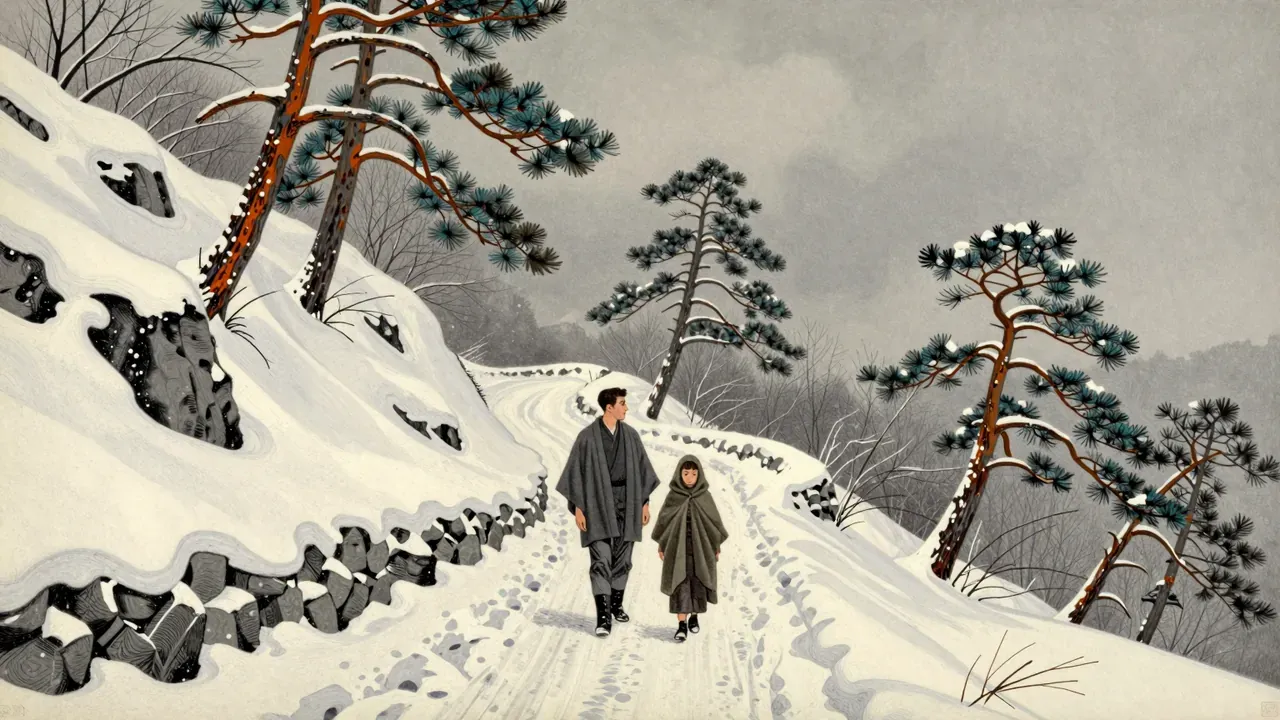
What lands most firmly is the film’s restraint in treating violence as punctuation rather than climax. The dice-cutting scene works not because it displays skill but because it exposes hypocrisy: fair dice hidden in a man’s hair, weighted ones in plain sight — the system is rigged, and Ichi unmasks it without raising his voice. The snowfall during the final duel is not romantic but functional: it muffles sound, slows movement, makes footing uncertain — and yet Ichi moves with unchanged certainty. His sparing of Giju is more resonant than any kill: the old man’s name triggers no revelation, only a quiet, unshared recognition of shared loss, and Ichi walks away without explanation. The mountain sunrise at the end is neither triumph nor closure but continuity — a ritual repeated across years, seasons, films. These are not gestures toward theme but enactments of it: justice as calibration, not retribution; honour as consistency, not proclamation. Even the betrayal feels earned — not because Giju is evil, but because he is desperate, and desperation wears the same face in every era. (157 words)
What repeats
What does not land is the structural reliance on prior entries, particularly the repetition of narrative beats from the eighth film: the dice-cutting, the go-room confrontation, the off-screen killing of a secondary antagonist. These feel less like motifs and more like placeholders, relying on audience memory to supply emotional weight the scene itself does not generate. Shinsuke’s arc collapses too quickly — his confession arrives without psychological preparation, making his death feel procedural rather than tragic. The subplot involving the vanished headman lacks grounding: we never see the village, hear its grievances voiced by more than one person, or understand why protest against Gorota Kajime carries such risk. The boys who expose Giju’s betrayal appear without introduction and vanish after delivering their line, functioning as plot mechanics rather than characters. There is also a tonal inconsistency in how women are framed: Saki’s agency is real but narrow, confined to waiting, travelling, and reacting; Osen exists primarily as exposition and emotional counterweight. None of this breaks the film, but it keeps it from deepening beyond its established groove. (156 words)
Where the rot sits
The themes that matter are filial silence, institutional rot, and the weight of unclaimed identity. Zatoichi’s repeated refusal to name himself — or to let others name him — is not evasion but discipline: identity here is not a label but a set of obligations, and he chooses which to uphold. The intendant Gorota Kajime and crime boss Jinbei do not oppose each other but cohabit, their power symbiotic — one issues decrees, the other enforces them, and both profit from the vendors’ fear. This is not feudal corruption but bureaucratic complicity, made visible in the 40% extortion demand, a figure so precise it reads like a ledger entry. Gounosuke’s lament about being the third son of a minor lord speaks to a wider crisis of worth: when birth no longer confers purpose, what remains is skill — and skill without context becomes mere danger. The mountain sunrise ritual matters because it is unaffiliated: no shrine, no priest, no doctrine — just light, time, and a man who shows up. That is the film’s quiet thesis: meaning persists not in institutions but in repetition done with attention. (155 words)
Who watches it
This film is for viewers who already know Zatoichi’s rhythm — those who watch not for surprise but for variation in tone, texture, and restraint. It rewards patience with small accumulations: the way Katsu tilts his head a fraction higher when listening to footsteps on gravel, or how Kosugi’s music returns a single phrase three times across the film, each time slower and lower. It is not for those expecting escalation, innovation, or psychological exposition — anyone needing motivation spelled out, or moral ambiguity resolved, will find it thin. Fans of modern action cinema may balk at the long pauses, the refusal to show wounds or blood, the insistence that a sword drawn is already a verdict. But those who value craft as accumulation — editing that trusts duration, acting that lives in the breath between lines, music that knows when to stop — will find it rich. A viewer who disliked the seventh or eighth Zatoichi will likely find this indistinguishable; one who loved them will notice the slight tightening in Yasuda’s framing, the quieter gravity in Katsu’s walk. (159 words)
What remains at dawn
Yes, it is worth your evening — provided you approach it as a chapter, not a destination. At 86 minutes, it occupies less time than a commute, and its pacing gives back what it asks: no filler, no false urgency, no obligation to care more than the film itself does. It assumes familiarity, so first-timers may feel adrift, but that is not a flaw — it is a condition of its form. Those who dislike ritual, repetition, or unresolved endings will leave unsatisfied; those who find resonance in small, repeated acts — lighting a lantern, pouring sake, watching dawn — will recognise its economy as generosity. It does not argue for itself, nor does it need to: its confidence lies in knowing exactly what kind of film it is, and refusing to be anything else. To call it ‘minor’ is to mistake modesty for absence — this is not a lesser Zatoichi, but a necessary one: the hinge between early exuberance and late austerity. (158 words)