What it watches
Vive le Tour is an 18-minute French documentary from 1962 that observes the 1962 Tour de France not as spectacle but as logistical theatre: how riders are fed, patched, dosed, and propelled across roads under sun and rain. Louis Malle does not aim to narrate a race or crown a winner; he treats the event as a mobile ecosystem, one where mechanics adjust gears in roadside dust, journalists shout questions into microphones held aloft like weapons, and exhausted cyclists slump over handlebars while bystanders offer bread and wine. The film’s purpose is descriptive, not expository — it accumulates detail rather than argument, and its authority rests on proximity, not explanation. It assumes familiarity with cycling’s rhythms but does not require expertise: what matters is the texture of effort, the repetition of motion, the quiet desperation behind the grin. Malle filmed during the race itself, embedding himself among teams and officials without staging or interviews. This is not a history of the Tour, nor a tribute to heroes, but a snapshot of endurance as daily work — unvarnished, unheroic, and unsentimental. (158 words)
How it watches
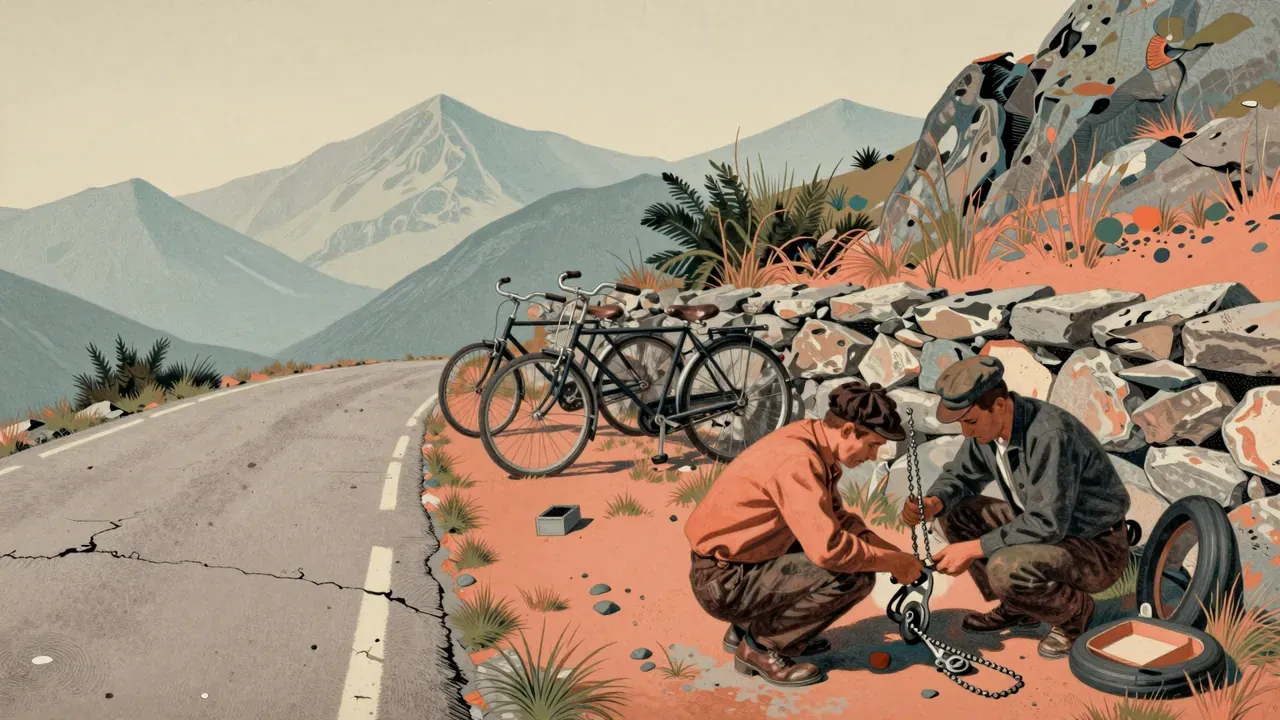
The film works through tight, handheld observation and rhythmic editing: Ghislain Cloquet and Jacques Ertaud’s camerawork stays low and close, tracking wheels, mud-splattered jerseys, and hands tightening bolts. Louis Malle appears both behind and in front of the lens — as director, cinematographer, and occasional presence in shot — reinforcing the film’s self-aware modesty. Jean Bobet’s voice-over is measured, dry, and lightly ironic, describing doping controls and roadside meals with the tone of a man who has seen both fail. Georges Delerue’s score is spare, mostly piano and strings, used not to underscore emotion but to punctuate transitions — a brief swell as a rider crests a pass, then silence again. There are no re-enactments, no archival inserts, no title cards explaining rules. The structure follows the race’s geography more than its chronology: stages blur into one another, linked by recurring motifs — the clatter of gears, the rustle of cellophane-wrapped sandwiches, the whirr of press cameras. Performance is absent in the conventional sense; the cyclists, mechanics, and spectators behave as they would without a camera, which gives the film its unforced authenticity. (159 words)
What sticks
What lands is the cumulative weight of small, repeated truths: the exhaustion in a rider’s eyes after three hours, the way a mechanic’s fingers move without looking, the absurdity of a journalist asking for ‘a quote on suffering’ while a cyclist vomits into a ditch. The film’s brevity works in its favour — it refuses to overstate, never lingers too long on tragedy or triumph, and avoids the didacticism common to sports documentaries of the era. Its black humour feels earned, not imposed: when a rider collapses and is revived with brandy, the camera holds on the empty glass, not the face. The sound design — wind, chain noise, distant crowd murmur — is precise and unembellished, grounding each sequence in physical reality. Even the music serves restraint: Delerue’s phrases are short, unresolved, often cut off mid-phrase as the image changes. This is a film that trusts the viewer to infer meaning from gesture and context, and that trust is repaid. It does not ask for admiration, only attention — and delivers both without strain. (157 words)
What it leaves out
What does not land is any sustained engagement with the ethical questions the film gestures toward — doping, exploitation, class disparity between riders and sponsors — because it declines to interrogate them. The voice-over notes the use of stimulants but offers no context, no critique, no follow-up. Similarly, the film’s affection for the race’s rituals never extends to questioning their cost: injuries are shown, but never discussed beyond the immediate treatment; crashes are edited for rhythm, not consequence. There is no sense of scale — no map, no time stamps, no indication of distance covered — which makes the physical toll harder to grasp for viewers unfamiliar with the Tour’s demands. The absence of interviews or direct address also means the film cannot clarify ambiguity: when a rider receives an injection, we do not know if it is permitted, necessary, or dangerous. This is not negligence, but a deliberate narrowing of focus — yet it leaves some of the film’s implied themes stranded, half-formed. A viewer seeking moral clarity or historical framing will find neither here. (159 words)
What it says about effort
The themes that matter are endurance as routine, not spectacle; labour disguised as sport; and the quiet complicity of spectacle-making. The film treats the Tour not as a contest of individual will but as a distributed system — riders, cooks, doctors, journalists, fans — all performing interlocking roles with little agency over the machine they serve. Doping is not framed as scandal but as logistics: another item on the support team’s checklist, like spare tubes or boiled potatoes. Food appears repeatedly — not as celebration but as fuel, hastily consumed, often cold. Injury is managed, not mourned; recovery is assumed, not guaranteed. There is no distinction drawn between amateur and professional effort: the mechanics’ hands are as grimy as the riders’, their concentration just as absolute. The film’s most persistent motif is repetition — the same gestures, the same sounds, the same roadside crowds — suggesting that heroism, if it exists here, lies in persistence rather than victory. It is a film about maintenance, not transformation. (156 words)
Who it’s for
This film is for viewers who value precision over exposition, who find interest in the unremarkable details of skilled work, and who accept that a documentary need not explain itself to be persuasive. It suits those familiar with cycling’s physical grammar — the sight of a rider’s shoulders dropping at kilometre 120, the sound of a freewheel clicking on descent — but it is also accessible to newcomers willing to watch without needing context. It is not for viewers who require narrative scaffolding, moral resolution, or biographical framing; those expecting a portrait of champions or a critique of sport’s commercialisation will leave unsatisfied. Some may find its detachment alienating, especially given the New York Times’ description of ‘unspeakable tragedy’ — the film registers such moments without amplifying them. A different approach — longer runtime, deeper interviews, archival context — would shift the verdict, but this version asks only for patience and attention, not investment. (159 words)
Why it lasts
Yes, it is worth your evening — not as a standalone feature, but as a calibrated, intelligent pause: 18 minutes that recalibrate how you see effort, organisation, and spectacle. It rewards slow viewing, not passive consumption; its power lies in accumulation, not revelation. Those who dismiss it as slight have mistaken brevity for thinness — it is dense with observation, economical with judgement. It is not for viewers who demand explanation, uplift, or closure; its refusal of those things is its integrity. A student of film craft will note how much is achieved with so little equipment and no script beyond Bobet’s narration; a cyclist will recognise the truth in every grease-stained frame. To call it ‘minor’ is accurate, but misleading — minor works can hold major truths, and this one does. Its value increases with rewatching, as new details emerge: a glance, a shadow, a change in pedal stroke. It earns its place not by scale, but by exactness. (158 words)