The vow in the cell
Zatoichi and the Doomed Man is the eleventh entry in Daiei’s 26-film Zatoichi series, a mid-1960s Japanese chambara built around Shintarō Katsu’s blind itinerant masseur and swordsman. It follows a familiar structural rhythm: Zatoichi arrives in a new town, observes injustice, intervenes reluctantly, and departs after a decisive confrontation. Here, the catalyst is Shimazo — a fellow prisoner who claims wrongful conviction for arson, murder and housebreaking — and Zatoichi’s subsequent promise to clear his name. The film attempts to balance procedural fidelity with moral urgency, using the legal vulnerability of the powerless as a frame for Zatoichi’s quiet authority. It does not seek reinvention but consolidation: reaffirming the character’s ethical compass within tightly wound genre constraints. Its ambition lies in restraint — in how much weight a single vow, a few lashes, and a half-remembered name can carry across eighty-eight minutes of measured pacing and unadorned staging. It assumes familiarity with the series’ grammar and offers no exposition for newcomers.
The ears before the blade
The story moves through three clear zones: imprisonment, investigation, and resolution — though the third act contracts sharply, leaving several threads unresolved. Shintarō Katsu performs with habitual economy: his Zatoichi listens more than he speaks, reacts with micro-shifts in posture and breath, and fights with economical, grounded precision. Sachiko Murase gives Shimazo’s wife Oyone quiet dignity without sentimentality; Koichi Mizuhara’s Shimazo registers as genuinely desperate, not merely plot-convenient. Kazuo Mori directs with functional clarity: compositions are uncluttered, action staged in wide shots that preserve spatial logic, and editing avoids flourish. Seitarō Ōmori’s score is sparse — strings and shamisen punctuate rather than underscore — and Shōzaburō Asai’s script keeps dialogue terse, favouring implication over exposition. There is no visual flamboyance, no tonal experimentation: every craft choice serves legibility and momentum, even when momentum falters in the final stretch.
The weight of a name
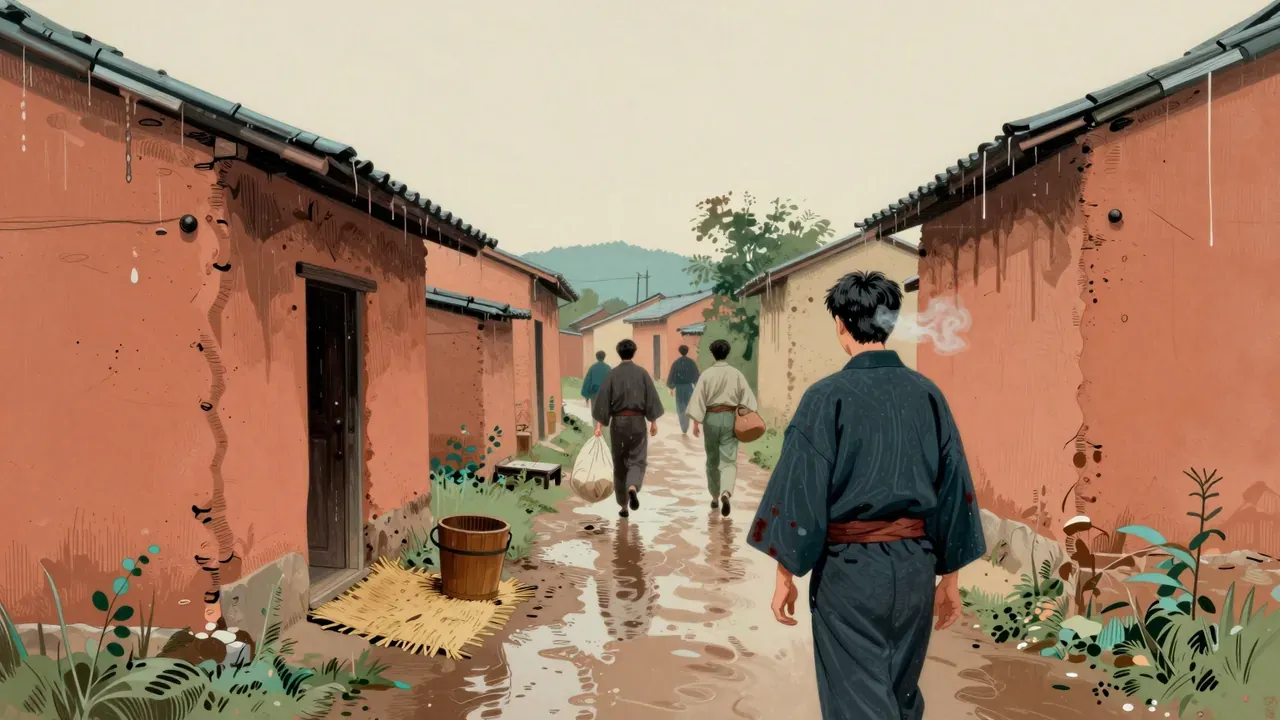
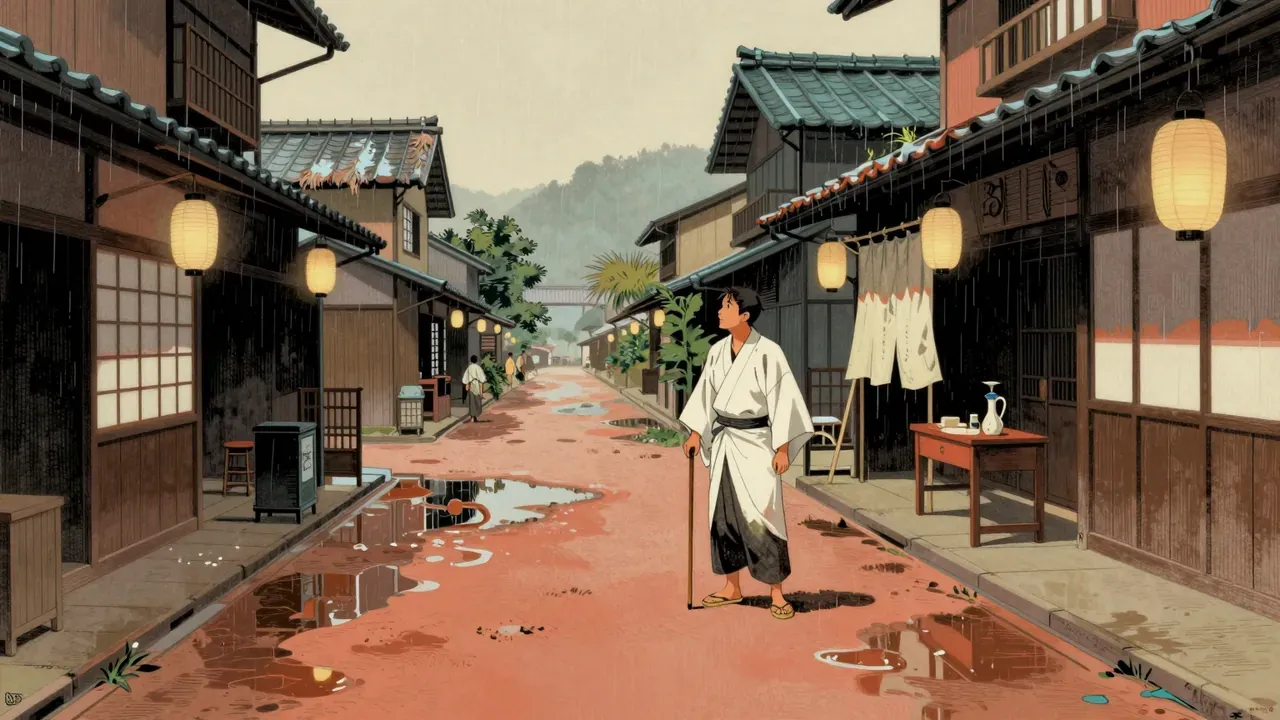
What lands is the texture of lived-in injustice: the way jailers treat prisoners as interchangeable, how rumour spreads faster than evidence, and how easily a man’s reputation dissolves without witnesses. A sequence where Zatoichi walks through a rain-slicked street at night, guided only by sound and memory, conveys his agency without spectacle. Another — where he quietly disarms two yakuza by exploiting their assumptions about blindness — works because it relies on character logic, not choreographic showmanship. The film’s best moments are those where power resides in stillness: Zatoichi listening to a confession, or pausing before delivering a verdict no court has authorised him to give. These scenes do not ask for admiration; they ask for attention. They land because they are consistent with what the series has established — that Zatoichi’s strength is not invincibility, but calibration: of risk, timing, and consequence. His interventions feel earned, not imposed.
The people who vanish
What does not land is the narrative scaffolding holding those moments up. Shimazo’s alleged crimes lack detail, making his plea for help abstract rather than urgent. The influential associate he names never appears; his wife’s subplot evaporates after two scenes; the yakuza boss remains a silhouette with no motive beyond generic menace. The film’s truncated ending — arriving without emotional or structural preparation — reads less like austerity and more like omission. One comic interlude, involving a Zatoichi impersonator, feels tonally adrift, neither satirising nor deepening the central themes. The pacing sags in the middle stretch, where exposition substitutes for development: characters state intentions instead of revealing them through action or contradiction. This is not underwriting, but under-imagining — a failure to invest the supporting world with enough specificity to sustain the protagonist’s moral weight.
The pause before the cut
The themes that matter are obligation and erasure: how a promise made in confinement acquires binding force once spoken aloud, and how systems — legal, social, criminal — conspire to make certain people vanish from record and memory. Zatoichi operates outside those systems not as a rebel but as a counterweight: his presence insists on continuity where institutions enforce rupture. The film also treats blindness not as deficit but as recalibration — a different mode of witness, one that hears hesitation in a voice or detects tension in a floorboard’s resonance. There is no mysticism in his perception, only accumulated attention. Justice here is not delivered by courts but by proximity: by being near enough to hear a lie, close enough to feel a tremor, present long enough to remember a name. These ideas are not argued but embedded — in the rhythm of walking sticks on packed earth, in the silence between accusations, in the way a sword is drawn not to kill but to stop time for a moment longer.
The eleventh step
This film is for viewers already invested in the Zatoichi series, particularly those attentive to its evolving ethics and restrained aesthetics. It rewards patience with small, cumulative gestures — a glance held too long, a pause before a strike, the weight of a folded letter handed over without comment. It is not for those seeking narrative closure, psychological depth in secondary characters, or stylistic innovation. Anyone approaching it as an introduction to the franchise will find its shorthand opaque and its stakes diffuse. Those who value tightly plotted thrillers or morally complex antagonists may find its simplicity frustrating. A viewer who prefers action-driven momentum over contemplative pacing would likely leave unsatisfied. The film assumes a baseline of goodwill toward its protagonist and its form — and that assumption holds only if the viewer has already spent time in this world. Without that context, its virtues recede into background noise.
The path, not the peak
It is worth your evening if you accept its limitations as part of its language — not flaws to be excused, but features of a serial form working within tight production schedules and audience expectations. Its eighty-eight minutes pass without strain, and its best sequences linger precisely because they resist emphasis. It is not essential viewing, but it is coherent, honest, and occasionally piercing in its modesty. Someone who values narrative symmetry or thematic elaboration might reasonably judge it insufficient. A change in pacing — extending the investigation phase by ten minutes, clarifying Shimazo’s backstory, or giving Oyone a single consequential choice — would lift the film from serviceable to resonant. As it stands, it functions like a well-worn path: unremarkable in isolation, but meaningful within a longer journey.