A concierge, a stolen painting, and a fascist regime closing in
The Grand Budapest Hotel follows Monsieur Gustave H., celebrated concierge of a mountain resort in the fictional country of Zubrowka, after he’s framed for murdering a wealthy elderly guest and has to clear his name with the help of his lobby boy Zero while a fascist regime closes in around them. Wes Anderson wrote and directed the film, drawing on the fiction and biography of Austrian writer Stefan Zweig, particularly Zweig’s account of pre-war Vienna in The World of Yesterday. Made for 23 million euros, financed partly through German government tax rebates, the film grossed $174.8 million worldwide, becoming Anderson’s highest-grossing release. Ralph Fiennes plays Gustave with a courtliness that the encroaching political violence around him never quite dents.
Seventeen actors, a Görlitz department store, and a six-week script
Anderson assembled a seventeen-actor ensemble built from regular collaborators including Bill Murray, Adrien Brody, Willem Dafoe and Tilda Swinton, most of whom signed on immediately after reading the script, while casting director Douglas Aibel spent months auditioning in Egypt, Lebanon, Israel and elsewhere before finding Tony Revolori, a novice actor of Guatemalan descent, for the role of young Zero. Anderson finished the screenplay in six weeks after nearly a decade of false starts on an earlier, unrelated version of the idea. Filming took place over ten weeks in eastern Germany, using a vacant early-twentieth-century department store in Görlitz as the hotel’s lobby, its top two floors repurposed for production offices. Robert Yeoman’s cinematography drew on the dramatic lighting of Vittorio Storaro’s One from the Heart, while Alexandre Desplat’s score mixes symphonic writing with Russian folk instrumentation, work that won him the Academy Award for Best Original Score.
What the craft accomplishes
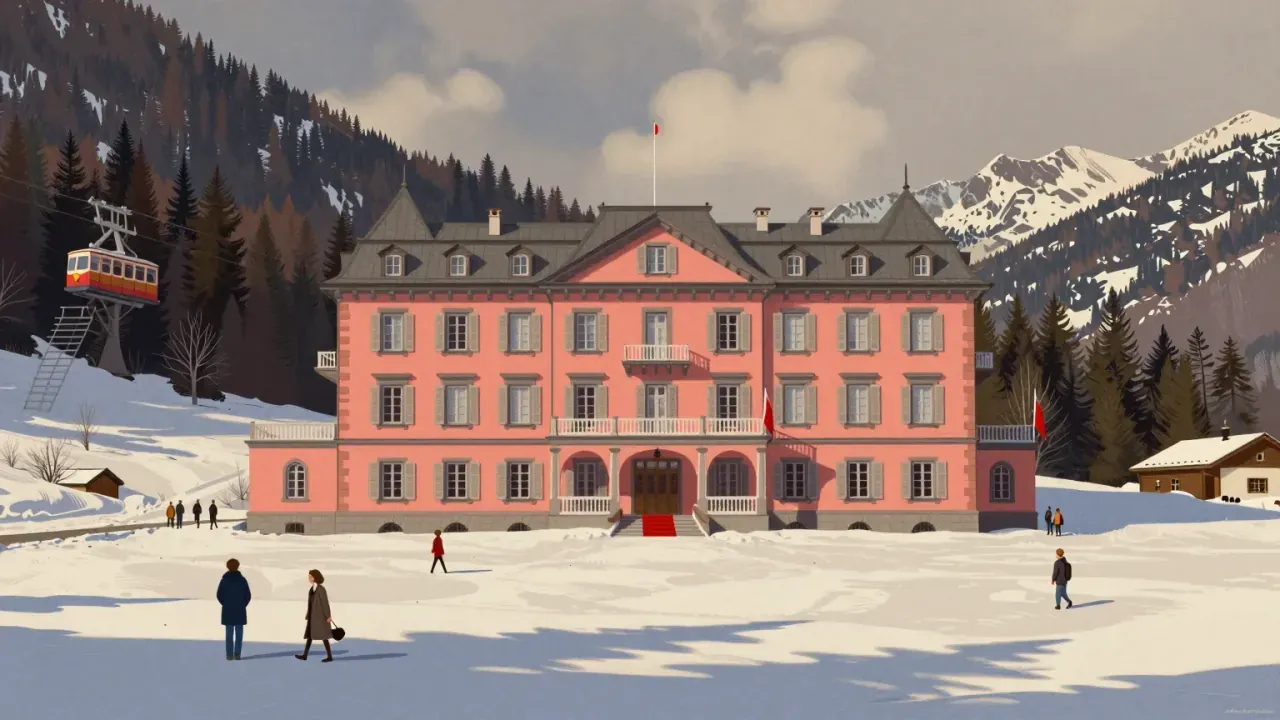
The film’s most distinctive craft choice is its use of three different aspect ratios to mark its three nested timelines, a device that lets the 1930s Zubrowka sequences feel physically boxed-in and ornate compared with the wider, drabber frame of its 1960s and present-day narrators. That attention extends to the film’s colour design, which several critics have since analysed as a structural device in its own right, the hotel’s candy pinks fading as the story moves further from Gustave’s era. The film won Academy Awards for its production design, costume design, makeup and hairstyling, and original score, four of the nine categories it was nominated in, along with the Silver Bear Grand Jury Prize at the Berlin Film Festival where it premiered.
Where the comic tone thins the stakes
Anderson’s exacting visual control meant the cast could not improvise on set, which Fiennes has said left him initially unsure how to calibrate Gustave’s tone between outright camp and something more restrained, given how little spontaneous adjustment the production allowed for. Because the ensemble runs to seventeen credited actors within a 99-minute film, most of the starrier names, Murray, Goldblum, Keitel, Law, appear for only a scene or two each, which keeps the film moving but means several performers register as recognisable faces more than as characters. The story’s violence, including a fascist paramilitary force modelled loosely on European history, sits inside Anderson’s brightly stylised visual language in a way some viewers have found tonally uneasy rather than pointed.
Nostalgia for a Europe that was already ending
Anderson has said he built the film out of ambivalence toward how Hollywood had traditionally depicted pre-war Europe, choosing pastiche over straightforward homage, and Zweig’s fatalist view of a civilisation that doesn’t survive its own century runs underneath the film’s comic surface throughout. Gustave’s fastidious devotion to hospitality and manners becomes, over the film’s length, a kind of resistance in miniature, an insistence on grace and loyalty that the rising fascist state around Zubrowka has no room for and will eventually erase along with the hotel itself. The nested narration, with an older Zero recounting the story decades later to a young writer, frames the entire film as an act of remembering something already understood to be gone.
Who this suits, and who might find it mannered
This suits viewers who enjoy Anderson’s meticulous visual style and ensemble casts, and anyone interested in how period design, costume and colour can carry a film’s emotional argument as much as its script does. Fans of Ralph Fiennes will find one of his most purely enjoyable comic performances here. It’s a weaker fit for viewers who find Anderson’s symmetrical, dollhouse aesthetic distancing rather than charming, or for anyone who wants the film’s fascist backdrop treated with more weight than its comic register allows; those wanting substantial screen time for the ensemble’s biggest names may also come away wanting more from actors like Murray or Goldblum.
A brisk 99 minutes, dense with reward
At 99 minutes, The Grand Budapest Hotel moves fast enough that its density of incident, from a prison break to a ski chase to a museum heist, never feels padded. Rotten Tomatoes lists a 92% Tomatometer score and an 8.4 out of 10 average rating, with Metacritic at 88 out of 100, strong marks for a film that has since been selected for preservation by the Library of Congress. It’s an easy, rewarding choice for an evening, especially for viewers who enjoy noticing craft, and it holds together as both a comedy and a small elegy for a Europe that Zweig himself didn’t survive to see rebuilt.