Three men, a grave marker, and someone else’s war
The Good, the Bad and the Ugly closes out what United Artists marketed as the Dollars Trilogy, though Sergio Leone’s three films share only a leading man and a sensibility, not a plot. Shot in Italy and Spain in the summer of 1966 on a budget of roughly $1.2 million, it drops three men - a bounty hunter, a wanted outlaw, and a former Confederate officer turned mercenary - into the last stretch of the American Civil War, all three chasing the same buried cache of Confederate gold. Leone shot in Techniscope, favouring the widescreen frame for both vast desert distances and the tightest possible close-ups on eyes and hands. The war itself is treated as scenery here, not subject: armies bleed each other white so three opportunists can dig up a fortune undisturbed once the guns fall quiet.
Wallach’s Tuco against Delli Colli’s lens
Clint Eastwood’s Blondie, Eli Wallach’s Tuco and Lee Van Cleef’s Angel Eyes spend most of the film’s 177 minutes double-crossing each other over a name written on a grave marker, the only clue to where the gold is buried. Wallach carries the picture: his Tuco is talkative, filthy, permanently improvising, and Leone lets him steal scenes from two much cooler co-stars by design. Cinematographer Tonino Delli Colli, pushed by Leone to think harder about light than on the previous two films, builds whole sequences around faces before a shot is fired. Ennio Morricone’s score does as much storytelling as the dialogue, and editors Eugenio Alabiso and Nino Baragli stretch the closing three-way duel at Sad Hill cemetery into a sequence of held stares that runs several minutes without a single shot going off.
The Sad Hill standoff and Morricone’s dirge
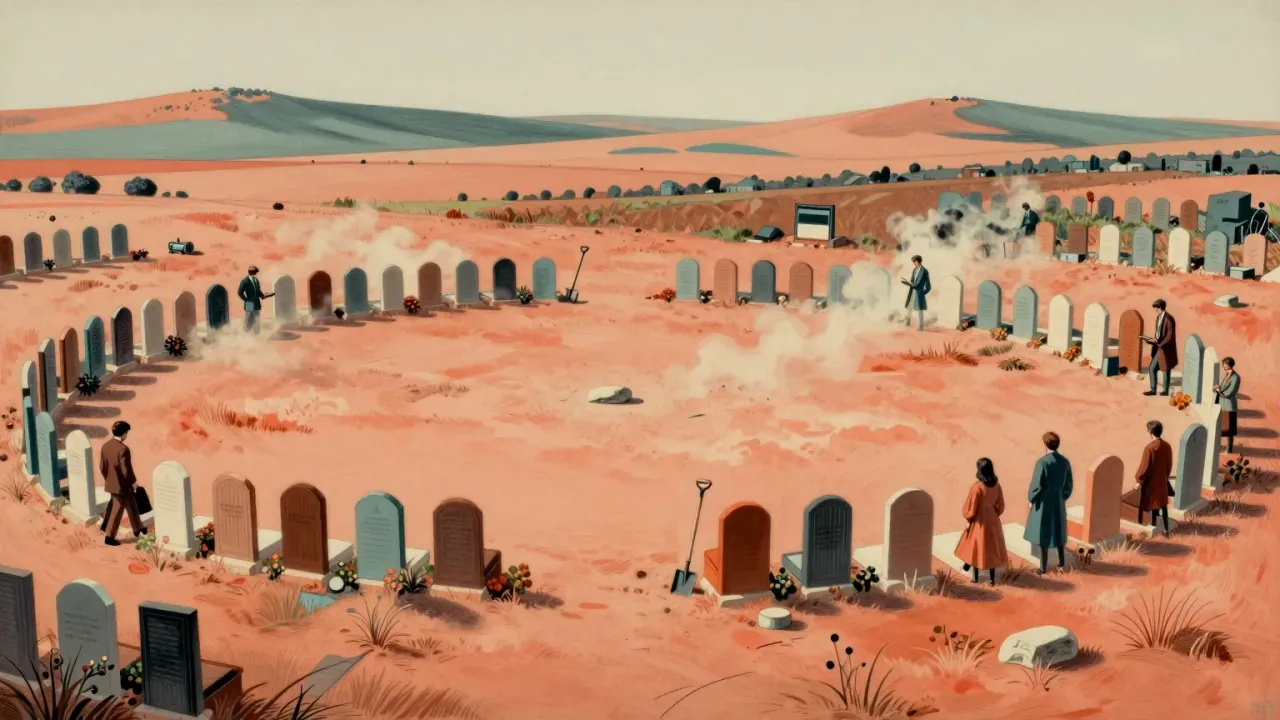
The cemetery stands as the film’s clearest achievement: Spanish soldiers built several thousand headstones into a circular arena for the finale, and the space itself does the dramatic work before a gun is drawn. Wallach’s comic timing keeps a three-hour film from sagging under its own self-seriousness - his Tuco stumbling through a ruined bridge town, screaming at a dwarf gunsmith, or bargaining with the priest brother he abandoned is as memorable as anything Eastwood or Van Cleef do. Morricone’s score, especially the trumpet-and-choir theme written for the graveyard, has outlived the film itself in popular culture. Delli Colli’s handling of the Civil War battlefield and prisoner-camp scenes, filmed with real extras and smoke on a scale few Italian productions could then afford, gives the middle third a weight the trilogy’s earlier films never attempted.
A three-hour film that occasionally stalls
At 177 minutes the film asks for patience it does not always reward: the bridge-demolition subplot, where Blondie and Tuco help destroy a river crossing to bypass Union and Confederate lines, runs long for what it contributes to the gold hunt, and had to be filmed twice after the first explosion destroyed all three cameras recording it. The Civil War setting is treated as spectacle and metaphor rather than history - uniforms, artillery and prison camps appear with none of the specific detail the trilogy’s gunslingers get. Some of Leone’s trademark extreme close-ups, held a beat longer than the scene needs, tip from tension into mannerism, particularly in the opening hour, before the three leads have properly shared a frame or a reason to distrust one another.
A war with no cause worth fighting
Leone was less interested in the Civil War as history than in what he considered its uselessness, and he stages it as slaughter with no side worth backing - a Union officer gets his men drunk and marches them to pointless deaths rather than let a bridge stand undamaged. Greed, not ideology, is the only motive the film fully trusts: Tuco, Angel Eyes and Blondie form and break alliances purely on who currently holds useful information, and the film never asks the audience to prefer one man’s violence to another’s. Loyalty appears only in flashes - Tuco’s memory of the brother who became a priest while he turned outlaw - before the gold hunt swallows it again, and it stands as a bleak accounting of what men do once a war removes any reason to behave otherwise.
Who this suits: patient genre fans
This suits viewers who already like westerns and want to see the genre pushed toward opera - long silences, extreme close-ups, a score doing half the emotional labour - rather than brisk gunfights and clean moral lines. Anyone drawn to Morricone’s music, or curious where decades of homages and parodies, from advertising jingles to other directors’ showdowns, actually originated, has reason to sit through the full three hours. It is not for viewers wanting tight plotting or historical seriousness about the Civil War, which the film treats as a stage set for its three leads. Younger audiences used to faster pacing may find the opening hour, before the leads’ paths properly cross, slow going, and anyone impatient with Leone’s unhurried, stylised violence should look elsewhere in the genre entirely.
A three-hour sitting that pays off
On the numbers alone the case is easy: a $1.2 million production returned nearly $39 million and now sits near the top of every major aggregate score, from a 97 percent Tomatometer to a 90 Metascore. But the more durable argument is that the film changed what a western could sound and look like, and that influence is still visible whenever a director stretches out a standoff decades later. Watch it for Wallach, for Morricone, and for the cemetery sequence, and accept that the Civil War plotting is thinner than the craft surrounding it. It rewards an evening set aside specifically for it rather than a distracted watch - the pacing wants full attention, and it gives back a finale that earns the wait.