A five-year search built from a real abduction
The Searchers is John Ford’s telling of a years-long manhunt across the Texas frontier, adapted by Frank S. Nugent from Alan Le May’s 1954 novel, itself built from real nineteenth-century captivity cases including the 1836 abduction of Cynthia Ann Parker. Ethan Edwards, a Confederate veteran played by John Wayne, returns to his brother’s homestead in 1868 still carrying gold of unexplained origin and a refusal to swear loyalty to the Texas Rangers. When a Comanche raid burns the homestead, kills his brother’s family, and carries off his young niece Debbie, Ethan sets out after her with her part-Cherokee adoptive brother Martin Pawley, a search that stretches across years rather than days. Shot on a $3.8 million budget largely in Monument Valley, in VistaVision and Technicolor, it uses Ford’s most familiar landscape to tell one of his least comfortable stories.
Hoch’s frame and a hatred that hardens
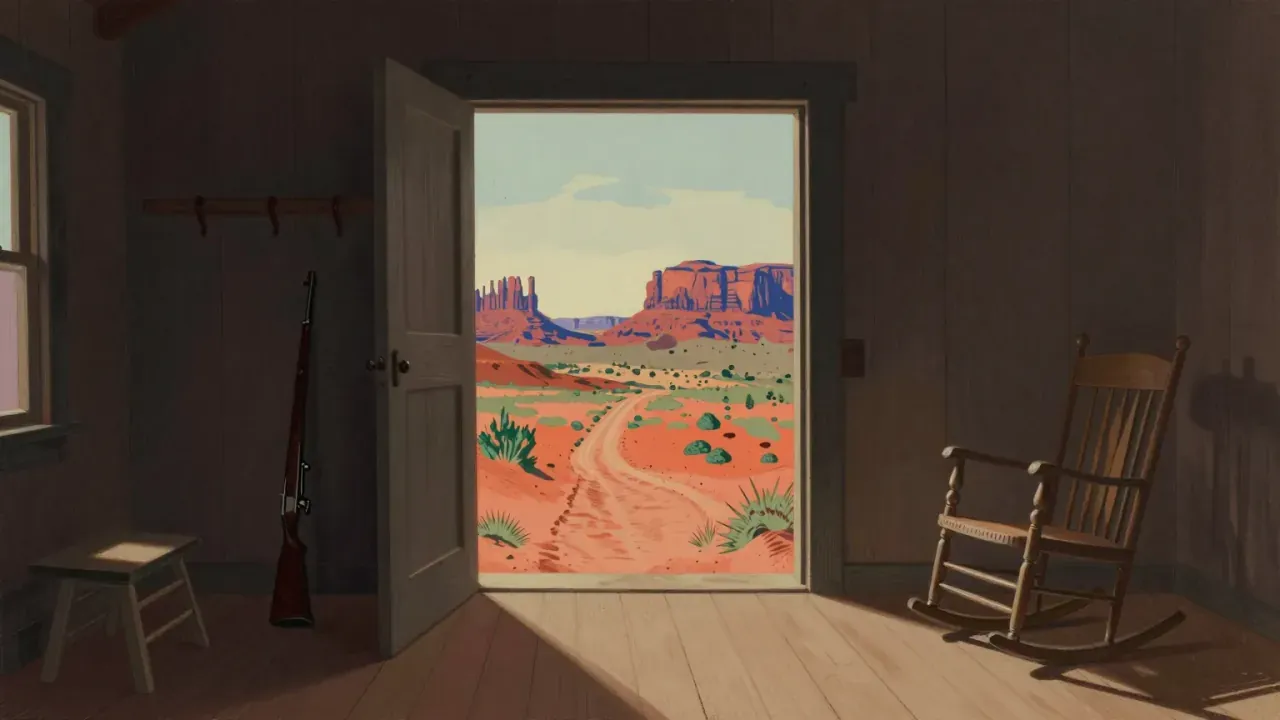
Wayne plays Ethan as consumed by a hatred of the people who took his niece that curdles, over the long search, into something closer to hatred of what she has become: when the pair finally find Debbie living as one of Comanche chief Scar’s wives, Ethan intends to kill her rather than bring her home. Jeffrey Hunter’s Martin Pawley, mixed-race and quietly furious at Ethan’s racism, becomes the film’s moral counterweight, physically shielding Debbie from his own searching partner. Winton Hoch’s cinematography frames Monument Valley’s rock formations as both a magnificent backdrop and an indifferent one, most famously in the opening and closing shots, where a doorway swings from black interior to blazing exterior and back. Max Steiner’s score and Jack Murray’s editing let long stretches of the search pass in silence and landscape rather than incident, closer to a ballad than a plotted thriller.
The doorway that shuts him out
The closing shot, where Ethan carries Debbie inside to safety and then stands alone outside the ranch house as the door swings shut on him, is the film’s most quoted image for good reason: it refuses to let its central character rejoin the community he has just saved, and Ford holds the frame long enough to make that exclusion unmistakable. Wayne’s performance is the least sympathetic of his career and arguably his best, playing Ethan’s racism and violence without softening either for the camera. The wedding brawl and Martin’s furious defence of Debbie state most clearly what the story is testing: whether family is decided by blood or by who is actually willing to protect you. Hoch’s photography of Monument Valley remains a reference point for how a landscape can carry a film’s meaning on its own.
Comic relief that misjudges its moment
The comic interludes involving Ken Curtis’s Charlie McCorry courting Laurie Jorgensen sit oddly against the film’s darker material, playing for laughs in scenes adjacent to a search for a murdered and abducted family. Vera Miles and Jeffrey Hunter’s courtship subplot, narrated at points through letters read aloud, slows a film already stretched thin across a five-year timeline compressed into 119 minutes, and some of its time jumps land abruptly. The film’s treatment of its Comanche characters, particularly Scar, gives them almost no interiority next to the attention paid to Ethan’s psychology, which was consistent with the genre’s conventions in 1956 but reads now as a significant imbalance, especially in a film otherwise interested in interrogating racial hatred rather than simply staging it.
Violence and bigotry as one instinct
Ethan’s racism is the engine of the plot rather than incidental colour: his plan to kill Debbie for having lived among the Comanche makes explicit what several of Ford’s earlier, gentler westerns left unstated, that the frontier hero’s violence and his bigotry are the same instinct pointed in different directions. Martin’s mixed heritage puts him permanently outside both the white settler world and the family he is fighting to save, and the film never resolves that position - it simply lets him keep choosing loyalty over belonging. Manhood, in Ethan’s case, is measured entirely by a capacity for violence and a refusal to belong anywhere long enough to be tied down, which is also what leaves him standing outside that final doorway, useful to a family he cannot actually rejoin once the search ends.
Who should sit with its discomfort
This suits viewers already interested in how the western handled, or avoided handling, racial violence at its own genre’s height, and anyone tracing John Wayne’s or John Ford’s careers, since it complicates the heroic frontiersman both had spent two decades building. Its reputation among filmmakers, cited for decades as a reference point for framing and landscape, makes it worth seeing for anyone studying craft as much as story. It is not an easy recommendation for viewers sensitive to a lead character’s open racism, which the film puts on screen without much narrative distance for long stretches, or for those wanting a tighter plot than a five-year search compressed into two hours naturally allows. Viewers wanting a straightforwardly heroic western should look elsewhere in Ford’s own filmography instead.
An ending that still refuses to resolve
Scores in the high eighties and nineties across critics’ aggregates, a National Film Registry listing among the first 25 films selected in 1989, and repeated placement near the top of greatest-films polls all point the same way, and the film’s influence on later directors is hard to overstate. What makes it worth an evening now is less the polish, which shows its age in places, than the discomfort Ford builds into a genre that usually offered none: a hero the film cannot fully endorse, sent back out into the landscape alone. It asks more of a viewer than a typical 1950s western and repays that attention with an ending that still unsettles rather than resolves anything neatly. Set aside the two hours properly; this is not one to half-watch while doing something else.